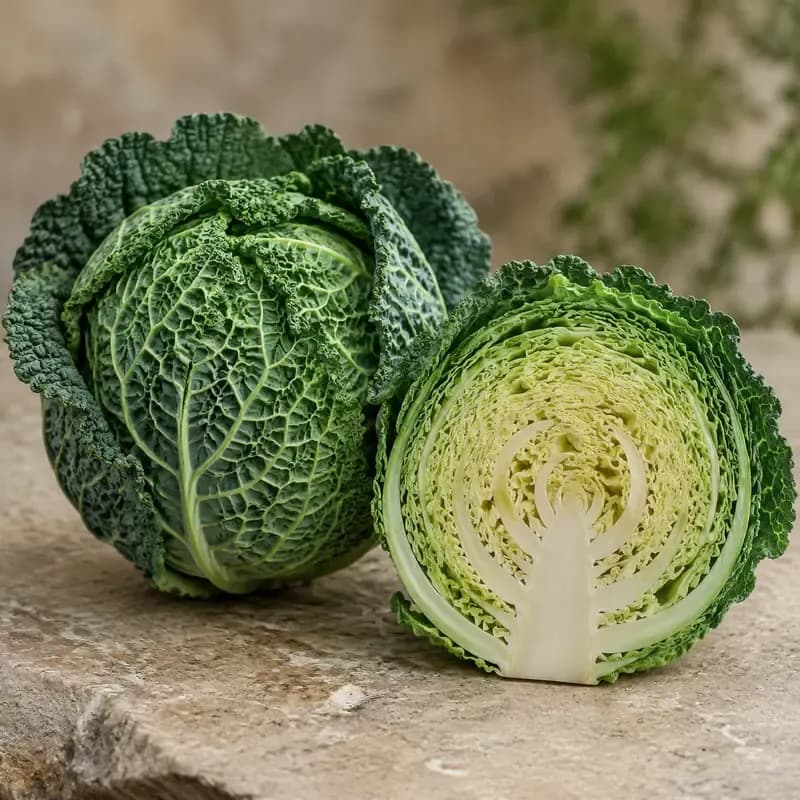
Savoy Cabbage
Brassica oleracea var. sabauda
Savoy cabbage, scientifically known as Brassica oleracea var. sabauda, is a cool-season leafy vegetable distinguished by its deeply crinkled, blistered leaves and loosely packed round head. It belongs to the mustard family, Brassicaceae, and shares the species Brassica oleracea with green cabbage, red cabbage, kale, broccoli, cauliflower, Brussels sprouts, and kohlrabi. Its outer leaves range from dark blue-green to forest green, while the tender inner layers are usually pale green or yellow-green. Savoy cabbage has a delicate, mildly sweet, earthy flavor and a softer texture than conventional smooth-leaved cabbage. Its flexible leaves make it particularly suitable for stuffed cabbage rolls, while its textured surface captures sauces, dressings, butter, and seasonings. It can be shredded raw for salads, briefly steamed, sauteed, stir-fried, braised, roasted, fermented, or added to soups and stews. Raw Savoy cabbage provides vitamin K, vitamin C, folate, vitamin B6, fiber, potassium, magnesium, manganese, copper, and carotenoids with relatively few calories. The crop was developed in Europe from the wild cabbage lineage and became closely associated with the historical Savoy region of the western Alps. Its attractive leaves, cold tolerance, and culinary versatility now make it a valued winter vegetable in European and international cuisines.
Savoy Cabbage Galeria de fotos
Explore Savoy Cabbage em detalhes
Savoy Cabbage - Vista principal
Savoy Cabbage Informações nutricionais
💊Vitaminas
Por 100 g
⚡Minerais
Por 100 g
Por porção
Detalhamento nutricional por porção
Benefícios para a saúde de Savoy Cabbage
Savoy Cabbage Origem e distribuição
Developed in Europe from wild Brassica oleracea native to coastal western and southern Europe; traditionally associated with the Savoy region of the western Alps
Savoy cabbage developed from the wild cabbage lineage that also produced kale, green cabbage, red cabbage, broccoli, cauliflower, Brussels sprouts, and kohlrabi. European farmers selected plants with compact heads and strongly crinkled leaves. The crop became associated with Savoy, a historic Alpine territory spanning areas of modern France, Italy, and Switzerland, and its English name reflects that connection. Savoy cabbage was established in European cultivation by the early modern period and became valued for its cold tolerance, delicate flavor, and tender leaves. It entered soups, stews, braises, stuffed-leaf dishes, and regional peasant cooking throughout Europe. European migration and commercial seed production later spread it internationally. Agricultural statistics generally combine Savoy cabbage with other headed cabbages, so a reliable current ranking of countries producing Savoy cabbage specifically is not supplied here.
Savoy Cabbage Melhor época
Savoy cabbage is a cool-season crop. Early cultivars can be harvested during summer, while frost-tolerant late varieties mature from autumn through winter. Availability varies with local climate and storage practices.
Savoy Cabbage Variedades
Cada variedade oferece sabores, texturas e usos culinários únicos
January King
Vertus
Famosa F1
Melissa F1
Alcosa F1
Savonarch F1
Deadon F1
Savoy Cabbage Guia de armazenamento e seleção
Mantenha a fruta fresca por mais tempo
Como escolher a fruta perfeita
Choose heads that feel reasonably heavy for their size and have crisp, deeply crinkled leaves.
Look for fresh blue-green or green outer leaves without widespread yellowing, slime, mold, or watery decay.
Avoid heads with strong off-odors, severely wilted leaves, blackened cores, or extensive insect damage.
Check that the cut stem is firm and relatively fresh rather than mushy, deeply cracked, or severely dried.
Select smaller tender heads for salads and quick cooking, and larger mature heads for soups, braises, and stuffed cabbage.
Métodos de armazenamento
Store whole, unwashed Savoy cabbage in a perforated or loosely closed bag in the refrigerator crisper.
Avoid washing before storage because moisture trapped between the crinkled leaves can encourage decay.
Wrap cut surfaces tightly or place cut cabbage in an airtight container and refrigerate promptly.
Use shredded cabbage sooner than a whole head because cutting accelerates moisture loss and deterioration.
Inspect stored cabbage regularly and remove any leaves that become slimy, moldy, or rotten.
Guia de validade
Preparation Tips
Remove wilted or damaged outer leaves, then rinse the head or separated leaves thoroughly under cool running water.
Pay particular attention to folds in the crinkled leaves, where soil, grit, or insects may be trapped.
Quarter the head and remove the dense core with a sharp knife; tender portions of the core can be sliced thinly and cooked.
Shred leaves evenly for salads and stir-fries so they marinate or cook at a consistent rate.
For cabbage rolls, blanch or steam whole leaves briefly to make them flexible without causing excessive tearing.
Avoid prolonged boiling when possible because it softens the delicate leaves, intensifies sulfurous aromas, and increases losses of water-soluble nutrients.
Instruções para congelar
Preserve a frescura por meses
Remove damaged outer leaves, separate or cut the cabbage, and rinse thoroughly between the crinkled layers.
Blanch wedges for approximately 3 minutes or shredded leaves for about 1 to 2 minutes.
Cool the blanched cabbage promptly in ice water, then drain and dry it thoroughly.
Freeze pieces in a single layer before transferring them to airtight freezer bags or containers.
Use frozen Savoy cabbage in soups, stews, braises, casseroles, or stir-fries because thawing softens its raw texture.
Dica
Identifique itens congelados com a data para acompanhar a frescura. A maioria das frutas mantém a qualidade por 2-3 meses quando congelada corretamente. Para melhores resultados, use recipientes herméticos ou sacos próprios para congelador para evitar queimadura de freezer.
Jornada culinária
Descubra possibilidades deliciosas
Usos comuns
Combinações perfeitas
Receitas populares
Cooking Methods
Informações de segurança
Savoy cabbage allergy is uncommon but possible. Reactions may include oral itching, hives, swelling, digestive symptoms, wheezing, or, rarely, anaphylaxis. Some people allergic to mustard-family vegetables may react to cabbage, although cross-reactivity is not universal. Anyone experiencing breathing difficulty, faintness, or rapidly progressing swelling should seek emergency medical care, while suspected cabbage allergy should be evaluated by a qualified allergy specialist.
Agricultural practices and measured residues vary by farm, country, and season. Remove damaged outer leaves and rinse Savoy cabbage thoroughly under running water, paying special attention to folds where soil and insects can collect. Washing removes debris, microorganisms, and some surface residues but does not replace agricultural safety controls. Do not wash produce with soap, bleach, or household detergent. Consumers seeking current residue information should consult their national food-safety authority.
- • People with a diagnosed cabbage or Brassica allergy should avoid Savoy cabbage and follow advice from their allergy specialist.
- • People taking warfarin or another vitamin K-sensitive anticoagulant should maintain a consistent intake and follow clinical guidance.
- • Individuals with thyroid disease and iodine deficiency should discuss unusually large daily quantities of raw cruciferous vegetables with their clinician.
- • People following a prescribed potassium restriction should account for Savoy cabbage portions within their individualized plan.
- • Anyone should avoid cabbage that is moldy, slimy, rotten, leaking, or strongly off-smelling.
- •Large portions of raw or cooked Savoy cabbage may cause gas, bloating, or abdominal discomfort in sensitive individuals.
- •A sudden change in vitamin K intake can interfere with warfarin management.
- •Very large sustained intakes of raw cruciferous vegetables may be relevant to iodine metabolism in people with inadequate iodine status.
- •Heavily salted, fermented, cream-based, or meat-rich cabbage dishes may contribute substantial sodium, saturated fat, or calories.
- •Allergic reactions can range from localized oral symptoms to a potentially serious systemic response.
- • Remove damaged outer leaves and wash carefully between the crinkled layers before cutting or cooking.
- • Use clean knives, boards, bowls, and utensils to reduce cross-contamination.
- • Keep raw cabbage separate from raw meat, poultry, seafood, and contaminated preparation surfaces.
- • Discard cabbage that is extensively slimy, moldy, rotten, leaking, or strongly off-smelling.
- • When preparing stuffed leaves with meat, cook the filling to a safe internal temperature appropriate for the type of meat used.
- • Refrigerate cooked Savoy cabbage within two hours, or within one hour in very hot conditions, and use refrigerated leftovers within 3 to 4 days.
Curiosidades sobre Savoy Cabbage
Fatos surpreendentes que você vai amar!
Savoy cabbage is named after the historic Savoy region of the western Alps.
Its wrinkled leaf texture is described botanically and horticulturally as crinkled, blistered, or savoyed.
Savoy cabbage belongs to the same species as kale, broccoli, cauliflower, Brussels sprouts, kohlrabi, and other headed cabbages.
The flexible leaves make Savoy cabbage especially suitable for stuffed rolls and vegetable wraps.
January King is a colorful winter type often displaying purple or reddish outer leaves.
Savoy cabbage generally has a looser head and more delicate texture than common green cabbage.
The visible cabbage head consists of overlapping leaves surrounding a shortened central stem.
Cool weather can improve the sweetness and tenderness of many Savoy cabbage cultivars.
Perguntas frequentes
Is Savoy cabbage botanically a leaf vegetable?
ScienceYes. The edible head of Savoy cabbage consists mainly of overlapping leaves arranged around a short central stem, so leaf is the best botanical category. It is not a root, bulb, flower, or botanical fruit. Savoy cabbage is a cultivated variety of Brassica oleracea, the same species that includes green cabbage, red cabbage, kale, broccoli, cauliflower, Brussels sprouts, and kohlrabi. Farmers selected different plant structures in each crop. In Savoy cabbage, selection emphasized compact heads, deeply crinkled leaves, cold tolerance, tenderness, and a mild flavor.
How is Savoy cabbage different from green cabbage?
GeneralSavoy cabbage has deeply crinkled, blistered leaves and a looser, more tender head than common smooth-leaved green cabbage. Its flavor is generally milder, sweeter, and less aggressively peppery, especially after brief cooking. The flexible leaves separate relatively easily and work particularly well for cabbage rolls and wraps. Green cabbage is usually denser, crunchier, longer-lasting in storage, and well suited to firm slaws and sauerkraut. Their nutrient profiles are similar but not identical; Savoy cabbage is particularly notable for vitamin K, vitamin C, folate, fiber, and vitamin B6.
Can Savoy cabbage be eaten raw?
PreparationSavoy cabbage can be eaten raw. Its tender inner leaves are particularly suitable for salads, slaws, sandwiches, wraps, and garnishes. Remove damaged outer leaves, rinse thoroughly between the crinkled folds, trim the core, and shred the leaves finely. Massaging shredded cabbage briefly with a small amount of salt or acidic dressing can soften its texture. Raw cabbage retains more heat-sensitive vitamin C and active myrosinase than extensively cooked cabbage. People who experience gas or abdominal discomfort from raw cruciferous vegetables may tolerate smaller portions or lightly cooked leaves more comfortably.
Is Savoy cabbage healthier raw or cooked?
HealthNeither preparation is universally healthier. Raw Savoy cabbage retains its crisp texture, active myrosinase, and more heat-sensitive vitamin C and folate. Cooking softens the leaves, reduces volume and pungency, and can make the vegetable easier to tolerate for people sensitive to raw cabbage. Boiling can move water-soluble nutrients into discarded liquid, whereas steaming, microwaving, brief sauteing, or consuming soup broth reduces that loss. Cooking may also improve access to some carotenoids. Including both raw and lightly cooked Savoy cabbage provides useful culinary and nutritional variety.
Can people taking warfarin eat Savoy cabbage?
HealthSavoy cabbage is rich in vitamin K, providing about 57% of the Daily Value per 100 g. Vitamin K participates in blood-clotting pathways and can influence the effect of warfarin and similar vitamin K-sensitive anticoagulants. People taking these medicines generally do not need to eliminate Savoy cabbage, but they should keep their intake reasonably consistent rather than suddenly eating much more or much less. Medication monitoring and individual targets vary, so patients should follow guidance from their prescribing clinician or anticoagulation service instead of changing medication or diet independently.
Does Savoy cabbage affect thyroid function?
HealthSavoy cabbage contains glucosinolates that can form compounds capable of influencing iodine use under certain experimental or high-intake conditions. For most people with adequate iodine intake, ordinary food portions are not considered a thyroid concern. Potential relevance is greater when extremely large quantities of raw cruciferous vegetables are consumed regularly alongside iodine deficiency. Cooking modifies some glucosinolate-related compounds. People with diagnosed thyroid disease usually do not need to avoid Savoy cabbage automatically, but they should maintain adequate iodine intake and follow personalized advice from their clinician or registered dietitian.
How do you prepare Savoy cabbage for stuffed cabbage rolls?
PreparationRemove damaged outer leaves and carefully separate the number of whole leaves required. Rinse each leaf thoroughly because soil or insects can hide within the crinkled folds. Blanch the leaves briefly in simmering water or steam them until flexible, then cool and drain them. Use a knife to shave down the thickest part of each central rib without cutting through the leaf. Add the prepared filling, fold in the sides, and roll securely. Cooking time depends on the filling, so ensure meat-based fillings reach an appropriate safe internal temperature.
Why does Savoy cabbage sometimes smell strong when cooked?
ScienceSavoy cabbage contains sulfur-containing glucosinolates and related compounds characteristic of the mustard family. Cutting and heating release volatile sulfur compounds that create the familiar cabbage aroma. The smell generally becomes stronger when cabbage is boiled for too long because prolonged heating produces and releases more of these volatiles. Cook only until the desired tenderness is reached, use steaming, sauteing, roasting, or quick stir-frying, and ventilate the kitchen. Adding lemon juice, vinegar, herbs, spices, or aromatic vegetables can balance the flavor, although these additions do not remove every sulfur compound.
How should fresh Savoy cabbage be stored?
GeneralKeep a whole, unwashed head in a perforated or loosely closed bag in the refrigerator crisper. Because Savoy cabbage has looser and more delicate leaves than conventional green cabbage, it generally retains its best quality for about one to two weeks rather than exceptionally long periods. Once cut, wrap the exposed surface tightly or place the cabbage in an airtight container and use it within about three to five days. Shredded cabbage deteriorates faster. Discard cabbage showing widespread slime, mold, watery decay, or a strongly unpleasant odor.