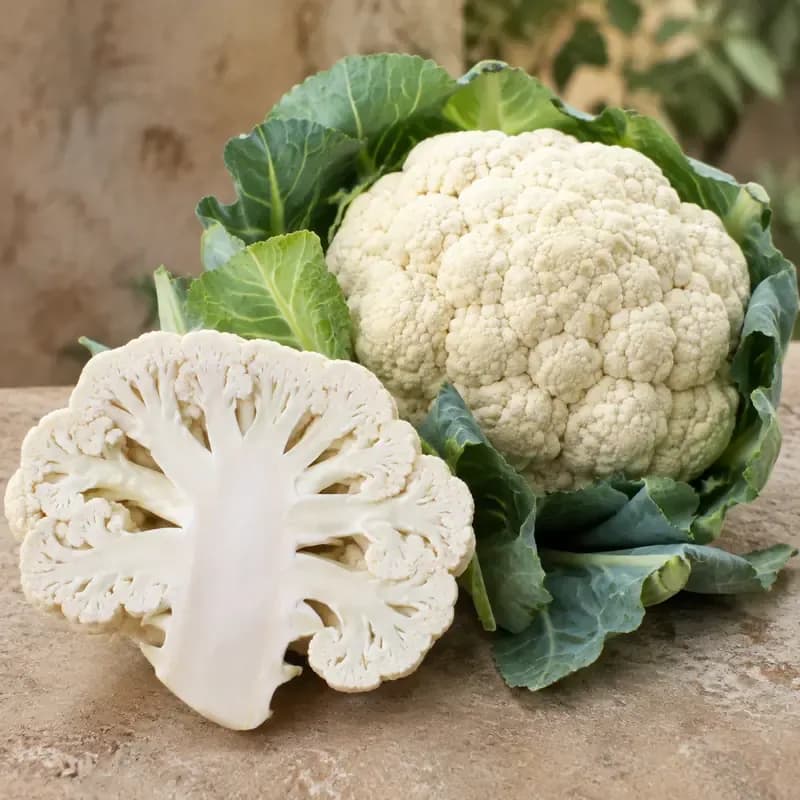
Cauliflower
Brassica oleracea var. botrytis
Cauliflower, scientifically known as Brassica oleracea var. botrytis, is a cool-season vegetable in the mustard family, Brassicaceae. Its familiar edible head, called the curd, consists of densely clustered, undeveloped flowering structures and meristematic tissue supported by fleshy branching stems. This makes flower the best-fit botanical category, even though the compact head is harvested before individual flowers open. Classic cauliflower has an ivory-white curd surrounded by broad green leaves, but cultivars also produce orange, purple, green, and intricately spiraled Romanesco heads. Raw cauliflower is crisp, juicy, mildly peppery, and slightly nutty. Cooking softens its texture, moderates its mustard-like flavor, and can develop sweetness and savory browned notes. The florets, central stalk, tender stems, and leaves are all edible, making cauliflower a remarkably low-waste vegetable. It can be roasted, steamed, boiled, grilled, sauteed, mashed, pickled, fermented, or finely chopped into cauliflower rice. Raw cauliflower provides vitamin C, vitamin K, folate, vitamin B6, pantothenic acid, choline, fiber, potassium, manganese, and glucosinolates with relatively few calories. Developed from Mediterranean wild cabbage through centuries of selection, cauliflower became especially important in European and Asian cuisines and is now cultivated worldwide.
Cauliflower Galeria de fotos
Explore Cauliflower em detalhes
Cauliflower - Vista principal
Cauliflower Informações nutricionais
💊Vitaminas
Por 100 g
⚡Minerais
Por 100 g
Por porção
Detalhamento nutricional por porção
Benefícios para a saúde de Cauliflower
Cauliflower Origem e distribuição
Developed in the Mediterranean region from cultivated forms of wild Brassica oleracea native to coastal southern and western Europe
Cauliflower descended from wild Brassica oleracea populations growing along Mediterranean and European coastlines. Farmers gradually selected plants with enlarged, compact, undeveloped flowering structures. Early forms were cultivated around the eastern Mediterranean, including Cyprus, and were sometimes called Cyprus coleworts in historical European sources. Cauliflower reached Italy and other parts of Europe during the medieval and early modern periods and became established in France and Britain by the seventeenth and eighteenth centuries. European trade and colonial agriculture later spread it to Asia, the Americas, Africa, and Australia. India and China developed extensive regional cultivation and numerous adapted varieties. Modern breeding produced white, green, orange, purple, sprouting, and Romanesco types. International production statistics commonly combine cauliflower with broccoli, so producer rankings may represent the combined commodity category rather than cauliflower alone.
Cauliflower Melhor época
Cauliflower is a cool-season crop. Planting and harvest periods vary by climate and cultivar, allowing production during spring, autumn, or winter. Modern regional supply chains make it available throughout much of the year.
Cauliflower Variedades
Cada variedade oferece sabores, texturas e usos culinários únicos
Snowball
Fremont F1
Cheddar
Graffiti
Purple of Sicily
Romanesco
Fioretto
Pusa Snowball K-1
Cauliflower Guia de armazenamento e seleção
Mantenha a fruta fresca por mais tempo
Como escolher a fruta perfeita
Choose cauliflower with a firm, compact curd and tightly clustered florets.
Look for creamy white, orange, green, or purple coloration appropriate to the cultivar, without widespread browning, mold, slime, or watery decay.
Select heads surrounded by crisp green leaves because fresh wrapper leaves help indicate recent harvest and protect the curd.
Avoid heads with a strong off-odor, soft florets, extensive separation, blackened areas, or mushy stems.
Choose a head that feels heavy for its size and has a firm, moist-looking cut stem.
Métodos de armazenamento
Store unwashed cauliflower stem-side down in a perforated or loosely closed bag in the refrigerator crisper.
Keep the head dry because moisture trapped on the curd can encourage browning and microbial decay.
Refrigerate cut florets in an airtight container and use them sooner than a whole head.
Keep cauliflower away from raw meat, poultry, seafood, and contaminated surfaces.
Inspect stored cauliflower regularly and discard portions that become moldy, slimy, mushy, or strongly off-smelling.
Guia de validade
Preparation Tips
Remove the outer leaves, trim the base, and rinse the cauliflower thoroughly under cool running water.
Separate the head into evenly sized florets by cutting through the branching stems rather than crushing the curd.
Soak florets briefly in clean cold water if needed to loosen trapped soil or insects, then rinse and drain thoroughly.
Peel the fibrous exterior from thick stalks and slice the tender interior for soups, stir-fries, roasting, or cauliflower rice.
Slice tender leaves and cook them like cabbage or kale instead of discarding them.
Avoid overcooking because cauliflower can become mushy and develop a stronger sulfurous odor.
Instruções para congelar
Preserve a frescura por meses
Remove leaves, trim damaged areas, wash the head, and divide it into evenly sized florets.
Blanch florets in boiling water or steam before freezing to slow enzymatic deterioration.
Cool blanched florets promptly in ice water, then drain and dry them thoroughly.
Freeze florets in a single layer before transferring them to airtight freezer bags or containers.
Use frozen cauliflower directly in soups, curries, casseroles, mashes, or roasted dishes where a slightly softer texture is acceptable.
Dica
Identifique itens congelados com a data para acompanhar a frescura. A maioria das frutas mantém a qualidade por 2-3 meses quando congelada corretamente. Para melhores resultados, use recipientes herméticos ou sacos próprios para congelador para evitar queimadura de freezer.
Jornada culinária
Descubra possibilidades deliciosas
Usos comuns
Combinações perfeitas
Receitas populares
Cooking Methods
Informações de segurança
Cauliflower allergy is uncommon but possible. Reactions may include oral itching, hives, swelling, digestive symptoms, wheezing, or, rarely, anaphylaxis. Some people allergic to mustard-family vegetables may react to cauliflower, although cross-reactivity is not universal. Anyone experiencing breathing difficulty, faintness, or rapidly progressing swelling should seek emergency medical care, while suspected cauliflower allergy should be evaluated by a qualified allergy specialist.
Agricultural practices and measured residues vary by farm, country, and season. Remove damaged leaves and rinse the head and separated florets thoroughly under running water, paying attention to spaces where soil or insects may be trapped. Washing removes debris, microorganisms, and some surface residues but does not replace agricultural safety controls. Do not wash produce with soap, bleach, or household detergent. Consumers seeking current residue information should consult their national food-safety authority.
- • People with a diagnosed cauliflower or Brassica allergy should avoid cauliflower and follow advice from their allergy specialist.
- • People taking warfarin or another vitamin K-sensitive anticoagulant should maintain a reasonably consistent intake and follow clinical guidance.
- • Individuals with thyroid disease and iodine deficiency should discuss unusually large daily quantities of raw cruciferous vegetables with their clinician.
- • People following a prescribed potassium restriction should account for cauliflower portions within their individualized plan.
- • Anyone should avoid cauliflower that is moldy, slimy, rotten, mushy, leaking, or strongly off-smelling.
- •Large portions of raw or cooked cauliflower may cause gas, bloating, or abdominal discomfort in sensitive individuals.
- •A sudden major change in vitamin K intake may be relevant to warfarin management.
- •Very large sustained intakes of raw cruciferous vegetables may affect iodine metabolism in people with inadequate iodine status.
- •Fried, breaded, cheese-covered, or heavily salted preparations may contribute substantial calories, sodium, saturated fat, or refined carbohydrate.
- •Allergic reactions can range from localized oral symptoms to a potentially serious systemic response.
- • Remove damaged outer leaves and rinse the cauliflower thoroughly before cutting or cooking.
- • Use clean knives, boards, bowls, and utensils to reduce cross-contamination.
- • Keep raw cauliflower separate from raw meat, poultry, seafood, and contaminated preparation surfaces.
- • Discard cauliflower that is extensively moldy, slimy, mushy, rotten, leaking, or strongly off-smelling.
- • Cut firm raw florets into age-appropriate pieces for young children to reduce choking risk.
- • Refrigerate cooked cauliflower within two hours, or within one hour in very hot conditions, and use refrigerated leftovers within 3 to 4 days.
Curiosidades sobre Cauliflower
Fatos surpreendentes que você vai amar!
The edible cauliflower head is called a curd.
Cauliflower belongs to the same species as cabbage, kale, broccoli, Brussels sprouts, and kohlrabi.
White cauliflower remains pale because wrapper leaves shield the developing curd from sunlight in self-blanching or manually blanched cultivars.
Purple cauliflower obtains its color from anthocyanin pigments.
Orange cauliflower contains more carotenoid pigments than typical white varieties.
Romanesco displays repeating spiral patterns associated with fractal-like geometry.
Cauliflower leaves, stems, and central stalk are edible as well as the curd.
Finely chopped cauliflower became widely popular as a vegetable alternative to grain rice.
Perguntas frequentes
Is cauliflower botanically a flower vegetable?
ScienceCauliflower is best classified as a flower vegetable because its edible head consists of densely clustered, undeveloped flowering structures and meristematic tissue. The compact head is called the curd and is harvested before it elongates and produces recognizable flowers. Individual florets connect to fleshy branching stems that join the central stalk. Cauliflower is therefore different from cabbage, whose edible head consists mainly of overlapping leaves. It belongs to Brassica oleracea, the same species as broccoli, kale, cabbage, Brussels sprouts, and kohlrabi, each selected for a different plant structure.
Can cauliflower be eaten raw?
PreparationCauliflower can be eaten raw after thorough washing and preparation. Fresh raw florets are crisp, juicy, mildly peppery, and suitable for vegetable platters, salads, slaws, dips, and finely chopped cauliflower rice. The peeled stalk and tender leaves are also edible. Raw cauliflower retains more heat-sensitive vitamin C and active myrosinase than extensively cooked cauliflower. However, some people experience gas, bloating, or abdominal discomfort from raw cruciferous vegetables. Smaller portions or steamed, roasted, or sauteed cauliflower may be easier to tolerate while remaining nutritious.
Is cauliflower healthier raw or cooked?
HealthNeither preparation is universally healthier. Raw cauliflower retains its crisp texture, more heat-sensitive vitamin C, and active myrosinase, which helps form isothiocyanates from glucosinolates. Cooking softens the vegetable, reduces volume and pungency, and may improve tolerance for people sensitive to raw cruciferous vegetables. Boiling can transfer vitamin C and other water-soluble compounds into discarded water, while steaming, microwaving, roasting, and brief stir-frying generally reduce that loss. Eating cauliflower in both raw and lightly cooked forms provides useful culinary and nutritional variety.
Is cauliflower rice nutritionally the same as regular rice?
HealthNo. Cauliflower rice is made by finely chopping or grating cauliflower, while regular rice is a cereal grain. Raw cauliflower contains about 5 g of carbohydrate and 25 calories per 100 g, whereas cooked grain rice generally provides substantially more carbohydrate and calories. Cauliflower rice contributes vitamin C, folate, vitamin K, fiber, and Brassica phytonutrients, but it does not provide the same starch, texture, or energy as rice. It can replace rice when a lighter vegetable base is desired, but the two foods are nutritionally and botanically different.
Why does cauliflower smell strong when cooked?
ScienceCauliflower contains sulfur-containing glucosinolates characteristic of cruciferous vegetables. Cutting and heating break down plant cells and release volatile sulfur compounds responsible for the familiar cabbage-like aroma. The smell generally becomes stronger when cauliflower is boiled for too long because prolonged heat produces and releases more of these compounds. Cook only until tender, use steaming, roasting, sauteing, or brief boiling, and ventilate the kitchen. Lemon juice, herbs, garlic, spices, or cheese can balance the flavor, although they do not eliminate every sulfur compound.
Do purple and orange cauliflower have different nutrients?
ScienceColored cauliflower varieties share the basic nutritional characteristics of white cauliflower but contain additional pigments. Purple cauliflower contains anthocyanins, the red-purple flavonoid pigments also found in red cabbage and many berries. Orange cauliflower contains more carotenoid pigments, including beta-carotene, than ordinary white cauliflower. Green and Romanesco types have their own pigment and phytonutrient profiles. Exact nutrient amounts vary by cultivar, maturity, growing conditions, storage, and cooking. The generic raw USDA values in this record should therefore not be treated as exact measurements for every colored variety.
Does cauliflower affect thyroid function?
HealthCauliflower contains glucosinolates that can form compounds capable of influencing iodine use under certain experimental or high-intake conditions. For most people with adequate iodine intake, normal food portions are not considered a thyroid problem. Potential concern is greater when extremely large quantities of raw cruciferous vegetables are consumed regularly alongside iodine deficiency. Cooking modifies some glucosinolate-related compounds. People with diagnosed thyroid disease usually do not need to avoid cauliflower automatically, but they should maintain adequate iodine intake and follow personalized guidance from their clinician or registered dietitian.
Can cauliflower leaves and stalks be eaten?
GeneralCauliflower leaves, stalks, and branching stems are edible when fresh and properly cleaned. Tender leaves can be roasted, sauteed, steamed, stir-fried, or added to soups much like cabbage or kale. The thick central stalk may have a fibrous exterior, but peeling reveals a mild, crisp interior suitable for roasting, soups, vegetable stocks, slaws, and cauliflower rice. Using these parts reduces kitchen waste and adds useful texture. Discard leaves or stems that are moldy, slimy, extensively damaged, rotten, or strongly off-smelling.
How should fresh cauliflower be stored?
GeneralStore a whole, unwashed cauliflower head in a perforated or loosely closed bag in the refrigerator crisper, preferably with the stem facing downward so moisture does not collect on the curd. A fresh head generally retains good quality for about four to seven days. Refrigerate cut florets in an airtight container and use them within approximately three to four days. Avoid washing before storage because trapped moisture encourages browning and decay. Discard cauliflower that develops widespread mold, slime, mushy areas, watery decay, or a strongly unpleasant odor.