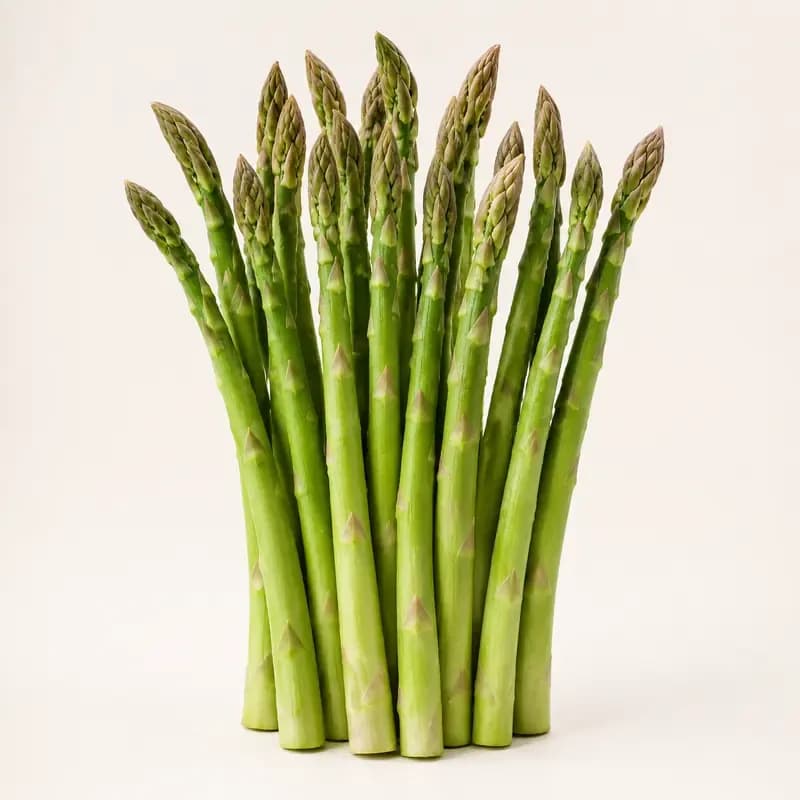
Asparagus
Asparagus officinalis L.
Asparagus, scientifically known as Asparagus officinalis, is a long-lived perennial vegetable cultivated for its tender young shoots. The edible spears emerge each spring from an underground crown and root system. If left unharvested, they rapidly elongate into tall, branching plants with delicate, fern-like cladodes. Green asparagus develops chlorophyll above the soil, white asparagus is protected from light by soil or opaque coverings, and purple cultivars contain anthocyanin pigments. Fresh spears have a grassy, subtly sweet, nutty flavor with mild sulfurous notes. Thin spears cook quickly, while thick spears often remain especially juicy when properly roasted, grilled, steamed, or blanched. Only the young shoots are normally eaten; mature foliage is tough, and the red berries produced by female plants should not be consumed. Raw asparagus provides vitamin K, copper, folate, thiamin, iron, riboflavin, vitamin B6, vitamin E, manganese, vitamin C, niacin, zinc, phosphorus, potassium, fiber, and protein for relatively few calories. It also contains rutin, quercetin, glutathione, fructans, saponins, and the distinctive sulfur-containing compound asparagusic acid. Asparagus is strongly associated with spring cuisine but is available year-round through production in different climates and international trade.
Asparagus Galeria de fotos
Explore Asparagus em detalhes
Asparagus - Vista principal
Asparagus Informações nutricionais
💊Vitaminas
Por 100 g
⚡Minerais
Por 100 g
Por porção
Detalhamento nutricional por porção
Benefícios para a saúde de Asparagus
Asparagus Origem e distribuição
Europe through temperate western and central Asia to Mongolia, with important early cultivation around the Mediterranean
Asparagus officinalis is native across much of Europe and temperate Asia, reaching eastward to Mongolia. Wild relatives and early cultivated forms were gathered around Mediterranean and coastal regions long before modern varieties developed. Ancient Greek and Roman writers described asparagus as a valued food, and Roman agricultural texts discussed its cultivation. A surviving Roman culinary collection includes methods for cooking it, while the emperor Augustus was associated with an expression comparing rapid action to the quick cooking of asparagus. Cultivation continued in parts of the Byzantine and Islamic worlds and later expanded through European monastery, royal, and market gardens. European settlers carried asparagus to North America by the seventeenth century. White asparagus became especially important in Germany, France, the Netherlands, and neighboring countries, where growers excluded light from developing shoots. Modern breeding has produced male-dominant hybrids, purple cultivars, disease-resistant lines, and varieties adapted to different climates. Because established crowns can remain productive for many years, asparagus requires long-term field planning.
Asparagus Melhor época
Asparagus is a cool-season perennial whose shoots emerge during spring as soil temperatures rise. Domestic harvests are usually brief, although imports from different hemispheres support year-round availability.
Asparagus Variedades
Cada variedade oferece sabores, texturas e usos culinários únicos
Green Asparagus
White Asparagus
Purple Asparagus
Mary Washington
Jersey Giant
UC 157
Gijnlim
Asparagus Guia de armazenamento e seleção
Mantenha a fruta fresca por mais tempo
Como escolher a fruta perfeita
Choose asparagus with firm, straight spears and tightly closed, compact tips.
Look for smooth stalks with fresh color and moist-looking cut ends.
Select spears of similar thickness when they will be cooked together so they finish at approximately the same time.
Choose thin spears for very quick cooking and thick spears for roasting, grilling, and juicy interiors.
Avoid asparagus with slimy tips, wrinkled stalks, sour odors, spreading flower buds, or extensively dried ends.
For white asparagus, choose firm ivory spears without excessive browning, splitting, or hollow areas.
Métodos de armazenamento
Refrigerate asparagus promptly at 4°C or below because the spears lose sweetness and tenderness after harvest.
Trim a small amount from the cut ends and stand the spears upright in a container with approximately 2 to 3 cm of clean water.
Cover the tops loosely with a clean reusable bag while avoiding an airtight, condensation-heavy environment.
Alternatively, wrap the cut ends in a clean damp towel and place the bunch in a ventilated refrigerator container.
Change standing water daily and remove any slimy or decaying spears.
Keep asparagus separate from raw meat, poultry, seafood, eggs, and their juices.
Guia de validade
Preparation Tips
Rinse spears under cool running water, paying attention to the compact tips where soil can collect.
Trim dry or woody ends with a knife rather than relying entirely on snapping, which can remove more edible stalk than necessary.
Peel the lower portion of thick green or purple spears when the exterior is fibrous.
Peel most of the lower stalk of white asparagus because its skin is commonly tougher and more bitter.
Keep spears a similar thickness or separate them into groups for even cooking.
Dry asparagus before roasting, grilling, or sautéing so excess moisture does not prevent browning.
Do not wash asparagus with soap, detergent, bleach, or household disinfectants.
Instruções para congelar
Preserve a frescura por meses
Wash the spears and trim or peel away tough lower portions.
Sort spears by thickness to promote even blanching.
Blanch small spears for approximately 2 minutes, medium spears for 3 minutes, and large spears for up to 4 minutes.
Cool immediately in ice water for approximately the same duration as blanching.
Drain and dry thoroughly before freezing in airtight containers or bags.
Use frozen asparagus in soups, casseroles, quiches, pasta, stir-fries, and roasted dishes because thawing softens its texture.
Dica
Identifique itens congelados com a data para acompanhar a frescura. A maioria das frutas mantém a qualidade por 2-3 meses quando congelada corretamente. Para melhores resultados, use recipientes herméticos ou sacos próprios para congelador para evitar queimadura de freezer.
Jornada culinária
Descubra possibilidades deliciosas
Usos comuns
Combinações perfeitas
Receitas populares
Cooking Methods
Bebidas refrescantes
Informações de segurança
Asparagus allergy is uncommon but possible. Reactions may occur after eating, handling, or working with raw asparagus and can include oral itching, hives, swelling, nasal symptoms, asthma, digestive distress, or anaphylaxis. Occupational contact reactions have been reported among agricultural and food-processing workers. Anyone with a diagnosed asparagus allergy should avoid the vegetable unless an allergy specialist confirms it is safe. Breathing difficulty, throat swelling, faintness, or widespread hives requires urgent medical attention.
Pesticide use and measured residues vary by country, farm, season, and production method. Rinse asparagus thoroughly under running water, paying special attention to the tips where soil and debris can collect. Washing can reduce soil, microorganisms, and some surface residues but cannot remove every residue. Organic asparagus should also be washed because organic production does not eliminate microbial contamination.
- • People with a diagnosed asparagus allergy should avoid raw and cooked asparagus unless cleared by an allergy specialist.
- • People taking warfarin or another vitamin K antagonist should maintain a consistent intake and consult their clinician before making major dietary changes.
- • People following a medically supervised low-FODMAP diet may need to limit asparagus because it contains fermentable fructans.
- • People with kidney disease who have been instructed to restrict potassium should ask their renal clinician or dietitian about appropriate portions.
- • People with recurrent gout should follow individualized advice rather than eliminating asparagus solely because it contains purines.
- • Children and pets should not consume asparagus berries.
- • Anyone should avoid spears that are slimy, moldy, foul-smelling, extensively decayed, recalled, or stored at unsafe temperatures.
- •Fructans in asparagus may cause gas, bloating, cramping, or diarrhea in people with irritable bowel syndrome or fructan sensitivity.
- •Asparagusic acid metabolites can produce a strong but harmless sulfurous odor in urine.
- •Sudden major changes in asparagus intake may affect anticoagulation in people taking warfarin because the vegetable contains vitamin K.
- •Large portions may increase digestive discomfort in people who are unaccustomed to fiber-rich vegetables.
- •Raw asparagus can occasionally cause contact irritation or allergic symptoms in sensitized individuals.
- •Improperly handled raw asparagus can transmit foodborne microorganisms.
- • Wash hands, knives, cutting boards, sinks, peelers, and storage containers before preparing asparagus.
- • Keep asparagus separate from raw meat, poultry, seafood, eggs, and their juices.
- • Rinse spears under cool running water without using soap, detergent, bleach, or household disinfectants.
- • Do not eat red asparagus berries or use mature unidentified plant parts as food.
- • Refrigerate cooked asparagus within two hours, or within one hour in very hot conditions.
- • Use refrigerated cooked leftovers within 3 to 4 days and reheat them thoroughly.
- • Discard asparagus with slimy tips, mold, foul odors, or extensive soft decay.
Curiosidades sobre Asparagus
Fatos surpreendentes que você vai amar!
Asparagus spears are young stems harvested before they branch and become fern-like plants.
An established asparagus bed can remain productive for 10 to 15 years or longer under suitable management.
White asparagus is created mainly by excluding light rather than by growing a completely separate species.
Purple asparagus contains anthocyanin pigments and often tastes sweeter than green asparagus.
Asparagusic acid is responsible for the harmless sulfurous odor some people notice in urine.
Some people produce asparagus-related urinary odor but cannot detect it because of genetic differences in smell perception.
The Roman emperor Augustus was associated with an expression meaning faster than cooking asparagus.
Asparagus plants are commonly male or female, although breeding has produced male-dominant commercial hybrids.
Female plants can produce red berries, but these berries should not be eaten.
The fine, leaf-like structures on mature asparagus plants are modified stems called cladodes.
Perguntas frequentes
What part of the asparagus plant do people eat?
ScienceThe familiar asparagus spear is a young stem or shoot emerging from a perennial underground crown. Its pointed tip contains tightly packed developing branches. Growers harvest these shoots before they elongate and become tough. If harvesting stops, the spears grow into tall branching plants with fine, needle-like cladodes that perform much of the plant's photosynthesis. Mature foliage is not normally eaten because it becomes fibrous. Female plants may produce red berries later in the season, but those berries are not food and should be kept away from children and pets.
What is the difference between green, white, and purple asparagus?
ScienceGreen asparagus grows above the soil in sunlight, allowing chlorophyll to develop. White asparagus is usually produced from green-capable cultivars by mounding soil over the shoots or covering beds with opaque material. The lack of light prevents normal green pigmentation and creates a milder, slightly bitter spear that usually requires peeling. Purple asparagus comes from cultivars genetically selected for purple anthocyanin pigments and often has a sweeter flavor. Purple spears may become greener during cooking because heat changes pigments and exposes the chlorophyll already present beneath the surface.
How should asparagus be trimmed and prepared?
PreparationRinse the spears under cool running water, gently cleaning around the compact tips. Examine the lower ends and cut away only the visibly dry, woody portion. Snapping each spear works, but the natural breaking point can remove more edible stalk than necessary. Thick green or purple spears may benefit from peeling along the lower third. White asparagus usually requires more extensive peeling below the tip because its outer layer can be tough and bitter. Dry spears before roasting or grilling, and group similar thicknesses together so they cook evenly.
How do you cook asparagus without making it mushy?
PreparationMatch the method and cooking time to spear thickness. Thin spears may need only two to four minutes of sautéing, steaming, or blanching, while thick spears can tolerate longer roasting or grilling. Use high heat for roasting and leave space between spears so moisture can evaporate. When blanching, transfer asparagus immediately to ice water if it will be served cold or reheated later. The ideal texture is tender enough for a knife to enter the stalk while retaining some firmness. Carryover heat continues cooking the spears after removal.
Why does asparagus make urine smell unusual?
HealthAsparagus contains asparagusic acid, a sulfur-containing compound characteristic of the vegetable. During digestion and metabolism, it can be converted into volatile sulfur compounds that pass into urine and produce a cabbage-like or sulfurous odor. The smell may appear relatively soon after eating asparagus and is temporary. People differ both in how strongly they produce these metabolites and in whether their olfactory receptors can detect them. The odor itself is harmless and does not indicate kidney damage, dehydration, infection, or a need to avoid asparagus.
Can asparagus be eaten raw?
HealthFresh asparagus can be eaten raw when it has been handled safely and washed thoroughly. Thin spears are naturally tender, while thick spears are easier to eat when the lower portion is peeled. Shaving the stalks into ribbons or cutting them into thin diagonal slices improves texture. Raw asparagus retains heat-sensitive vitamin C and provides a crisp, grassy flavor. However, cooking softens fiber and may improve tolerance for some people. Individuals sensitive to fructans may experience digestive symptoms from either raw or cooked asparagus, depending on portion size.
Is asparagus a good food during pregnancy?
HealthAsparagus contributes folate, providing approximately 13% of the FDA Daily Value per 100 g in its raw form. Folate supports DNA synthesis and cell division, making adequate intake especially important before conception and during early pregnancy. Asparagus can therefore be part of a varied prenatal diet, but it does not replace a prenatal vitamin or folic-acid supplement recommended by a clinician. Pregnant people should wash fresh asparagus thoroughly, avoid cross-contamination, cook it appropriately when food-safety risk is a concern, and follow individualized medical and dietary guidance.
Can people with gout eat asparagus?
HealthAsparagus contains purines, but evidence generally does not place purine-rich vegetables in the same risk category as organ meats, large quantities of red meat, or certain seafoods. Many people with gout can include ordinary portions of asparagus within an overall eating pattern designed for uric-acid management. Individual tolerance, total diet, alcohol intake, body weight, kidney function, hydration, and medication are more important than one vegetable alone. Anyone experiencing recurrent gout attacks or following a prescribed low-purine plan should ask a clinician or registered dietitian about suitable portions.
How long does fresh asparagus last in the refrigerator?
GeneralFresh asparagus is generally best within three to five days of purchase. Trim a small amount from the cut ends, stand the spears upright in a container holding approximately two to three centimeters of clean water, cover the tops loosely, and refrigerate at 4°C or below. Change the water daily. Alternatively, wrap the ends in a clean damp towel and place the bunch in a ventilated container. Discard spears with slimy tips, sour odors, extensive mold, or soft decay. Blanching and freezing are better options for longer storage.