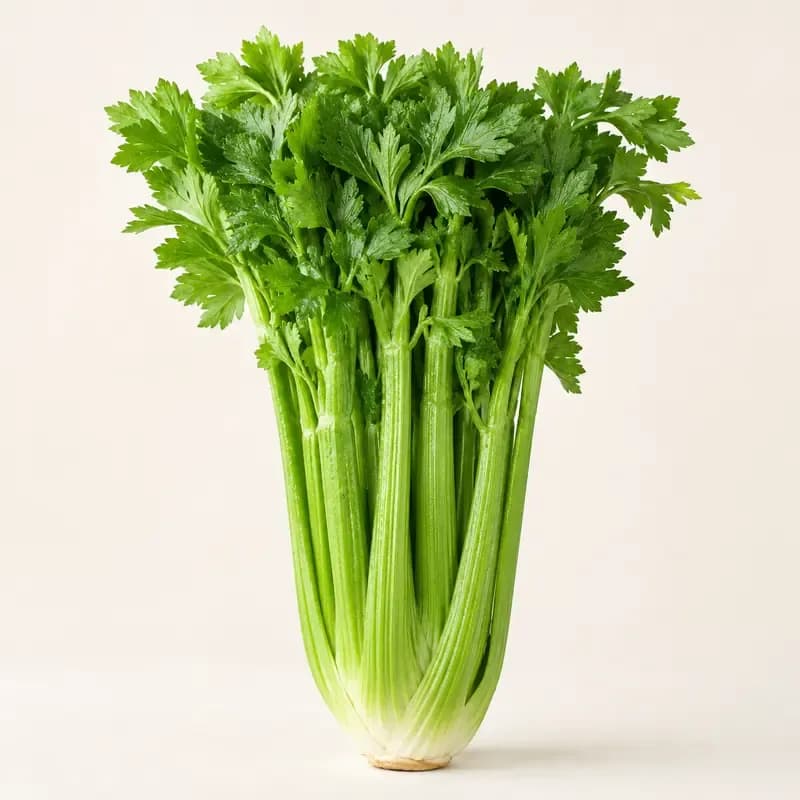
Celery
Apium graveolens L. Dulce Group
Celery, scientifically classified as Apium graveolens and represented by the Dulce Group of cultivated varieties, is an aromatic vegetable in the carrot family, Apiaceae. The crisp structures commonly called celery stalks are technically enlarged leaf stalks, or petioles, rather than true botanical stems. They surround a compact central growing point and carry strongly scented, divided green leaves. Celery has a clean, salty, mildly bitter flavor with herbal, grassy, and peppery notes. Pale inner stalks are usually sweeter and more tender, while dark outer stalks and leaves have a stronger aroma. The petioles, leaves, tender shoots, and seeds are edible, although celery seed is generally used as a spice. Closely related cultivated groups include leaf celery, selected for aromatic foliage, and celeriac, selected for a swollen edible stem base and hypocotyl. Celery may be eaten raw, juiced, sautéed, steamed, braised, roasted, grilled, simmered, or used as an aromatic foundation for soups, stocks, sauces, and stews. Raw celery is approximately 95% water and provides vitamin K, folate, potassium, fiber, pantothenic acid, vitamin B6, riboflavin, manganese, copper, vitamin C, calcium, and diverse aromatic phytochemicals for relatively few calories.
Celery Galeria de fotos
Explore Celery em detalhes
Celery - Vista principal
Celery Informações nutricionais
💊Vitaminas
Por 100 g
⚡Minerais
Por 100 g
Por porção
Detalhamento nutricional por porção
Benefícios para a saúde de Celery
Celery Origem e distribuição
Macaronesia and northern Africa through Europe, the Mediterranean region, western Asia, and the western Himalayas
Wild Apium graveolens grows naturally across a broad Old World range, particularly in damp, saline, and coastal habitats. Ancient Egyptians, Greeks, Romans, and Chinese communities used forms of celery as condiments, ceremonial plants, and traditional remedies. Early celery was more pungent, fibrous, and bitter than modern stalk cultivars. European growers, especially in Italy and France, selected milder plants with enlarged, succulent leaf stalks during the sixteenth and seventeenth centuries. Blanching the stalks by excluding light became a traditional method for reducing green color and bitterness. Celery subsequently spread across northern Europe and North America, where Pascal and self-blanching types became important commercial vegetables. Separate cultivated groups developed for different edible organs: the Dulce Group for thick petioles, the Secalinum Group for aromatic leaves and thin stalks, and the Rapaceum Group for celeriac's enlarged stem base and hypocotyl. Contemporary breeding emphasizes crispness, uniform color, disease resistance, reduced stringiness, slow bolting, yield, and storage quality.
Celery Melhor época
Celery is a cool-season crop that develops best under moderate temperatures with consistent moisture. Regional harvests commonly peak from late summer through autumn, while protected cultivation and geographically distributed production support year-round availability.
Celery Variedades
Cada variedade oferece sabores, texturas e usos culinários únicos
Pascal Celery
Golden Self-Blanching
Tall Utah
Tango
Chinese Celery
Celeriac
Celery Guia de armazenamento e seleção
Mantenha a fruta fresca por mais tempo
Como escolher a fruta perfeita
Choose celery with firm, tightly clustered stalks that snap rather than bend.
Look for crisp green or pale stalks appropriate to the cultivar without extensive bruising, browning, or translucent soft areas.
Select bunches with fresh, vibrant leaves rather than wilted, yellow, or slimy foliage.
Check the cut base for freshness and avoid bunches with mold, dark decay, or a sour odor.
Choose thinner inner stalks for raw preparations and larger outer stalks for soups, stocks, braises, and roasting.
Inspect packaged celery for an intact seal and minimal excessive condensation.
Métodos de armazenamento
Refrigerate celery promptly at 4°C or below in the high-humidity produce drawer.
Keep the bunch whole until needed because cut stalks lose moisture more rapidly.
Wrap celery loosely in foil or place it in a ventilated reusable container to reduce moisture loss without trapping excessive condensation.
Store trimmed celery sticks in a covered container in the refrigerator and replace clean water regularly if using water storage.
Keep celery separate from raw meat, poultry, seafood, eggs, and their juices.
Remove slimy or moldy stalks and leaves promptly so deterioration does not spread.
Guia de validade
Preparation Tips
Separate the stalks and rinse them thoroughly under cool running water, paying attention to the base and inner grooves where soil can collect.
Rinse usable leaves separately and dry them before chopping or storing.
Trim the dry base and any brown, bruised, hollow, or damaged areas.
Remove tough outer strings with a vegetable peeler or paring knife when preparing mature stalks for raw eating.
Slice stalks across the fibers for a more tender texture in salads, soups, and stir-fries.
Use the strongly flavored leaves sparingly in salads or more generously in stocks, soups, sauces, and herb mixtures.
Do not wash celery with soap, detergent, bleach, or household disinfectants.
Instruções para congelar
Preserve a frescura por meses
Wash the stalks and leaves thoroughly and trim damaged portions.
Cut celery into slices or recipe-sized pieces before freezing.
Blanch pieces in boiling water for approximately 3 minutes.
Cool immediately in ice water, then drain and dry thoroughly.
Freeze in airtight containers or bags with excess air removed and label with the date.
Use frozen celery in soups, stocks, casseroles, sauces, and stews because thawed stalks lose their raw crispness.
Dica
Identifique itens congelados com a data para acompanhar a frescura. A maioria das frutas mantém a qualidade por 2-3 meses quando congelada corretamente. Para melhores resultados, use recipientes herméticos ou sacos próprios para congelador para evitar queimadura de freezer.
Jornada culinária
Descubra possibilidades deliciosas
Usos comuns
Combinações perfeitas
Receitas populares
Cooking Methods
Bebidas refrescantes
Informações de segurança
Celery is a clinically important food allergen and is one of the allergens requiring mandatory declaration in the European Union and United Kingdom. Allergy may be associated with birch or mugwort pollen sensitization and can involve stalk celery, leaves, celeriac, celery seed, spice mixtures, soups, stocks, and processed foods. Symptoms range from oral itching and hives to swelling, respiratory difficulty, or anaphylaxis. Heating may reduce some allergenic proteins but does not reliably make celery safe for every allergic individual.
Pesticide use and measured residues vary by country, farm, season, and production method. Separate the stalks and rinse them thoroughly under running water, paying attention to the base and grooves where soil can collect. Washing can reduce dirt, microorganisms, and some surface residues but cannot remove every residue. Organic celery should also be washed because organic production does not eliminate microbial contamination.
- • People with a diagnosed celery allergy should avoid celery stalks, leaves, celeriac, seeds, celery salt, extracts, and foods containing undeclared celery.
- • People with birch or mugwort pollen allergy who experience oral or systemic symptoms after celery should seek evaluation from an allergy specialist.
- • People taking warfarin or another vitamin K antagonist should maintain a consistent intake and consult their clinician before making major dietary changes.
- • People with kidney disease who have been instructed to restrict potassium or sodium should ask their renal clinician or dietitian about appropriate portions.
- • People with known photosensitivity disorders should seek professional advice before using concentrated celery seed, oil, or extract products.
- • Anyone should avoid celery that is slimy, moldy, foul-smelling, extensively decayed, recalled, or stored at unsafe temperatures.
- •Celery can trigger oral allergy symptoms, hives, swelling, digestive reactions, breathing difficulty, or anaphylaxis in allergic individuals.
- •Large servings may cause gas, bloating, or digestive discomfort in sensitive people.
- •Sudden major changes in celery intake may affect anticoagulation in people taking warfarin because celery contains vitamin K.
- •Celery contains furanocoumarins that can contribute to phototoxic skin reactions after substantial skin exposure to celery sap followed by ultraviolet light.
- •Concentrated celery juice can deliver less fiber and more celery-derived compounds per sitting than a typical serving of whole stalks.
- •Improperly handled raw celery can transmit foodborne microorganisms.
- • Wash hands, knives, cutting boards, sinks, juicers, and storage containers before preparing celery.
- • Keep celery separate from raw meat, poultry, seafood, eggs, and their juices.
- • Rinse stalks and leaves under cool running water without using soap, detergent, bleach, or household disinfectants.
- • Clean juicing equipment immediately after use because moist vegetable residue can support microbial growth.
- • Refrigerate cut celery and cooked celery dishes within two hours, or within one hour in very hot conditions.
- • Use refrigerated cooked leftovers within 3 to 4 days and reheat them thoroughly.
- • Discard celery with slime, mold, foul odors, or extensive soft decay.
Curiosidades sobre Celery
Fatos surpreendentes que você vai amar!
The structures commonly called celery stalks are botanically leaf stalks known as petioles.
Celery belongs to the same plant family as carrots, parsley, fennel, coriander, cumin, and parsnips.
The scientific epithet graveolens refers to the plant's strong smell.
Wild celery naturally grows in damp and sometimes salty habitats.
Ancient cultures used celery long before modern thick, crisp stalks were developed.
Traditional growers blanched celery by excluding light to produce paler, milder stalks.
Mirepoix traditionally combines celery, onions, and carrots as an aromatic cooking base.
Celery, onions, and bell peppers form the aromatic base called the holy trinity in Cajun and Creole cuisine.
Celery leaves are edible and usually have a stronger flavor than the stalks.
Celeriac and stalk celery are cultivated forms of the same species selected for different edible structures.
Perguntas frequentes
Is a celery stalk botanically a stem?
ScienceThe structure commonly called a celery stalk is technically a petiole, meaning the leaf stalk that connects a leaf blade to the plant's central stem. Cultivated stalk celery has been selected for thick, crisp, succulent petioles that form the familiar bunch. The true stem remains comparatively short near the center until the plant begins flowering, when it elongates and produces umbels. Under the simplified culinary categories used for vegetables, celery is commonly classified as a stem vegetable because its stalk-like petioles are the principal edible portion, even though the precise botanical term is leaf stalk.
Are celery, leaf celery, and celeriac the same plant?
ScienceThey belong to the same species, Apium graveolens, but represent cultivated groups selected for different edible organs. Stalk celery, or the Dulce Group, produces enlarged crisp petioles. Leaf celery, or the Secalinum Group, has thinner stalks and strongly aromatic leaves used as a vegetable and seasoning. Celeriac, or the Rapaceum Group, develops a large, knobbly stem base and hypocotyl that is peeled and eaten raw or cooked. Their flavors are recognizably related, but textures, serving sizes, preparation methods, and nutrient profiles differ enough that one should not automatically use another's nutrition data.
How should fresh celery be washed and prepared?
PreparationSeparate the stalks because soil and debris can collect at the base and inside the grooves. Rinse each stalk thoroughly under cool running water while rubbing the surfaces. Wash usable leaves separately. Do not use soap, detergent, bleach, or household disinfectants. Trim the dry base, bruised areas, and damaged leaf tips. Mature outer stalks may have tough fibers that can be removed with a vegetable peeler or paring knife. Dry celery intended for salads or storage, and use clean hands, knives, cutting boards, and containers to prevent cross-contamination.
How can tough strings be removed from celery?
PreparationCelery's strings are vascular bundles and supporting tissues running lengthwise through the petiole. They become more noticeable in large, mature outer stalks. To remove them, trim a small piece from one end without cutting completely through, then pull it down the length of the stalk so some fibers come away with it. A vegetable peeler can also remove a thin outer layer from the ridged side. String removal is optional for soups, stocks, juicing, and finely chopped dishes, but it can improve tenderness when stalks are served raw or in large pieces.
Is celery healthier raw or cooked?
HealthRaw and cooked celery can both contribute to a healthy diet. Raw celery retains its crisp texture and generally preserves more heat-sensitive vitamin C and folate. Cooking softens the petioles, concentrates celery within a smaller volume, and makes it easier to include in soups, stews, sauces, and braises. Water-soluble nutrients may move into cooking liquid, but they remain part of the meal when the broth or sauce is consumed. Roasting and sautéing intensify flavor but can add calories depending on the oil or butter used. Variety across preparations is reasonable.
Is celery juice more nutritious than eating whole celery?
HealthCelery juice contains water and some vitamins, minerals, sugars, and phytochemicals extracted from the stalks. However, strained juice removes much of the insoluble fiber present in whole celery and can make it easier to consume several stalks quickly. There is no strong evidence that celery juice detoxifies the body, cures chronic disease, or provides unique benefits unavailable from whole vegetables. People who enjoy it can include it as a beverage, but it should not replace water, balanced meals, medically prescribed treatment, or a varied intake of whole fruits and vegetables.
Can celery cause a serious allergic reaction?
HealthCelery can cause food allergy, and reactions may occasionally be severe. It is a legally designated major allergen in the European Union and United Kingdom. Celery allergy is often associated with sensitization to birch or mugwort pollen because structurally related proteins can cross-react. Symptoms may include itching or tingling in the mouth, hives, swelling, vomiting, wheezing, breathing difficulty, or anaphylaxis. Cooking does not reliably make celery safe for every allergic person, and celery seed, celeriac, spice mixtures, soups, and stocks may also trigger reactions. Diagnosed individuals should follow an allergist's guidance.
How long does celery last in the refrigerator?
GeneralA fresh whole bunch commonly maintains useful quality for approximately seven to fourteen days when refrigerated at 4°C or below. Keep it whole and protect it from moisture loss with loose foil, a ventilated container, or an appropriate produce bag. Cut stalks generally remain at their best for three to five days in a covered refrigerated container. Celery that has become slightly limp but is otherwise safe may regain some crispness in cold water. Discard stalks that are slimy, moldy, foul-smelling, extensively brown, or affected by soft rot.