Loading Vegetable Details...
Please wait while we fetch nutritional information and health benefits
Please wait while we fetch nutritional information and health benefits
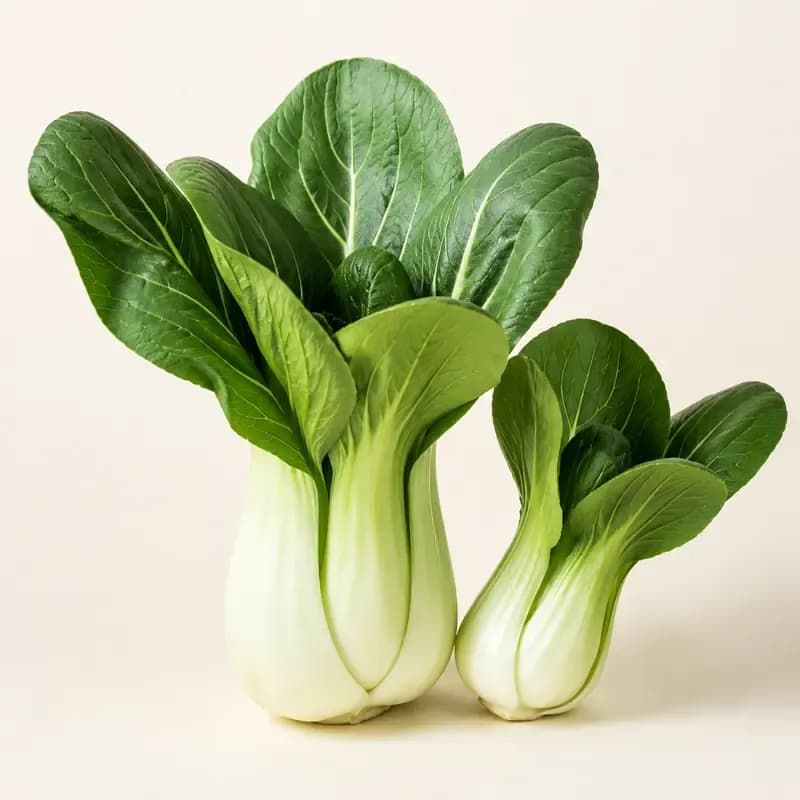
Brassica rapa subsp. chinensis
Bok choy, scientifically known as Brassica rapa subsp. chinensis, is a non-heading Chinese cabbage cultivated for its tender green leaves and crisp, succulent leaf stalks. It is also called pak choi, bok choi, pok choi, Chinese mustard cabbage, and spoon cabbage. Unlike napa cabbage, bok choy does not form a tight head; its leaves grow in an upright rosette with smooth or slightly crinkled blades and white, cream, or pale-green stalks. The entire above-ground vegetable is edible, including the leaves, petioles, tender stems, and young flowering shoots. Raw bok choy tastes fresh, mildly peppery, and subtly sweet, while brief cooking softens its brassica notes without eliminating its characteristic crunch. It is widely stir-fried, steamed, simmered, braised, grilled, roasted, pickled, and added to soups, noodles, dumplings, rice dishes, and salads. Raw bok choy is approximately 95% water and provides vitamin C, vitamin A from carotenoids, vitamin K, folate, vitamin B6, calcium, potassium, manganese, fiber, and glucosinolate compounds for very few calories. Its ability to mature quickly and thrive in cool weather has helped make it an important vegetable throughout China, East Asia, Southeast Asia, and increasingly across Europe, Australia, and North America.
Explore Bok Choy in stunning detail
Bok Choy - Main View
Per 100g
Per 100g
Nutrition breakdown for one serving
China, particularly regions associated with the long cultivation and diversification of non-heading Chinese cabbages
Bok choy belongs to the diverse Brassica rapa crop complex and has been cultivated in China for well over a thousand years. Historical accounts place recognizable non-heading Chinese cabbages in cultivation by approximately the fifth century CE, although related Asian mustards have a considerably longer agricultural history. Farmers selected plants for broad leaves, enlarged succulent petioles, compact growth, tenderness, flavor, and adaptation to different climates. White-stemmed forms became especially associated with southern China, while pale-green Shanghai types developed prominence in eastern China. Trade and migration spread bok choy throughout East and Southeast Asia and later to Europe, Australia, the Caribbean, and North America. Contemporary breeding has produced miniature, purple, heat-tolerant, cold-tolerant, slow-bolting, and disease-resistant cultivars for farms, home gardens, hydroponic systems, and protected cultivation.
Bok choy is primarily a cool-season crop grown during autumn, winter, and spring, although heat-tolerant cultivars and protected cultivation permit year-round production in many regions.
Each variety offers unique flavors, textures, and culinary applications
Keep your fruit fresh and delicious for longer
Choose bok choy with crisp, upright leaves and firm, plump stalks that look freshly cut.
Look for vivid green leaf blades and clean white or pale-green petioles appropriate to the variety.
Select smaller heads for tender whole-plant cooking and larger heads when separate stalk and leaf textures are desired.
Avoid heads with slime, mold, sour odors, extensive yellowing, wilted leaves, or deeply cracked and dried stalks.
Inspect packaged bok choy for an intact seal and minimal condensation, which can encourage decay.
Refrigerate unwashed bok choy promptly at 4°C or below in a perforated bag or ventilated container.
Wrap the bok choy loosely in a clean, slightly damp towel if necessary to reduce wilting without trapping excessive moisture.
If the vegetable has already been washed, dry the leaves and stalks thoroughly before refrigeration.
Keep bok choy separate from raw meat, poultry, seafood, eggs, and their juices.
Avoid cutting bok choy far in advance because damaged tissues lose moisture and deteriorate more quickly.
Trim the dry base and separate the stalks so soil trapped between the petioles can be removed.
Rinse every stalk and leaf thoroughly under cool running water, rubbing crevices near the base where grit commonly collects.
Dry bok choy intended for stir-frying or roasting to limit splattering and encourage browning.
Separate thick stalks from the leaves when cooking a mature head, adding the stalks first because they require more time.
Halve or quarter baby bok choy lengthwise so each portion retains part of the base and remains intact during cooking.
Blanch bok choy briefly before freezing or before adding it to recipes that require very short final cooking.
Do not wash bok choy with soap, detergent, bleach, or household disinfectants.
Preserve freshness for months
Separate the leaves, rinse thoroughly, and trim damaged or discolored portions.
Cut large stalks and leaves into convenient pieces while leaving small heads whole or halved.
Blanch prepared bok choy in boiling water for approximately 2 minutes, using slightly less time for very small pieces.
Cool immediately in ice water to stop cooking and help preserve color.
Drain and dry thoroughly, portion into airtight freezer containers or bags, remove excess air, and label with the date.
Use thawed bok choy in soups, braises, curries, casseroles, and stir-fries because freezing softens its crisp stalks.
Label frozen items with the date to track freshness. Most fruits maintain quality for 2-3 months when properly frozen. For best results, use airtight containers or freezer bags to prevent freezer burn.
Discover delicious possibilities
Allergy to bok choy is uncommon but possible. Reactions may include oral itching, hives, swelling, digestive symptoms, breathing difficulty, or, rarely, anaphylaxis. People allergic to other mustard-family vegetables or mustard may require professional evaluation because cross-reactivity is possible. Breathing difficulty, throat swelling, faintness, or widespread hives requires urgent medical attention.
Pesticide use and measured residues vary by country, farm, season, and production method. Separate the stalks and rinse them thoroughly under running water, paying special attention to the base and inner curves where soil can collect. Washing can reduce dirt, microorganisms, and some surface residues but cannot remove every residue. Organic bok choy should also be washed because organic cultivation does not eliminate microbial contamination.
Surprising trivia you'll love!
Bok choy and napa cabbage belong to the same species but represent different cultivated groups.
The name bok choy derives from Cantonese words commonly interpreted as white vegetable.
What cooks commonly call bok choy stems are technically enlarged leaf stalks called petioles.
Bok choy forms an open rosette instead of the dense head produced by napa cabbage.
White-stemmed and pale-green Shanghai types are two of the most recognizable bok choy forms.
Baby bok choy is usually an immature or compact market form rather than one single botanical variety.
Purple bok choy cultivars contain anthocyanin pigments that create burgundy or violet leaf surfaces.
Bok choy can bolt rapidly and produce yellow flowers when exposed to stressful temperature changes or lengthening days.
The plant is commonly harvested as an annual vegetable even though its natural life cycle can be biennial.
Bok choy grows successfully in fields, containers, greenhouses, and hydroponic systems.
Bok choy is a non-heading Chinese cabbage scientifically classified as Brassica rapa subsp. chinensis. The term Chinese cabbage can refer to several vegetables, so it is not always specific. Bok choy forms an open rosette of green leaves and enlarged white or pale-green petioles, whereas napa cabbage, Brassica rapa subsp. pekinensis, generally forms an elongated, tightly packed head. Both belong to the same species and mustard family but represent different cultivated groups. Bok choy may also be labeled pak choi, bok choi, pok choi, Chinese mustard cabbage, or spoon cabbage.
Both portions are edible, nutritious, and useful in cooking. The thick white or pale-green structures commonly called stems are technically enlarged leaf stalks, or petioles. They have a juicy, crisp texture and need slightly more cooking time than the thin leaf blades. When preparing a mature head, cooks often separate the stalks from the leaves, begin cooking the stalk pieces, and add the leaves near the end. Small baby bok choy heads can be halved or quartered and cooked intact. Tender flowering shoots are also edible when harvested before becoming fibrous.
Soil commonly becomes trapped where bok choy stalks meet near the base. Trim only the dry end, separate the stalks, and rinse each one under cool running water while rubbing the inner curves and crevices. Do not use soap, detergent, bleach, or household disinfectant. Dry the vegetable if it will be stir-fried, sautéed, grilled, or roasted. For a mature head, slice the thick stalks and leaves separately so the stalks can begin cooking first. Baby bok choy may be halved lengthwise, rinsed between the layers, and cooked with the base attached.
Neither form is universally healthier because preparation changes different characteristics. Raw bok choy retains its crisp texture and generally preserves more heat-sensitive vitamin C. Cooking softens plant tissues, reduces volume, makes larger portions easier to eat, and can improve the availability of some carotenoids, especially when a small amount of fat is present. Boiling may move vitamin C, folate, and other water-soluble compounds into the cooking liquid. Steaming, microwaving, or brief stir-frying limits that loss. A varied diet can include both raw and lightly cooked bok choy according to preference and tolerance.
Bok choy contains glucosinolates, compounds characteristic of the Brassicaceae family. The intact plant stores these compounds separately from an enzyme called myrosinase. Cutting, chewing, or crushing the tissues allows the enzyme and glucosinolates to interact, producing isothiocyanates and other breakdown products that contribute mustard-like aromas and sensations. Bok choy is usually milder than mustard greens because its cultivar and compound profile differ. Plant age, growing temperature, water stress, storage, chopping, and cooking all affect flavor. Heating reduces myrosinase activity and can disperse volatile compounds, producing a milder taste.
Bok choy provides approximately 38% of the Daily Value for vitamin K per 100 g. Vitamin K can influence the effect of warfarin and other vitamin K antagonist medicines. People taking these medications generally should not automatically eliminate nutritious leafy vegetables. Healthcare professionals commonly recommend keeping vitamin K intake reasonably consistent so the medication dose can be managed appropriately. Sudden large increases or decreases may alter anticoagulation. Anyone taking warfarin should follow individualized advice from the prescribing clinician or registered dietitian and should not change medication or make major dietary changes independently.
Bok choy contains glucosinolates that can form compounds capable of interfering with iodine use under certain conditions. For most people with adequate iodine intake, ordinary portions of cooked or raw bok choy within a varied diet are unlikely to impair thyroid function. Concern is greater when exceptionally large quantities of raw cruciferous vegetables are consumed regularly, particularly alongside iodine deficiency or existing thyroid disease. Cooking reduces myrosinase activity and changes some glucosinolate breakdown products. People with thyroid disorders who consume unusually large daily amounts should discuss their diet with a qualified clinician or dietitian.
Fresh bok choy is usually at its best for approximately three to five days, although exceptionally fresh heads may remain usable for up to seven days when properly refrigerated. Store it unwashed at 4°C or below in a perforated bag or ventilated container. If it has been washed, dry it thoroughly first because trapped moisture accelerates decay. Bok choy can be frozen, but its stalks will lose much of their crispness. For better quality, blanch cleaned pieces briefly, cool them in ice water, drain thoroughly, and freeze airtight for later use in cooked dishes.
Sustainability insights
Bok choy grows quickly and can produce a marketable crop within a relatively short season. Its overall environmental impact depends on fertilizer use, irrigation, pest management, soil practices, greenhouse energy, refrigeration, packaging, transportation, and food waste. Crop rotation, integrated pest management, efficient fertilizer application, compost use, renewable-energy-powered protected cultivation, and careful harvest planning can improve sustainability.
No single carbon-footprint value accurately represents all bok choy production. Seasonal field-grown bok choy generally requires less production energy than crops grown in heated structures or transported by air. Fertilizer manufacture, farm machinery, refrigeration, packaging, transport, cooking, and discarded produce all contribute to total emissions. Eating the stalks and leaves and purchasing only usable quantities can reduce waste-related impact.
Bok choy needs reliable moisture to develop crisp stalks and tender leaves, but its water footprint varies with climate, rainfall, soil, yield, and irrigation method. Drip irrigation, mulching, soil-moisture monitoring, rainfall-based scheduling, and improving soil organic matter can reduce unnecessary water use and limit stress-related bolting.
Locally grown seasonal bok choy may require less transport and long-term refrigeration while reaching consumers in fresher condition. Distance alone does not determine total sustainability because farming efficiency, greenhouse heating, fertilizer use, irrigation source, packaging, storage, transport mode, and food waste also matter. Locally produced bok choy grown in an energy-intensive heated structure may have a greater impact than efficiently field-grown produce transported by sea or road.
We aim to keep this Bok Choy profile accurate and easy to understand. Nutrition values and % Daily Value figures are based on established reference databases and standard daily value guidance.
Last updated: September 1, 2026
Medical disclaimer
This page is for general educational purposes and does not replace professional medical advice.
Found an issue? Contact us.