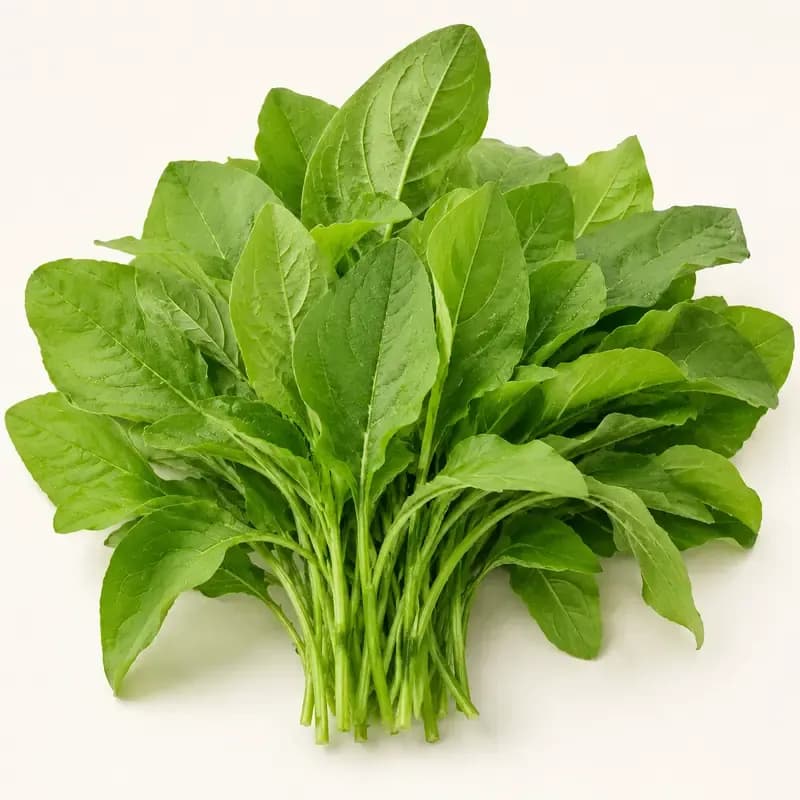
Amaranth Leaves
Amaranthus tricolor L. and other edible Amaranthus species
Amaranth leaves are tender leafy vegetables harvested from edible species of Amaranthus, especially Amaranthus tricolor, along with Amaranthus dubius, Amaranthus viridis, Amaranthus cruentus, and related cultivated forms. They are known by many regional names, including chaulai, lal saag, thotakura, keerai, callaloo, Chinese spinach, en choy, bayam, and African spinach. Depending on the species and cultivar, the leaves may be bright green, burgundy, purple-red, or dramatically variegated with yellow and crimson. Young leaves and stems are tender, mildly earthy, and subtly sweet, while mature foliage can develop a stronger mineral or slightly astringent flavor. Both the leaves and succulent stems are edible, although thick mature stalks require longer cooking. Amaranth greens are sautéed, steamed, boiled, braised, stir-fried, simmered in soups and dals, and cooked with coconut, legumes, grains, meat, or fish. Raw amaranth leaves provide vitamin K, vitamin C, folate, provitamin A carotenoids, manganese, copper, calcium, potassium, magnesium, iron, zinc, phosphorus, and protein for relatively few calories. Red cultivars additionally contain betalain pigments. Nutrient concentrations vary among species, cultivars, growing environments, and leaf ages, so the values presented here represent the USDA reference entry for raw amaranth leaves rather than every regional type.
Amaranth Leaves Galeria de fotos
Explore Amaranth Leaves em detalhes
Amaranth Leaves - Vista principal
Amaranth Leaves Informações nutricionais
💊Vitaminas
Por 100 g
⚡Minerais
Por 100 g
Por porção
Detalhamento nutricional por porção
Benefícios para a saúde de Amaranth Leaves
Amaranth Leaves Origem e distribuição
Tropical Asia for Amaranthus tricolor, while other vegetable amaranths originated in tropical regions of Africa and the Americas
Amaranth is an ancient crop genus containing species used for leaves, grain, ornament, and traditional medicine. Amaranthus tricolor, the principal Asian vegetable amaranth, originated in tropical Asia and was domesticated in prehistoric times. It became an important leafy vegetable throughout South Asia, China, and Southeast Asia under names such as chaulai, keerai, thotakura, bayam, and Chinese spinach. Other species developed as leafy vegetables in Africa, the Caribbean, and the Americas. Amaranthus cruentus and related American species were also cultivated for grain by pre-Columbian civilizations, while their young leaves remained edible vegetables. Enslaved and migrating communities helped carry African and American amaranth traditions throughout the Caribbean, where several leafy dishes became known collectively as callaloo. Modern vegetable breeding emphasizes rapid growth, tenderness, color, leaf yield, delayed flowering, heat tolerance, and repeated cutting. Amaranth greens are now grown in fields, gardens, containers, and protected systems throughout tropical, subtropical, and warm temperate regions.
Amaranth Leaves Melhor época
Vegetable amaranth is a warm-season crop that grows rapidly from late spring through early autumn. In tropical climates and protected production systems, leaves may be harvested throughout the year.
Amaranth Leaves Variedades
Cada variedade oferece sabores, texturas e usos culinários únicos
Green Amaranth
Red Amaranth
Chinese Spinach
Spleen Amaranth
Green Callaloo
Blood Amaranth
Green Amaranth or Slender Amaranth
Amaranth Leaves Guia de armazenamento e seleção
Mantenha a fruta fresca por mais tempo
Como escolher a fruta perfeita
Choose bunches with crisp, vibrant leaves and tender, freshly cut stems.
Look for green, red, burgundy, or variegated coloration appropriate to the cultivar without extensive yellowing or browning.
Select smaller leaves and thin stems for quick cooking, salads, and tender dishes.
Choose mature bunches for soups, dals, braises, and recipes requiring longer cooking.
Avoid leaves that are slimy, moldy, foul-smelling, extensively wilted, or severely insect-damaged.
Purchase cultivated amaranth from a traceable supplier rather than gathering plants from roadsides, industrial ground, or contaminated land.
Métodos de armazenamento
Refrigerate unwashed amaranth leaves promptly at 4°C or below in a perforated bag or ventilated container.
Wrap the bunch loosely in a clean, slightly damp towel to reduce wilting without trapping excessive water.
If the leaves have been washed, dry them thoroughly before refrigeration because excess surface moisture encourages decay.
Keep amaranth leaves separate from raw meat, poultry, seafood, eggs, and their juices.
Remove slimy, moldy, or badly damaged leaves promptly so spoilage does not spread.
Avoid crushing the leaves under heavy produce because bruising accelerates deterioration.
Guia de validade
Preparation Tips
Separate the leaves and rinse them thoroughly under cool running water because soil and insects can collect around the stems and leaf joints.
Trim roots, dry stem ends, damaged leaves, and fibrous lower stalks.
Retain tender young stems, slice them separately, and begin cooking them before the leaves.
Dry leaves intended for sautéing or stir-frying to reduce splattering and encourage even cooking.
Blanch or boil mature leaves when a softer texture or reduced soluble oxalate content is desired.
If discarding boiling water to reduce soluble compounds, remember that some vitamin C, folate, potassium, and other nutrients will also be lost.
Do not wash amaranth leaves with soap, detergent, bleach, or household disinfectants.
Instruções para congelar
Preserve a frescura por meses
Remove roots, damaged leaves, and very tough mature stems.
Rinse the leaves and retained tender stems thoroughly to remove soil and insects.
Blanch prepared amaranth leaves for approximately 2 minutes.
Cool immediately in ice water to stop cooking and help preserve color.
Drain thoroughly, press out excess moisture, and freeze in airtight recipe-sized portions.
Use frozen amaranth in soups, dals, curries, braises, purees, and other cooked dishes because freezing softens its texture.
Dica
Identifique itens congelados com a data para acompanhar a frescura. A maioria das frutas mantém a qualidade por 2-3 meses quando congelada corretamente. Para melhores resultados, use recipientes herméticos ou sacos próprios para congelador para evitar queimadura de freezer.
Jornada culinária
Descubra possibilidades deliciosas
Usos comuns
Combinações perfeitas
Receitas populares
Cooking Methods
Bebidas refrescantes
Informações de segurança
Allergy to amaranth leaves is uncommon but possible. Reactions may include oral itching, hives, swelling, digestive symptoms, breathing difficulty, or, rarely, anaphylaxis. Anyone with a known allergy to amaranth grain or another Amaranthus product should approach the leaves cautiously and seek professional advice. Breathing difficulty, throat swelling, faintness, or widespread hives requires urgent medical attention.
Pesticide use and measured residues vary by country, farm, season, and production method. Separate the leaves and rinse them thoroughly under running water, paying attention to leaf joints and undersides. Washing can reduce soil, microorganisms, and some surface residues but cannot remove every residue or contaminants absorbed from polluted soil. Organic amaranth should also be washed because organic production does not eliminate microbial contamination.
- • People with a diagnosed allergy to amaranth should avoid its leaves, stems, seeds, and processed products.
- • People taking warfarin or another vitamin K antagonist should maintain a consistent intake and consult their clinician before making major dietary changes.
- • People with recurrent calcium-oxalate kidney stones or a prescribed low-oxalate diet should seek individualized advice about portions and cooking methods.
- • People with kidney disease who have been instructed to restrict potassium should ask their renal clinician or dietitian about suitable portions.
- • Infants and other vulnerable individuals should not be given large quantities of raw or improperly stored high-nitrate leafy vegetables.
- • Anyone should avoid amaranth collected from roadsides, industrial areas, contaminated soils, sewage channels, or land treated with unknown chemicals.
- •Large servings may cause gas, bloating, or digestive discomfort because leafy vegetables contain fiber and fermentable carbohydrates.
- •Oxalates can reduce calcium availability and may be relevant to susceptible kidney-stone formers.
- •Amaranth leaves can accumulate nitrate when heavily fertilized or grown under low-light conditions.
- •Sudden changes in intake may affect anticoagulation in people taking warfarin because the leaves are exceptionally rich in vitamin K.
- •Improperly handled raw leaves can transmit foodborne microorganisms.
- •Wild or roadside amaranth may accumulate contaminants from polluted soil, water, dust, or chemical spraying.
- • Purchase cultivated amaranth from a traceable supplier rather than harvesting unidentified or roadside plants.
- • Confirm identification before eating wild amaranth because other plants may be mistaken for edible species.
- • Wash hands, knives, cutting boards, sinks, and bowls before preparation.
- • Keep amaranth leaves separate from raw meat, poultry, seafood, eggs, and their juices.
- • Rinse leaves under cool running water without using soap, detergent, bleach, or household disinfectants.
- • Refrigerate cooked amaranth within two hours, or within one hour in very hot conditions.
- • Use refrigerated cooked leftovers within 3 to 4 days and reheat them thoroughly.
- • Discard leaves with slime, mold, foul odors, or extensive decay.
Curiosidades sobre Amaranth Leaves
Fatos surpreendentes que você vai amar!
The name amaranth comes from a Greek word associated with a flower that does not fade.
Amaranthus contains leafy vegetables, grain crops, ornamentals, and agricultural weeds.
Vegetable amaranths use C4 photosynthesis, which supports rapid growth in warm, bright conditions.
Red amaranth owes much of its color to betalains rather than anthocyanins.
Beets and red amaranth both belong to the order Caryophyllales and can produce betalain pigments.
Amaranth leaves are known as chaulai, lal saag, thotakura, keerai, bayam, en choy, and callaloo in different cuisines.
Tender stems are edible and are often cooked before the faster-wilting leaves.
Many amaranth plants can regrow after careful cutting, allowing repeated leaf harvests.
Some grain-amaranth species also provide edible young leaves.
Amaranth can grow rapidly enough to become invasive or weedy when allowed to produce and disperse mature seed.
Perguntas frequentes
What are amaranth leaves, and are they related to amaranth grain?
ScienceAmaranth leaves and amaranth grain come from plants in the same genus, Amaranthus, but different species and cultivars may be selected primarily for leaves, seeds, or ornamental color. Vegetable amaranths such as Amaranthus tricolor are bred for tender, rapidly growing foliage. Grain species such as Amaranthus cruentus and Amaranthus hypochondriacus produce abundant edible seeds, although their young leaves can also be eaten. The nutritional profile of fresh leaves is completely different from that of dry grain. Leaves contain much more water and fewer calories, while dry seeds are more concentrated in starch, protein, and energy.
Are red and green amaranth leaves the same vegetable?
GeneralRed and green amaranth are closely related vegetable types, but they may represent different cultivars or species. Many red forms belong to Amaranthus tricolor and contain betalain pigments that produce burgundy, crimson, or purple-red leaves. Green forms may belong to A. tricolor, A. viridis, A. dubius, or other edible species. Their basic culinary uses are similar, although flavor, tenderness, mineral content, pigments, and cooking behavior vary. Red amaranth often colors cooking liquid pink or purple, while green forms generally produce a spinach-like green dish.
How should fresh amaranth leaves be cleaned and prepared?
PreparationRemove roots, dry stem ends, yellow leaves, slime, and damaged material. Separate the leaves and stems, then rinse them thoroughly under cool running water while rubbing away soil around the leaf joints. Do not use soap, detergent, bleach, or household disinfectants. Tender stems can be sliced and cooked, but mature fibrous stalks are better discarded. Because stems need more time than leaves, begin cooking sliced stems first and add the foliage later. Dry leaves intended for stir-frying or sautéing to limit splattering and prevent excessive steaming.
Why does red amaranth turn cooking water pink or purple?
ScienceRed amaranth contains water-soluble betalain pigments, particularly red-violet betacyanins. Cutting and heating the leaves release these pigments from plant cells, allowing them to dissolve into cooking water, soup, sauce, or rice. The final color depends on cultivar, pigment concentration, cooking time, temperature, and acidity. Betalains can be sensitive to prolonged heat, so extended cooking may dull the original red-purple color. The colored liquid is generally a normal property of red amaranth rather than evidence of artificial dye, assuming the vegetable came from a trustworthy source.
Are amaranth leaves healthier raw or cooked?
HealthRaw and cooked amaranth leaves have different advantages. Raw leaves generally retain more heat-sensitive vitamin C and folate, but mature leaves may be fibrous and can contain substantial oxalate or nitrate depending on species and growing conditions. Cooking softens the leaves, reduces volume, makes larger servings easier to eat, and can lower some soluble oxalate when the greens are boiled and drained. However, discarding cooking water also removes vitamin C, folate, potassium, and other water-soluble nutrients. Steaming or quick sautéing offers a compromise between tenderness and nutrient retention.
Can people taking warfarin eat amaranth leaves?
HealthThe USDA reference entry lists approximately 1,140 mcg of vitamin K per 100 g of raw amaranth leaves, equivalent to about 950% of the Daily Value. Vitamin K can influence the action of warfarin and other vitamin K antagonist medicines. People taking these drugs generally should not eliminate nutritious leafy vegetables automatically. Clinicians commonly recommend maintaining a reasonably consistent vitamin K intake so medication can be managed appropriately. Sudden major changes may alter anticoagulation. Anyone using an anticoagulant should follow individualized guidance from the prescribing clinician or registered dietitian.
Do amaranth leaves contain oxalates, and are they suitable for people with kidney stones?
HealthAmaranth leaves can contain oxalates, but concentrations vary considerably among species, cultivars, leaf ages, soils, and growing conditions. Oxalate can bind calcium in the digestive tract, and high intake may be relevant to people who form calcium-oxalate kidney stones. Boiling the leaves and discarding the water can reduce part of the soluble oxalate, although it also removes some water-soluble nutrients. People with recurrent stones, kidney disease, or a prescribed low-oxalate diet should obtain individualized advice about portions, cooking methods, calcium intake, hydration, and overall dietary patterns.
How long do amaranth leaves last in the refrigerator?
GeneralFresh amaranth leaves are usually at their best for approximately three to five days when refrigerated at 4°C or below. Store them unwashed in a perforated bag or ventilated container, ideally wrapped loosely in a clean towel that controls excess moisture. If they have already been washed, dry them thoroughly before refrigeration. Discard leaves that become slimy, moldy, foul-smelling, or extensively decayed. For longer storage, blanch the leaves, cool them in ice water, drain thoroughly, and freeze them in recipe-sized portions for soups, dals, curries, and braised dishes.