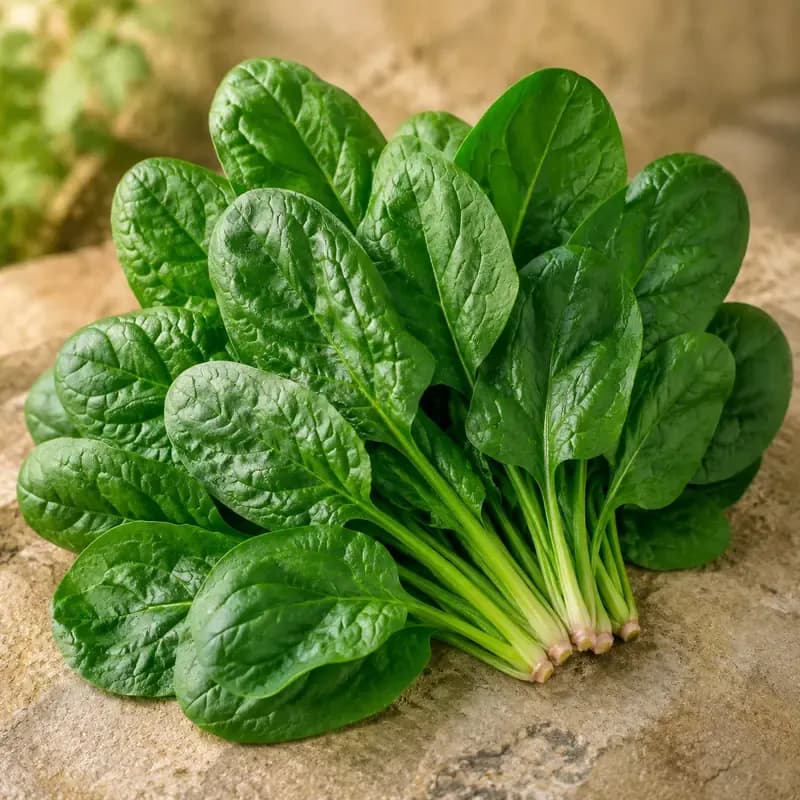
Spinach
Spinacia oleracea
Spinach (Spinacia oleracea) is a cool-season leafy vegetable in the Amaranthaceae family, the same botanical family that includes beet and Swiss chard. It forms a low rosette of smooth, semi-savoyed, or deeply crinkled green leaves attached to tender petioles. Young leaves are mild, delicate, and suitable for salads, while mature leaves develop a fuller earthy flavor and sturdier texture that works well in sautés, curries, soups, pasta fillings, and baked dishes. Spinach is naturally low in calories and supplies vitamin K, provitamin A carotenoids, folate, vitamin C, magnesium, manganese, potassium, iron, lutein, and zeaxanthin. Its iron is non-heme iron, and its calcium and iron bioavailability can be limited by naturally occurring oxalates, so nutrient content should not be confused with the amount the body absorbs. Cooking causes the leaves to lose considerable volume; boiling and draining can also reduce some soluble oxalate while leaching certain water-soluble nutrients. Spinach most likely originated in ancient Persia or the wider central and western Asian region before spreading through Asia, the Mediterranean, Europe, and eventually the Americas. Today it is cultivated worldwide and sold fresh, frozen, and canned.
Spinach Galería de fotos
Explora Spinach con todo detalle
Spinach - Vista principal
Spinach Información nutricional
💊Vitaminas
Por 100 g
⚡Minerales
Por 100 g
Por porción
Desglose nutricional por porción
Beneficios para la salud de Spinach
Spinach Origen y distribución
Central and western Asia, most likely ancient Persia and surrounding regions
Spinach is generally traced to ancient Persia or the broader central and western Asian region. Historical accounts indicate that it reached China by the seventh century, where it was associated with Persian origins. It spread west through Islamic agricultural and trade networks and became established around the Mediterranean during the medieval period. Spinach later entered northern European cooking and traveled to the Americas with European settlers. Centuries of selection produced smooth-leaf, savoy, semi-savoy, cold-tolerant, and slow-bolting cultivars suited to different climates and markets. It is now grown worldwide for fresh-market leaves and for frozen and canned products.
Spinach Temporada alta
Spinach is a cool-season crop. In temperate climates it is commonly grown in spring and autumn, while mild-winter regions can produce it during winter. Protected cultivation and international supply chains make it available throughout the year.
Spinach Variedades
Cada variedad ofrece sabores, texturas y usos culinarios únicos
Bloomsdale Long Standing
Giant Winter
Matador
Space F1
Regiment F1
Spinach Guía de selección y conservación
Mantén tu fruta fresca y deliciosa por más tiempo
Cómo elegir la fruta perfecta
Choose leaves that are crisp, fresh-looking, and green, without extensive yellowing, bruising, or wilted edges.
Avoid spinach with slime, a sour odor, mold, leaking liquid, or widespread decay.
For packaged spinach, choose an intact bag kept under refrigeration and check the use-by or best-quality date.
Choose tender baby leaves for raw salads and larger mature leaves when a stronger flavor and sturdier cooked texture are preferred.
Métodos de conservación
Refrigerate spinach promptly at 4°C or below and keep packaged spinach refrigerated continuously.
Keep loose spinach dry in a clean container or breathable bag lined with a dry paper towel to manage excess moisture.
Wash loose spinach shortly before use rather than before storage unless it can be dried very thoroughly.
Remove decaying leaves promptly because excess moisture and damaged tissue accelerate spoilage.
Follow the package date and storage directions for ready-to-eat spinach, and discard recalled products regardless of appearance.
Guía de vida útil
Preparation Tips
For loose or unpackaged spinach, separate the leaves and rinse them thoroughly under clean running water, then dry with a salad spinner or clean towel. Do not use soap, detergent, or bleach.
Spinach labelled pre-washed or ready-to-eat can be used without additional washing. If you choose to rewash it, use clean hands, utensils, and surfaces to avoid cross-contamination.
Trim only tough or damaged stem ends. Tender petioles and young stems are edible and can be chopped with the leaves.
Add spinach near the end of cooking soups, curries, and sauces because the leaves wilt quickly and prolonged cooking can dull their color and flavor.
To reduce some soluble oxalate, boil spinach in ample water and discard the water; this can also reduce water-soluble vitamins, so vary preparation methods.
For freezing, blanch spinach in boiling water for 2 minutes, cool it immediately in ice water, and drain thoroughly before packing.
Pair spinach with a vitamin C-rich ingredient such as bell pepper, tomato, or citrus to improve non-heme iron absorption, and include some dietary fat to support carotenoid absorption.
Instrucciones de congelación
Conserva la frescura por meses
Select young, tender leaves and remove damaged leaves and tough or woody stems.
Wash loose spinach thoroughly and water-blanch it for 2 minutes before freezing for best quality preservation.
Cool the blanched spinach promptly in ice water, drain it very thoroughly, and portion it into freezer-safe containers or bags.
Remove excess air, label with the date, freeze promptly, and use frozen spinach mainly in cooked dishes because thawed leaves will be soft.
Consejo
Etiqueta los alimentos congelados con la fecha para controlar la frescura. La mayoría de las frutas mantienen su calidad durante 2-3 meses si se congelan correctamente. Para mejores resultados, usa recipientes herméticos o bolsas para congelador para evitar quemaduras por congelación.
Viaje culinario
Descubre posibilidades deliciosas
Usos comunes
Maridajes perfectos
Recetas populares
Cooking Methods
Bebidas refrescantes
Información de seguridad
Spinach allergy is uncommon but possible. Reported reactions can include oral itching, hives, swelling, digestive symptoms, wheezing, or, rarely, anaphylaxis. Anyone with breathing difficulty, facial or throat swelling, faintness, or another severe reaction should seek emergency care. A qualified allergy specialist can assess suspected spinach allergy rather than relying on self-diagnosis.
Pesticide residues vary with location, season, and farming practices. Regulatory monitoring generally finds the great majority of sampled foods within established tolerances. For loose spinach, discard damaged leaves and rinse thoroughly under clean running water; do not use soap, detergent, bleach, or household cleaners. Washing can reduce some surface residues but cannot remove every residue or internal contamination. Organic production uses approved pesticides and does not eliminate the need for safe handling.
- • People with a diagnosed spinach allergy should avoid spinach and follow guidance from their allergy specialist.
- • People with recurrent calcium oxalate kidney stones may need to limit spinach if advised by a clinician or renal dietitian.
- • People taking warfarin should keep vitamin K intake consistent and consult their anticoagulation clinician before making major changes; complete avoidance is not routinely required.
- • People with chronic kidney disease or another prescribed potassium restriction should ask their clinician or renal dietitian whether spinach portions fit their plan.
- • Anyone should discard spinach that is recalled, slimy, moldy, sour-smelling, leaking, or otherwise spoiled.
- •Large amounts may cause temporary gas, bloating, or loose stool in people unaccustomed to fiber-rich vegetables.
- •Spinach oxalate can contribute substantially to dietary oxalate and may be unsuitable in large quantities for some people with calcium oxalate stones.
- •Sudden changes in spinach intake can alter warfarin response because spinach is very high in vitamin K.
- •Raw spinach can occasionally carry foodborne pathogens; washing reduces surface contamination but does not sterilize the leaves.
- • Wash hands with soap and water before and after handling spinach, and keep produce away from raw meat, poultry, seafood, and their utensils.
- • Rinse loose spinach under clean running water and dry it with clean equipment; do not use soap, detergent, bleach, or household cleaners.
- • Spinach labelled pre-washed or ready-to-eat can be used without washing again; prevent contact with contaminated sinks, utensils, and surfaces.
- • Keep spinach refrigerated at 4°C or below and refrigerate packaged or cut spinach promptly.
- • Discard recalled spinach even when it looks and smells normal because pathogens cannot be reliably detected by appearance.
- • Refrigerate cooked spinach and spinach-containing leftovers within 2 hours, or within 1 hour when the surrounding temperature is above 32°C, and use them within 3 to 4 days.
Datos curiosos sobre Spinach
¡Trivias sorprendentes que te encantarán!
Spinach belongs to the Amaranthaceae family and is botanically related to beet and Swiss chard.
Baby spinach is generally spinach harvested young rather than a separate species.
Spinach leaves lose substantial volume during cooking because their structure collapses and water is released.
The English word spinach ultimately traces through French, Latin, and Arabic forms to a Persian word for the plant.
Many spinach plants produce male and female flowers on separate plants, although reproductive patterns vary among cultivars.
Long days and warm temperatures encourage spinach to bolt, producing a flowering stalk and often more bitter leaves.
The familiar story that a misplaced decimal point created spinach's reputation for iron is unsupported and is itself considered a historical myth.
Popular culture strongly associated spinach with strength during the twentieth century, even though no single food produces instant strength.
Preguntas frecuentes
Is spinach better raw or cooked?
PreparationNeither form is universally better. Raw spinach retains a crisp texture and generally preserves more heat-sensitive vitamin C and folate, but a one-cup raw serving is very light and therefore provides modest absolute amounts of many nutrients. Cooking collapses the leaves, making it easier to eat a larger weight, and can improve access to some carotenoids when spinach is served with dietary fat. Boiling and draining can reduce soluble oxalate, but it also leaches some water-soluble nutrients. A varied diet can include both raw and cooked spinach prepared in different ways.
Why does spinach sometimes make teeth feel chalky or gritty?
ScienceThe temporary chalky sensation is often called spinach teeth. Spinach contains oxalate, and during chewing some soluble oxalate can interact with calcium in saliva, forming tiny calcium oxalate crystals that feel rough on tooth surfaces. The sensation is usually harmless and fades as saliva clears the mouth. Drinking water or rinsing the mouth after eating can help. Boiling spinach in ample water and discarding the water can reduce some soluble oxalate, although it does not remove all oxalate and also lowers certain water-soluble nutrients.
Can spinach help with weight management?
HealthSpinach can support a balanced weight-management pattern because it contains about 23 calories per 100 g and adds water-rich volume, color, and texture to meals. It does not burn fat or produce clinically meaningful weight loss by itself. One cup of raw spinach contains less than one gram of fiber, so it should be combined with more substantial sources of protein and fiber, such as beans, lentils, eggs, yogurt, whole grains, nuts, or seeds. Preparation matters as well: creamy sauces, cheese, oil, and sweetened smoothie ingredients can substantially increase a dish's energy content.
Is spinach a good source of iron, and can it prevent anemia?
HealthRaw spinach contains 2.71 mg of iron per 100 g, approximately 15% of the FDA Daily Value, but a typical one-cup raw serving weighs only about 30 g and provides roughly 0.81 mg. Its iron is non-heme iron, which is generally absorbed less efficiently than heme iron, and spinach oxalate further limits mineral bioavailability. Eating spinach with vitamin C-rich foods can improve non-heme iron absorption, but spinach should not be relied upon to prevent or treat anemia. Persistent fatigue or suspected iron deficiency requires appropriate medical assessment and laboratory testing.
Can people taking warfarin eat spinach?
HealthPeople taking warfarin can often eat spinach, but consistency is important because spinach is exceptionally high in vitamin K. Warfarin dosing is adjusted in relation to a person's usual vitamin K intake and INR results. A sudden large increase or decrease in spinach and other vitamin K-rich foods can change the medicine's effect. Do not eliminate nutritious leafy greens automatically or make major dietary changes without guidance. Keep intake reasonably stable and discuss planned changes, green-powder supplements, or frequent large smoothies with the clinician or anticoagulation service managing the prescription.
Should people prone to kidney stones avoid spinach?
HealthSpinach is high in oxalate, so some people with recurrent calcium oxalate stones may be advised to limit it. The correct approach depends on stone type, urine testing, overall diet, kidney function, medication, and clinical history. Adequate dietary calcium eaten with meals can bind some oxalate in the digestive tract, while excessive sodium and inadequate fluid intake may also affect stone risk. Boiling and draining spinach reduces some soluble oxalate but does not make it oxalate-free. Anyone with recurrent stones should obtain individualized advice from a clinician or renal dietitian rather than removing many foods unnecessarily.
Is baby spinach a different botanical variety from regular spinach?
GeneralBaby spinach usually describes ordinary Spinacia oleracea harvested while its leaves are young, rather than a separate botanical species. Producers select cultivars and growing conditions that create uniform, tender leaves suitable for early mechanical harvest, so commercial baby-spinach products may use particular cultivars. Young leaves are generally smaller, milder, and more tender than mature leaves. Mature spinach develops larger blades, stronger petioles, and a more pronounced earthy flavor. Both forms can be nutritious; the more meaningful nutritional differences come from serving weight, freshness, cultivar, growing conditions, storage, and preparation.
Does pre-washed packaged spinach need to be washed again?
PreparationSpinach clearly labelled pre-washed or ready-to-eat can be eaten without additional washing. Rewashing is optional and can introduce contamination if hands, sinks, utensils, towels, or work surfaces are not clean. Loose spinach that is not labelled ready-to-eat should be separated and rinsed thoroughly under clean running water, then dried with a clean towel or salad spinner. Do not wash produce with soap, detergent, bleach, or household cleaners. Washing can reduce dirt and some surface microorganisms, but it cannot guarantee removal of every pathogen, so recalled spinach should always be discarded.