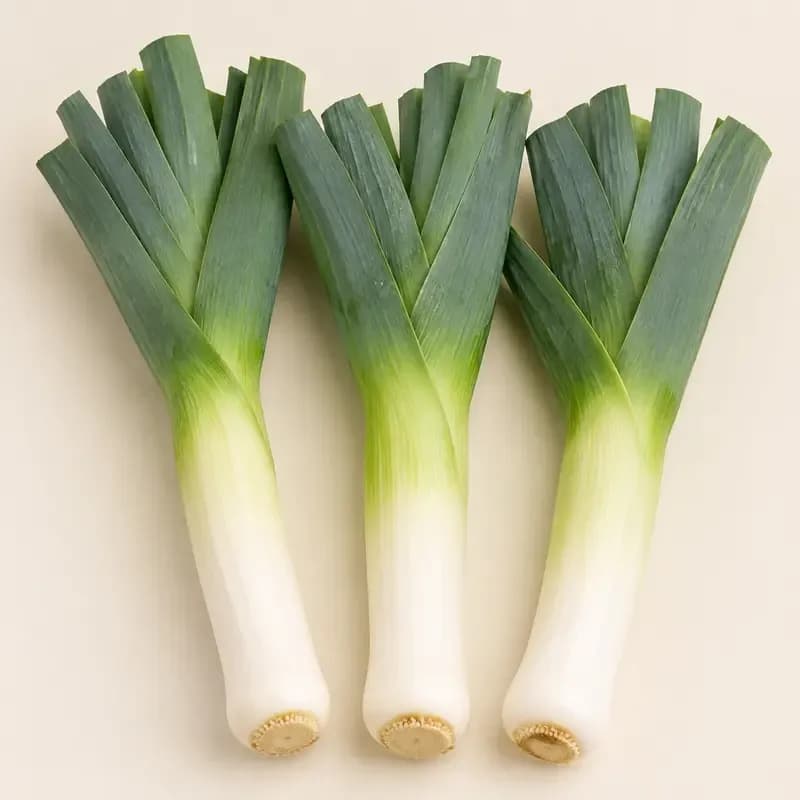
Leek
Allium ampeloprasum L. Leek Group
Leek, botanically classified as Allium ampeloprasum L. Leek Group and historically called Allium porrum, is a cool-season vegetable related to onions, garlic, shallots, and chives. Instead of producing the rounded storage bulb associated with an onion, a leek develops a long cylindrical shaft made from tightly overlapping leaf sheaths. Soil hilling or other blanching practices exclude light from the lower plant, creating the prized white and pale-green section. Its flavor is gently sweet, savory, and onion-like, with less pungency than most bulb onions. Slow cooking makes the layered tissues silky and mellow, while grilling or roasting creates caramelized edges. Raw young leek adds a crisp, sharper accent to salads and garnishes. The darker leaves are firmer but edible when sliced thinly, braised thoroughly, or used to flavor stocks, soups, and sauces. Leeks are central to dishes such as potato-leek soup, vichyssoise, cock-a-leekie soup, Welsh cawl, savory tarts, gratins, and braises. Raw leek supplies vitamin K, folate, vitamin B6, vitamin C, manganese, copper, iron, fiber, carotenoids, flavonoids, fructans, and characteristic Allium organosulfur compounds.
Leek Galeria de fotos
Explore Leek em detalhes
Leek - Vista principal
Leek Informações nutricionais
💊Vitaminas
Por 100 g
⚡Minerais
Por 100 g
Por porção
Detalhamento nutricional por porção
Benefícios para a saúde de Leek
Leek Origem e distribuição
The cultivated leek developed from Allium ampeloprasum populations native from Macaronesia and the Mediterranean region eastward into western and Central Asia
Leeks were domesticated from the broad Allium ampeloprasum complex, probably within the Mediterranean and western Asian region. Archaeological and written evidence indicates that leek-like alliums were known in ancient Egypt and Mesopotamia, and leeks were later valued by Greek and Roman societies as both food and seasoning. Cultivation spread throughout Europe, where farmers selected plants with increasingly long, thick, blanched shafts and reduced bulb formation. Distinct summer and winter forms developed to suit different climates and harvest periods. The leek became especially prominent in French, Belgian, Dutch, British, Balkan, Anatolian, and Middle Eastern cooking. It also acquired strong cultural significance in Wales, where it is a national emblem. Modern breeding emphasizes shaft length, cold tolerance, uniformity, disease resistance, color, and delayed bolting.
Leek Melhor época
Leeks are cool-season vegetables. Summer cultivars are harvested relatively early, while hardy winter types remain in the ground through cold weather; commercial production makes them available throughout much of the year.
Leek Variedades
Cada variedade oferece sabores, texturas e usos culinários únicos
American Flag
Giant Musselburgh
Bleu de Solaise
King Richard
Bulgarian Giant
Autumn Giant
Leek Guia de armazenamento e seleção
Mantenha a fruta fresca por mais tempo
Como escolher a fruta perfeita
Choose leeks with firm, straight shafts and tightly layered white and pale-green sections.
Look for crisp, fresh, dark-green leaves without extensive yellowing, wilting, slime, or decay.
Select smaller or medium leeks for tenderness and larger specimens for soups, braises, and recipes requiring substantial volume.
Avoid leeks with soft bases, split shafts, mold, sour odors, or flower stalks indicating advanced maturity.
Prefer bunches with roots and leaves that look recently harvested rather than dry or brittle.
Métodos de armazenamento
Refrigerate whole, unwashed leeks promptly in a perforated bag or loosely wrapped container at 4°C or below.
Do not seal dirty leeks in a completely airtight wet environment because trapped moisture can accelerate decay.
Store cut leeks in a covered container and use them within approximately 3 to 5 days.
Keep leeks separate from raw meat, poultry, seafood, eggs, and their juices.
Remove slimy or moldy portions promptly and discard leeks with extensive spoilage or foul odors.
Guia de validade
Preparation Tips
Trim the roots without removing so much of the base that the layered shaft falls apart.
Cut off damaged or excessively fibrous leaf tips, reserving sound dark-green portions for stocks and long-cooked dishes.
Split the leek lengthwise and fan the layers under cool running water because soil commonly collects deep inside the overlapping sheaths.
For sliced leeks, place the rings in a bowl of cool water, agitate them, lift them out, and repeat until no grit remains at the bottom.
Peel away tough, bruised, or slimy outer layers before cooking.
Slice tender white and pale-green sections thinly for quick cooking and cut tougher leaves more finely for braising or stock.
Do not wash leeks with soap, detergent, bleach, or household disinfectants.
Instruções para congelar
Preserve a frescura por meses
Trim the roots, remove damaged leaves, split or slice the leek, and wash thoroughly between the layers.
Blanch leek pieces in boiling water for approximately 1 to 2 minutes before freezing for longer storage.
Cool the blanched pieces immediately in ice water to stop cooking.
Drain and dry thoroughly, freeze pieces in a single layer, and transfer them to airtight freezer containers.
Use frozen leeks in soups, stews, sauces, casseroles, and braises because freezing softens their crisp texture.
Dica
Identifique itens congelados com a data para acompanhar a frescura. A maioria das frutas mantém a qualidade por 2-3 meses quando congelada corretamente. Para melhores resultados, use recipientes herméticos ou sacos próprios para congelador para evitar queimadura de freezer.
Jornada culinária
Descubra possibilidades deliciosas
Usos comuns
Combinações perfeitas
Receitas populares
Cooking Methods
Informações de segurança
Leek allergy is uncommon but possible. Because leek belongs to the Allium genus, people allergic to onion, garlic, chives, or related plants may experience cross-reactive symptoms. Reactions can include oral itching, hives, swelling, digestive symptoms, respiratory difficulty, or, rarely, anaphylaxis. Cooking does not guarantee safety for a person with a diagnosed allergy. Severe symptoms such as throat swelling, breathing difficulty, faintness, or widespread hives require urgent medical attention.
Pesticide use and measured residues vary by country, farm, season, and production method. Remove damaged outer leaves, split the shaft, and rinse thoroughly under running water because soil and residues may be trapped between layers. Washing can reduce dirt, microorganisms, and some surface residues but cannot remove every residue. Organic leeks should also be washed because organic cultivation does not eliminate microbial contamination.
- • People with a diagnosed leek or Allium allergy should avoid leeks unless an allergy specialist confirms they are safe.
- • People with irritable bowel syndrome or medically diagnosed fructan intolerance may need to limit portions under professional guidance.
- • People taking warfarin or another vitamin K antagonist should keep leek and other vitamin K intake consistent and consult their clinician before major dietary changes.
- • People with kidney disease who have been instructed to restrict potassium should ask their renal clinician or dietitian about suitable portions.
- • Anyone should avoid leeks that are slimy, moldy, foul-smelling, extensively decayed, recalled, or stored at unsafe temperatures.
- •Large portions may cause gas, bloating, cramping, or digestive discomfort because leeks contain fiber and fermentable fructans.
- •Leeks can trigger allergic symptoms in people sensitive to Allium vegetables.
- •Sudden major changes in intake may affect anticoagulation in people taking warfarin because leeks contain vitamin K.
- •Improperly washed raw leeks may carry soil and foodborne microorganisms between their tightly packed layers.
- •Leeks and other Allium vegetables can be toxic to dogs and cats, so scraps and prepared dishes should be kept away from pets.
- • Wash hands, knives, cutting boards, sinks, and other equipment before preparing leeks.
- • Keep leeks separate from raw meat, poultry, seafood, eggs, and their juices.
- • Split or slice leeks and rinse carefully between the layers under cool running water.
- • Do not use soap, detergent, bleach, or household disinfectants on leeks.
- • Refrigerate cooked leek dishes within two hours, or within one hour in very hot conditions.
- • Use refrigerated cooked leftovers within 3 to 4 days and reheat them thoroughly.
- • Discard leeks with slime, mold, foul odors, or extensive decay.
Curiosidades sobre Leek
Fatos surpreendentes que você vai amar!
A leek's familiar white shaft is formed by tightly overlapping leaf sheaths rather than by a true stem or rounded bulb.
Farmers blanch the lower portion by excluding light, often through soil hilling, deep planting, or protective sleeves.
Leeks belong to the same genus as onions, garlic, shallots, chives, and ramps.
Allium porrum remains a widely recognized name for leek, although modern taxonomy places it within Allium ampeloprasum.
The leek is one of the national emblems of Wales.
Vichyssoise is a smooth potato-leek soup commonly served chilled, while potato-leek soup may also be served hot.
Winter leek cultivars often have darker blue-green leaves and greater cold tolerance than early summer types.
Dark-green leek leaves can flavor stocks and broths, reducing food waste when they are clean and sound.
Cutting a leek releases enzymes that transform sulfur-containing precursors into many of its characteristic aroma compounds.
Perguntas frequentes
Is a leek the same thing as an onion?
ScienceA leek and a bulb onion are close relatives but are not the same crop. Leek is classified within Allium ampeloprasum, whereas the common bulb onion is Allium cepa. Both belong to the amaryllis family and produce sulfur-containing aroma compounds, but their structures differ. An onion stores reserves in a rounded bulb, while a leek forms an elongated shaft from overlapping leaf sheaths and ordinarily develops little obvious bulb. Leeks generally taste milder and sweeter after cooking, making them especially suitable for soups, braises, tarts, gratins, and gentle aromatic bases.
Which parts of a leek are edible?
GeneralThe white shaft, pale-green section, and sound dark-green leaves are all edible. The white and light-green tissues are the most tender, so recipes often favor them for sautés, soups, tarts, and braises. Dark-green leaves are firmer and may remain fibrous after short cooking, but they are useful when finely sliced and cooked thoroughly or added to stocks and broths. Tender young flower stalks and buds can also be eaten when available. Remove the roots, badly damaged tissue, slime, and exceptionally tough or dry leaf tips before preparation.
How do you clean grit from inside a leek?
PreparationTrim the roots and damaged leaf tips, then split the leek lengthwise through the layered shaft. Fan the layers apart under cool running water while rubbing away visible soil, particularly where the pale shaft turns green. For chopped leek, slice it first and place the pieces in a large bowl of cool water. Agitate gently so grit sinks, then lift the leek out rather than pouring the dirty water over it. Repeat if necessary and dry the pieces before sautéing. Do not use soap, bleach, detergent, or household disinfectants.
Can the dark-green tops of leeks be cooked?
PreparationYes. Dark-green leek leaves are edible, although they contain more structural fiber and are less tender than the blanched white shaft. Wash them carefully because soil can lodge between their layers. Slice them thinly across the grain for soups, stews, stir-fries, and long braises, or tie large pieces with herbs to flavor stock before removing them. Slow cooking softens the tissues more effectively than a brief sauté. Very old, dry, or exceptionally fibrous tips may be better composted, while slimy, moldy, or foul-smelling tissue should be discarded.
Are leeks healthier raw or cooked?
HealthBoth forms can fit a nutritious diet. Raw leek retains more heat-sensitive vitamin C and folate and offers a crisp texture with a sharper Allium flavor. Cooking softens its fibers, reduces pungency, and may make larger portions easier to eat. Boiling can move vitamin C, folate, and other water-soluble compounds into the cooking liquid, so using that liquid in soup reduces waste. Sautéing, steaming, roasting, or braising with a modest amount of fat can also help the body absorb carotenoids. The healthiest choice depends on the overall recipe and individual tolerance.
Why can leeks cause gas or bloating?
HealthLeeks contain fiber and fructans, carbohydrates that human digestive enzymes do not completely break down in the small intestine. Intestinal microbes ferment these compounds, producing gases and other metabolites. This process is normal and may support certain microbes, but it can cause bloating, discomfort, or altered bowel habits in sensitive people. Leeks are therefore considered a high-fructan food in many low-FODMAP approaches. Portion size and individual tolerance matter. People with irritable bowel syndrome should follow personalized advice rather than permanently eliminating broad food groups without appropriate nutritional guidance.
Can people taking warfarin eat leeks?
HealthRaw leek provides approximately 39% of the Daily Value for vitamin K per 100 g. Vitamin K can influence the action of warfarin and other vitamin K antagonist medicines. People taking these drugs generally do not need to eliminate leeks or nutritious vegetables automatically. Instead, clinicians commonly recommend keeping vitamin K intake reasonably consistent so the medicine can be dosed appropriately. Sudden major increases or decreases may alter anticoagulation. Anyone using an anticoagulant should follow instructions from the prescribing clinician or registered dietitian and should never change medication independently.
Are leeks a good source of folate during pregnancy?
HealthRaw leek supplies 64 mcg DFE of folate per 100 g, approximately 16% of the FDA Daily Value. Folate is required for DNA synthesis and cell division, and adequate intake around conception helps support normal fetal neural-tube development. Leeks can contribute to a varied diet containing leafy vegetables, legumes, citrus, fortified grains, and other folate sources. They should not be treated as a replacement for a clinician-recommended prenatal vitamin or folic acid supplement. Pregnant people should also wash leeks thoroughly and follow safe refrigeration and cooking practices.
How long do fresh leeks last in the refrigerator?
GeneralWhole, fresh leeks generally maintain good quality for about 7 to 14 days when refrigerated at 4°C or below in a perforated bag or loosely wrapped container. Store them unwashed unless they can be dried thoroughly, because trapped surface moisture encourages decay. Once cut or washed, place the pieces in a covered container and use them within approximately 3 to 5 days. Inspect leeks before use and discard those with slime, mold, extensive softness, or foul odors. Blanching and freezing are appropriate when surplus leeks cannot be used promptly.