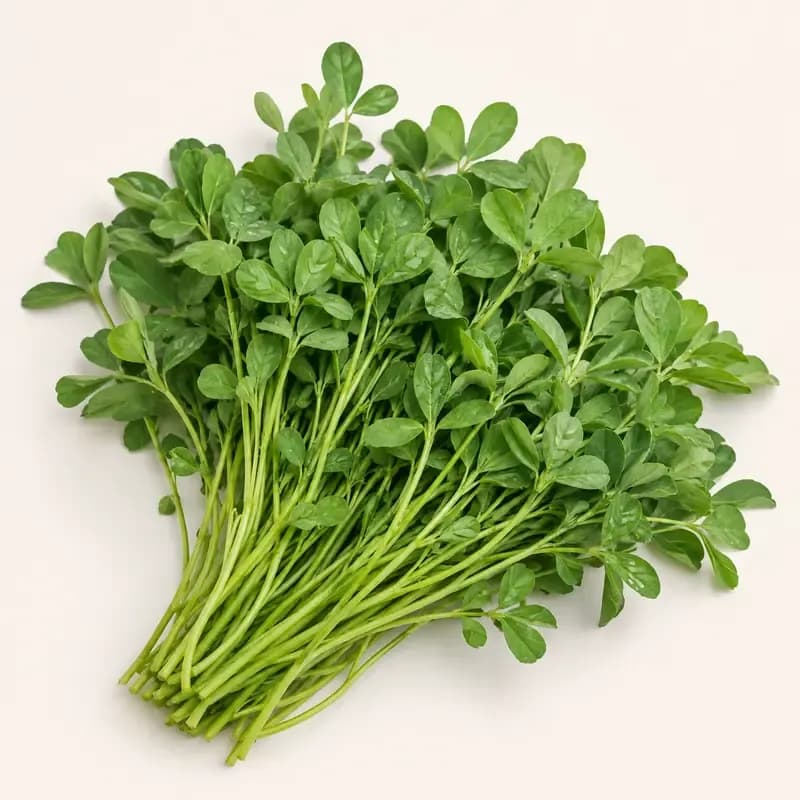
Fenugreek Leaves
Trigonella foenum-graecum L.
Fenugreek leaves, the fresh foliage of Trigonella foenum-graecum, are aromatic leafy vegetables belonging to the legume family, Fabaceae. They are widely known as methi in India and by regional names such as menthya, vendhaya keerai, shambalileh, helba, and hilbeh. Each leaf is divided into three small leaflets, giving the annual plant a clover-like appearance. Fresh leaves and tender stems have a complex flavor that is grassy, pleasantly bitter, mildly nutty, and subtly reminiscent of maple or caramel. This characteristic aroma is associated partly with sotolon and other volatile compounds. Fenugreek leaves are especially important in Indian, Pakistani, Iranian, Afghan, Middle Eastern, and North African cooking. They are sautéed, simmered, steamed, mixed into dough, cooked with potatoes or legumes, and dried to produce fragrant kasuri methi. Fresh leaves contain protein, vitamin C, provitamin A carotenoids, riboflavin, calcium, iron, phosphorus, fiber, flavonoids, saponins, and other phytochemicals. Fenugreek is also cultivated for its yellow-brown seeds, but fresh leaves, dried leaves, sprouts, and seeds have substantially different nutrient concentrations and culinary uses. The nutritional values presented here describe fresh raw leaves rather than dried kasuri methi or fenugreek seeds.
Fenugreek Leaves Galeria de fotos
Explore Fenugreek Leaves em detalhes
Fenugreek Leaves - Vista principal
Fenugreek Leaves Informações nutricionais
💊Vitaminas
Por 100 g
⚡Minerais
Por 100 g
Por porção
Detalhamento nutricional por porção
Benefícios para a saúde de Fenugreek Leaves
Fenugreek Leaves Origem e distribuição
Western Asia, with the accepted native range extending from Iraq to northern Pakistan
Fenugreek is one of the oldest cultivated herbs and legumes. Its accepted native range extends from Iraq to northern Pakistan, while domestication is generally associated with the ancient Near East and western Asia. Charred seeds recovered from archaeological sites in Iraq have been dated to approximately 4000 BCE, and fenugreek was known in ancient Egypt, the Levant, Greece, and Rome. The Latin name foenum-graecum means Greek hay, reflecting its historical use as fodder as well as food. Trade and migration carried fenugreek across the Mediterranean, North Africa, Ethiopia, Persia, Central Asia, and the Indian subcontinent. South Asian farmers developed numerous forms suited to leaf, seed, and dual-purpose production. Fresh methi became deeply integrated into regional vegetable dishes, flatbreads, lentils, pickles, and seasonal cooking, while dried kasuri methi developed into a concentrated aromatic seasoning. India is now the crop's most prominent producer, with Rajasthan serving as its principal seed-producing state.
Fenugreek Leaves Melhor época
Fenugreek is primarily a cool-season annual cultivated for fresh leaves during autumn, winter, and early spring. It can be grown during other seasons in moderate climates or protected environments.
Fenugreek Leaves Variedades
Cada variedade oferece sabores, texturas e usos culinários únicos
Common Methi
Kasuri Type
Pusa Early Bunching
Kasuri Supreme
CO 1
Lam Selection 1
Fenugreek Leaves Guia de armazenamento e seleção
Mantenha a fruta fresca por mais tempo
Como escolher a fruta perfeita
Choose bunches with crisp, vibrant green leaflets and tender, flexible stems.
Look for a fresh, characteristic fenugreek aroma without sour or fermented odors.
Select young shoots for tender cooking and a gentler bitterness.
Avoid bunches with slime, mold, extensive yellowing, blackened stems, or severe wilting.
Inspect packaged leaves for an intact seal, minimal excess condensation, and a valid use-by date.
Métodos de armazenamento
Refrigerate unwashed fenugreek leaves promptly at 4°C or below in a perforated bag or ventilated container.
Wrap the leaves loosely in a clean, dry absorbent towel to control condensation.
If the leaves have been washed, dry them thoroughly before storage because trapped moisture accelerates spoilage.
Keep fenugreek leaves separate from raw meat, poultry, seafood, eggs, and their juices.
Remove slimy, moldy, or extensively damaged leaves promptly so deterioration does not spread.
For longer storage, dry the leaves completely or freeze prepared portions.
Guia de validade
Preparation Tips
Pick the leaf clusters and tender upper stems from coarse, fibrous lower stems and roots.
Place the leaves in clean water briefly to loosen soil, then rinse them thoroughly under cool running water.
Repeat rinsing if grit remains between the small leaflets and stems.
Dry the leaves before sautéing to reduce splattering and prevent excessive steaming.
Chop the washed leaves shortly before cooking to limit moisture loss and discoloration.
To moderate bitterness, combine fenugreek leaves with potatoes, peas, lentils, dairy, mild sweetness, or acidic ingredients.
Do not wash fenugreek leaves with soap, detergent, bleach, or household disinfectants.
Instruções para congelar
Preserve a frescura por meses
Remove roots, coarse stems, yellow leaves, and damaged portions.
Wash the leaves thoroughly and dry them before freezing.
Blanch the leaves for approximately 1 minute, then cool them immediately in ice water.
Drain thoroughly and press out excess moisture before portioning into airtight containers or freezer bags.
Alternatively, sauté the chopped leaves briefly, cool them rapidly, and freeze them in recipe-sized portions.
Use frozen fenugreek leaves in curries, dals, soups, sauces, rice dishes, and doughs where a soft texture is acceptable.
Dica
Identifique itens congelados com a data para acompanhar a frescura. A maioria das frutas mantém a qualidade por 2-3 meses quando congelada corretamente. Para melhores resultados, use recipientes herméticos ou sacos próprios para congelador para evitar queimadura de freezer.
Jornada culinária
Descubra possibilidades deliciosas
Usos comuns
Combinações perfeitas
Receitas populares
Cooking Methods
Informações de segurança
Fenugreek can cause allergic reactions, and cross-reactivity may occur in people allergic to peanuts, chickpeas, or other legumes. Symptoms can include oral itching, hives, facial swelling, digestive distress, wheezing, breathing difficulty, or anaphylaxis. People with severe legume allergies should seek professional advice before consuming fenugreek. Breathing difficulty, throat swelling, faintness, or widespread hives requires urgent medical attention.
Pesticide use and measured residues vary by country, farm, season, and production method. Remove roots and damaged material, then rinse the leaves thoroughly under running water while separating the small leaflets and stems. Washing can reduce soil, microorganisms, and some surface residues but cannot remove every residue. Organic fenugreek leaves should also be washed because organic production does not eliminate microbial contamination.
- • People with a diagnosed fenugreek allergy should avoid its fresh leaves, dried leaves, seeds, sprouts, and extracts.
- • People with severe peanut, chickpea, or other legume allergies should consult an allergy specialist before trying fenugreek.
- • Pregnant people should avoid medicinal quantities and concentrated fenugreek products unless specifically approved by their clinician.
- • People taking glucose-lowering medicine should consult their clinician before using concentrated fenugreek powders, extracts, or unusually large daily quantities.
- • People taking anticoagulant or antiplatelet medicine should discuss concentrated fenugreek products with a clinician or pharmacist.
- • Anyone should avoid leaves that are slimy, moldy, foul-smelling, extensively decayed, recalled, or stored at unsafe temperatures.
- •Large servings may cause gas, bloating, diarrhea, abdominal discomfort, or nausea in sensitive individuals.
- •Fenugreek's aromatic compounds may impart a maple-like odor to perspiration, urine, or breast milk, particularly after concentrated intake.
- •Concentrated seed products may lower blood glucose and could add to the effects of diabetes medicines.
- •Concentrated fenugreek preparations may interact with anticoagulant or antiplatelet medicines, although ordinary culinary leaf portions are less concentrated.
- •Raw fenugreek sprouts carry the general microbial risks associated with sprouts and have been linked historically to serious foodborne outbreaks.
- •Improperly handled fresh leaves can transmit foodborne microorganisms.
- • Wash hands, knives, cutting boards, sinks, bowls, and other equipment before preparing fenugreek leaves.
- • Keep the leaves separate from raw meat, poultry, seafood, eggs, and their juices.
- • Rinse leaves under cool running water without using soap, detergent, bleach, or household disinfectants.
- • People at increased risk from foodborne illness should avoid raw fenugreek sprouts unless they have been cooked thoroughly.
- • Refrigerate cooked fenugreek dishes within two hours, or within one hour in very hot conditions.
- • Use refrigerated cooked leftovers within 3 to 4 days and reheat them thoroughly.
- • Discard fenugreek leaves with slime, mold, foul odors, or extensive decay.
Curiosidades sobre Fenugreek Leaves
Fatos surpreendentes que você vai amar!
Fenugreek belongs to the legume family alongside peas, beans, chickpeas, peanuts, and lentils.
Each fenugreek leaf is divided into three leaflets, creating a clover-like appearance.
The name foenum-graecum means Greek hay in Latin.
Fenugreek has been cultivated for thousands of years in western Asia and neighboring regions.
Archaeologists have recovered ancient fenugreek seeds from sites in Iraq and Egypt.
Sotolon contributes maple-like, caramel, and curry aromas to fenugreek.
Fresh methi is eaten as a vegetable, while kasuri methi is dried and used as a concentrated seasoning.
Fenugreek can be harvested as microgreens, fresh leaves, fodder, or mature seeds.
Cutting above the growing point can allow certain fenugreek varieties to produce additional leafy growth.
Kasuri methi is commonly crushed between the palms before use to release its aroma.
Perguntas frequentes
Are fenugreek leaves and fenugreek seeds the same ingredient?
GeneralFenugreek leaves and seeds come from the same plant, Trigonella foenum-graecum, but they are not interchangeable in equal quantities. Fresh leaves are cooked as a leafy vegetable and have a grassy, gently bitter flavor. Dried leaves, called kasuri methi, are more concentrated and are usually crushed into dishes in small amounts. The hard yellow-brown seeds have a stronger bitter, nutty, and maple-like aroma and are used whole, roasted, ground, sprouted, or extracted. Their moisture, calories, fiber, protein, minerals, phytochemicals, serving sizes, and safety considerations differ substantially.
What is the difference between fresh methi and kasuri methi?
GeneralFresh methi consists of recently harvested fenugreek leaves and tender stems. It is treated as a vegetable and used in dishes such as aloo methi, dal, rice, and flatbreads. Kasuri methi is dried fenugreek leaf, traditionally associated with the Kasur region of Punjab. Drying removes water and concentrates its aroma, so kasuri methi is normally used by the spoonful rather than as a full serving of greens. Crushing dried leaves between the palms before adding them releases their fragrance. Nutritional values for fresh leaves cannot be applied directly to dried kasuri methi.
How should fresh fenugreek leaves be cleaned and prepared?
PreparationRemove roots, coarse lower stems, yellow leaves, and damaged portions. Tender upper stems may be retained. Because soil can cling between the small leaflets, place the leaves briefly in a large bowl of clean water to loosen grit, lift them out rather than pouring the dirty water over them, and then rinse thoroughly under cool running water. Repeat if sediment remains. Do not use soap, detergent, bleach, or household disinfectants. Dry the leaves before sautéing, and chop them shortly before cooking. Clean hands, knives, boards, bowls, and towels help prevent cross-contamination.
How can the bitterness of fenugreek leaves be reduced?
PreparationStart with young, fresh leaves, which are usually more tender and less bitter than mature foliage. Remove coarse stems and avoid overcooking, which can make the flavor dull and harsh. Pair the leaves with potatoes, peas, onions, tomatoes, lentils, paneer, yogurt, cream, whole grains, or a small amount of sweetness. Lemon juice, amchur, or tomatoes add acidity that creates balance. Some cooks sprinkle chopped leaves lightly with salt and squeeze out moisture, but this also removes flavor and adds sodium, so it is optional rather than necessary.
What causes the distinctive smell of fenugreek leaves?
ScienceFenugreek produces numerous volatile compounds, including sotolon, a powerful aroma molecule associated with maple, caramel, curry, and toasted sugar notes. Sotolon is detectable at very low concentrations and contributes to the recognizable smell of both leaves and seeds, although their overall aroma profiles differ. Cultivar, growing conditions, plant maturity, drying, roasting, storage, and cooking alter the final fragrance. Fenugreek also contains saponins, alkaloids, flavonoids, and other compounds that contribute bitterness and complexity. The characteristic smell may occasionally be noticeable in perspiration or urine after consuming concentrated fenugreek products.
Are fresh fenugreek leaves healthy?
HealthFresh fenugreek leaves can contribute protein, vitamin C, beta-carotene, riboflavin, calcium, iron, phosphorus, fiber, and diverse phytochemicals. They are flavorful enough to enrich dishes without requiring large amounts of salt or rich sauce, although the final recipe determines its overall nutrition. Fresh leaves should not be confused with concentrated seed powders, extracts, or supplements used in clinical studies. Evidence concerning supplemental fenugreek and blood glucose, cholesterol, lactation, or other conditions cannot be transferred automatically to an ordinary serving of cooked leaves, and fenugreek should not replace prescribed medical treatment.
Can people with peanut or chickpea allergy eat fenugreek leaves?
HealthFenugreek belongs to the legume family, and allergic reactions have been reported, including cross-reactivity in some people allergic to peanuts or chickpeas. A person with a severe legume allergy should not assume fenugreek is safe simply because it is used as an herb or vegetable. An allergist can assess individual risk and determine whether supervised testing is appropriate. Possible symptoms include oral itching, hives, facial swelling, vomiting, wheezing, breathing difficulty, or anaphylaxis. Throat swelling, difficulty breathing, faintness, or widespread hives requires urgent medical attention.
Are fenugreek leaves safe during pregnancy and breastfeeding?
HealthFenugreek leaves used in ordinary cooked-food quantities are different from concentrated seed powders, teas, extracts, and supplements. High or medicinal fenugreek intake is generally discouraged during pregnancy because safety is uncertain and concentrated preparations have been associated with uterine effects in traditional and experimental contexts. Fenugreek is also promoted as a lactation aid, but evidence for effectiveness and safety is limited, and allergic reactions, digestive symptoms, medication interactions, and changes in body odor can occur. Pregnant or breastfeeding people should discuss supplements or unusually large daily amounts with their clinician.