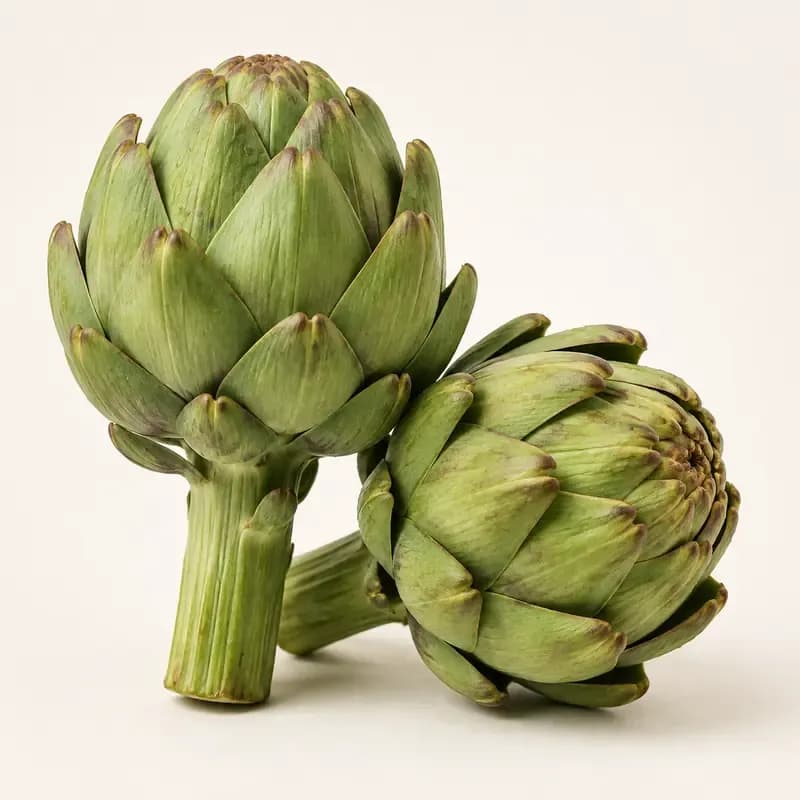
Artichoke
Cynara cardunculus L. Scolymus Group
The globe artichoke, scientifically classified as Cynara cardunculus Scolymus Group and also known by the synonym Cynara scolymus, is a cultivated Mediterranean thistle harvested for its immature flower head. What appears to be a single flower is actually a compact inflorescence composed of overlapping protective bracts surrounding many undeveloped florets. The edible portions include the tender bases of the bracts, the fleshy receptacle known as the heart, and the peeled upper stem. The fibrous central choke of a mature artichoke is removed before eating. Fresh artichokes have an earthy, nutty, mildly bitter flavor that can seem subtly sweet after each bite because compounds such as cynarin temporarily influence taste perception. Green, purple, round, elongated, smooth, and spiny cultivars are grown throughout Mediterranean climates and other suitable regions. Artichokes may be steamed, boiled, pressure-cooked, roasted, grilled, braised, baked, fried, stuffed, marinated, or eaten raw when exceptionally young and tender. Raw globe artichoke provides substantial fiber, copper, folate, magnesium, vitamin C, vitamin K, manganese, potassium, iron, phosphorus, niacin, pantothenic acid, vitamin B6, thiamin, zinc, and protein. It also contains inulin-type fructans, chlorogenic acid, cynarin, luteolin compounds, and other polyphenols.
Artichoke Galeria de fotos
Explore Artichoke em detalhes
Artichoke - Vista principal
Artichoke Informações nutricionais
💊Vitaminas
Por 100 g
⚡Minerais
Por 100 g
Por porção
Detalhamento nutricional por porção
Benefícios para a saúde de Artichoke
Artichoke Origem e distribuição
The Mediterranean basin, where globe artichoke was domesticated from wild cardoon
Globe artichoke was domesticated from wild cardoon, Cynara cardunculus, in the Mediterranean region. Classical Greek and Roman writers described cultivated thistles, although scholars continue to debate whether every ancient reference represented the fully domesticated globe artichoke or cardoon-like predecessors. Selection for enlarged flower heads likely occurred over centuries in North Africa, Sicily, southern Italy, and other Mediterranean centers. Medieval Islamic agriculture contributed to the crop's preservation, improvement, terminology, and movement around the Mediterranean. The English word artichoke ultimately reflects an Arabic linguistic origin transmitted through Spanish and Italian. By the Renaissance, artichokes had become fashionable in Italian and French cuisine and later spread throughout Europe. Spanish, Italian, and French settlers carried them to the Americas. Coastal California became a notable production region because its cool, foggy Mediterranean climate favors perennial cultivation. Modern cultivars may be propagated vegetatively or grown from seed, and some seed-grown types can produce buds during their first year.
Artichoke Melhor época
Globe artichokes grow best under mild Mediterranean conditions. The principal harvest is usually during spring, with a smaller autumn crop possible in some climates and cultivars.
Artichoke Variedades
Cada variedade oferece sabores, texturas e usos culinários únicos
Green Globe
Imperial Star
Violet de Provence
Romanesco
Spinoso Sardo
Blanca de Tudela
Camus de Bretagne
Artichoke Guia de armazenamento e seleção
Mantenha a fruta fresca por mais tempo
Como escolher a fruta perfeita
Choose artichokes that feel heavy and dense for their size, indicating good internal moisture.
Look for tightly closed bracts rather than widely spreading, dry, or flowering heads.
Gently squeeze the head; fresh bracts may produce a faint squeaking sound as they rub together.
Select stems that look freshly cut and firm rather than hollow, blackened, or severely dried.
Minor surface browning from cold weather may not affect eating quality, but avoid slime, mold, soft rot, and sour odors.
Choose small baby artichokes for whole-heart preparations and large mature heads for steaming, stuffing, or serving leaf by leaf.
Métodos de armazenamento
Refrigerate unwashed whole artichokes promptly at 4°C or below in a perforated bag or ventilated container.
Sprinkle the stems lightly with water or wrap them in a clean, slightly damp towel without soaking the flower heads.
Keep artichokes whole until preparation because cut surfaces brown and lose moisture quickly.
Store cooked hearts in a covered refrigerator container and protect them from cross-contamination.
Keep artichokes separate from raw meat, poultry, seafood, eggs, and their juices.
Discard heads with slime, mold, foul odors, or extensive soft decay.
Guia de validade
Preparation Tips
Rinse the whole artichoke under cool running water while gently opening the outer bracts so trapped soil can be removed.
Trim the dry stem end but retain part of the stem when desired; peel away its fibrous exterior because the inner core can be tender.
Remove tough lower bracts and use kitchen shears to snip sharp tips from the remaining leaves.
Cut off the upper portion of a mature head when a flat surface is needed for steaming or stuffing.
Rub cut surfaces with lemon or place them in acidulated water to slow enzymatic browning.
After cooking or halving a raw head, remove the fibrous choke with a spoon before serving the heart.
Wear gloves if artichoke sap irritates the skin or if handling large quantities.
Do not wash artichokes with soap, detergent, bleach, or household disinfectants.
Instruções para congelar
Preserve a frescura por meses
Do not freeze whole raw artichokes without preparation because texture, color, and flavor deteriorate.
Trim and prepare the hearts, placing cut surfaces in acidulated water to slow browning.
Blanch small hearts for approximately 3 to 5 minutes depending on size.
Cool immediately in ice water and drain thoroughly.
Freeze hearts in airtight containers or bags with excess air removed and label with the date.
Use frozen artichoke hearts in soups, pasta, casseroles, dips, braises, and roasted dishes.
Dica
Identifique itens congelados com a data para acompanhar a frescura. A maioria das frutas mantém a qualidade por 2-3 meses quando congelada corretamente. Para melhores resultados, use recipientes herméticos ou sacos próprios para congelador para evitar queimadura de freezer.
Jornada culinária
Descubra possibilidades deliciosas
Usos comuns
Combinações perfeitas
Receitas populares
Cooking Methods
Informações de segurança
Artichoke allergy is uncommon but possible. The plant belongs to the Asteraceae family, so cross-reactivity may occur in people allergic to ragweed, chamomile, chrysanthemum, sunflower, or related plants. Reactions can include oral itching, hives, swelling, digestive symptoms, wheezing, breathing difficulty, or anaphylaxis. Raw plant sap can also cause contact irritation. Severe symptoms require urgent medical attention.
Pesticide use and measured residues vary by country, farm, season, and production method. Rinse the whole flower head thoroughly under running water while gently opening the outer bracts. Washing can reduce soil, microorganisms, and some surface residues but cannot remove every residue. Organic artichokes should also be washed because organic production does not eliminate microbial contamination.
- • People with a diagnosed artichoke allergy should avoid the vegetable and related extracts unless cleared by an allergy specialist.
- • People with severe Asteraceae-family allergies should seek professional advice before trying artichoke.
- • People following a medically supervised low-FODMAP diet may need to limit artichokes because they contain fermentable fructans.
- • People with a blocked bile duct, gallstone complications, or serious gallbladder disease should consult a clinician before using concentrated artichoke-leaf extracts.
- • People with kidney disease who have been instructed to restrict potassium should ask their renal clinician or dietitian about appropriate portions.
- • Anyone should avoid artichokes that are slimy, moldy, foul-smelling, extensively decayed, recalled, or stored at unsafe temperatures.
- •Inulin-type fructans can cause gas, bloating, cramping, or diarrhea in sensitive individuals.
- •Large portions may cause digestive discomfort in people unaccustomed to fiber-rich foods.
- •Raw artichoke sap may cause contact irritation or allergic dermatitis in susceptible individuals.
- •The fibrous choke and tough bracts are unpleasant to swallow and may present a choking hazard if not removed or eaten correctly.
- •Canned, brined, or marinated artichokes may contain substantial sodium or added oil.
- •Improperly handled fresh or preserved artichokes can transmit foodborne microorganisms.
- • Wash hands, knives, kitchen shears, cutting boards, sinks, and storage containers before preparation.
- • Keep artichokes separate from raw meat, poultry, seafood, eggs, and their juices.
- • Rinse whole heads under cool running water without using soap, detergent, bleach, or household disinfectants.
- • Use care around spiny bract tips and trim them with kitchen shears when necessary.
- • Remove the fibrous choke from mature artichokes before eating the heart.
- • Refrigerate cooked artichokes within two hours, or within one hour in very hot conditions.
- • Use refrigerated cooked leftovers within 3 to 4 days.
- • Discard artichokes with slime, mold, foul odors, or extensive soft decay.
Curiosidades sobre Artichoke
Fatos surpreendentes que você vai amar!
A globe artichoke is an immature flower head belonging to the thistle family.
If left unharvested, the bud opens into a large purple thistle-like flower.
The artichoke heart is botanically the fleshy receptacle supporting the developing florets.
Globe artichoke and cardoon belong to the same species but were selected for different edible structures.
The word artichoke entered European languages through an Arabic linguistic route.
Cynarin can make plain water taste temporarily sweet after an artichoke is eaten.
Many traditional artichoke cultivars are propagated from plant divisions rather than seed.
Baby artichokes are usually immature side buds rather than miniature mature varieties.
Purple cultivars contain anthocyanin pigments in their bracts.
Castroville, California, is widely associated with commercial artichoke production in the United States.
Perguntas frequentes
What part of an artichoke is edible?
ScienceA globe artichoke is an immature flower head. On a mature head, the edible portions are the fleshy base of each bract, the tender inner bracts, the peeled center of the upper stem, and the thick flower receptacle known as the heart. The fibrous choke sitting above the heart is composed of immature florets and should be removed before the heart is eaten. Most of each tough outer bract is discarded after its tender base is scraped off with the teeth. Very young baby artichokes may have little or no developed fibrous choke.
How do you prepare a whole artichoke for cooking?
PreparationRinse the head thoroughly while gently separating the bracts so water reaches hidden areas. Trim the dry stem end, peel the remaining stem if it will be eaten, and pull away the toughest lower bracts. Use kitchen shears to remove sharp leaf tips, then cut a small portion from the top if desired. Rub cut surfaces with lemon to slow browning. The artichoke can then be steamed, boiled, pressure-cooked, stuffed, or partly cooked before grilling. Remove the fibrous choke before serving the heart, especially from mature heads.
How can you tell when a cooked artichoke is done?
PreparationA whole artichoke is ready when an outer bract pulls away with gentle resistance and the fleshy base is tender when scraped or bitten. A knife or skewer should enter the stem and heart without encountering a hard, raw center. Cooking time varies widely with size, maturity, freshness, and method. Small heads may steam within about 20 to 30 minutes, while large heads can require 40 minutes or longer. Pressure cooking is faster. Avoid relying only on color because some cultivars remain green or purple even when fully tender.
What is the difference between a globe artichoke and a Jerusalem artichoke?
ScienceGlobe artichoke and Jerusalem artichoke are unrelated vegetables. Globe artichoke is Cynara cardunculus Scolymus Group, a Mediterranean thistle cultivated for its immature flower heads. Jerusalem artichoke is Helianthus tuberosus, a North American sunflower cultivated for underground tubers. Globe artichokes provide edible bract bases and hearts, while Jerusalem artichokes are scrubbed or peeled and cooked more like potatoes. Both contain fermentable inulin-type carbohydrates, but their appearance, botanical families, edible organs, flavors, preparation methods, and nutritional profiles are substantially different.
Why can water or wine taste sweet after eating artichoke?
ScienceArtichokes contain cynarin and related caffeoylquinic compounds that may temporarily alter taste perception. After eating an artichoke, plain water, wine, or another food can seem unusually sweet even though no sugar was added. One explanation is that certain compounds initially suppress sweet-receptor activity and create a contrasting sweet sensation when they are rinsed away. This effect varies among individuals and can make wine pairing challenging because a dry wine may taste sweeter or otherwise different after each bite. The sensation is temporary and harmless.
Are artichokes good for digestion?
HealthWhole artichokes provide substantial dietary fiber, including fermentable inulin-type fructans. Fiber supports bowel regularity and adds bulk to intestinal contents. Fermentable carbohydrates can also serve as substrates for certain intestinal microorganisms. However, the same fermentation may produce gas, bloating, cramping, or diarrhea in people with irritable bowel syndrome or fructan sensitivity. Artichoke-leaf extracts marketed for digestion are concentrated products and should not be treated as equivalent to eating the vegetable. Persistent digestive symptoms require professional evaluation rather than self-treatment with supplements.
Can artichokes be eaten during pregnancy?
HealthProperly handled and cooked artichokes can be included in a varied pregnancy diet. Raw globe artichoke provides approximately 17% of the FDA Daily Value for folate per 100 g, along with fiber, copper, magnesium, vitamin C, and other nutrients. Folate supports DNA synthesis and cell division, but artichokes do not replace prenatal folic-acid supplementation recommended by a clinician. Pregnant people should wash fresh artichokes thoroughly, avoid cross-contamination, refrigerate leftovers promptly, and be cautious with unpasteurized dressings or improperly stored marinated products.
Can people with ragweed allergy react to artichokes?
HealthArtichokes belong to the Asteraceae family alongside ragweed, chamomile, chrysanthemum, sunflower, and several other plants. Allergy to artichoke is uncommon, but cross-reactivity may occur in sensitized individuals. Symptoms can include oral itching, hives, swelling, digestive distress, wheezing, or, rarely, anaphylaxis. Contact with raw plant sap may also irritate some people's skin. A person with severe Asteraceae allergy should seek advice from an allergy specialist before trying artichoke. Breathing difficulty, throat swelling, faintness, or widespread hives requires urgent medical attention.
How long do fresh artichokes last in the refrigerator?
GeneralFresh whole artichokes generally maintain their best quality for approximately four to seven days when refrigerated at 4°C or below. Store them unwashed in a perforated bag or ventilated container, and keep the stem slightly moist without soaking the flower head. Prepared raw hearts brown quickly and should be kept briefly in acidulated water before cooking. Cooked artichokes should be refrigerated within two hours and used within three to four days. Discard heads or hearts that become slimy, moldy, foul-smelling, or affected by extensive soft rot.