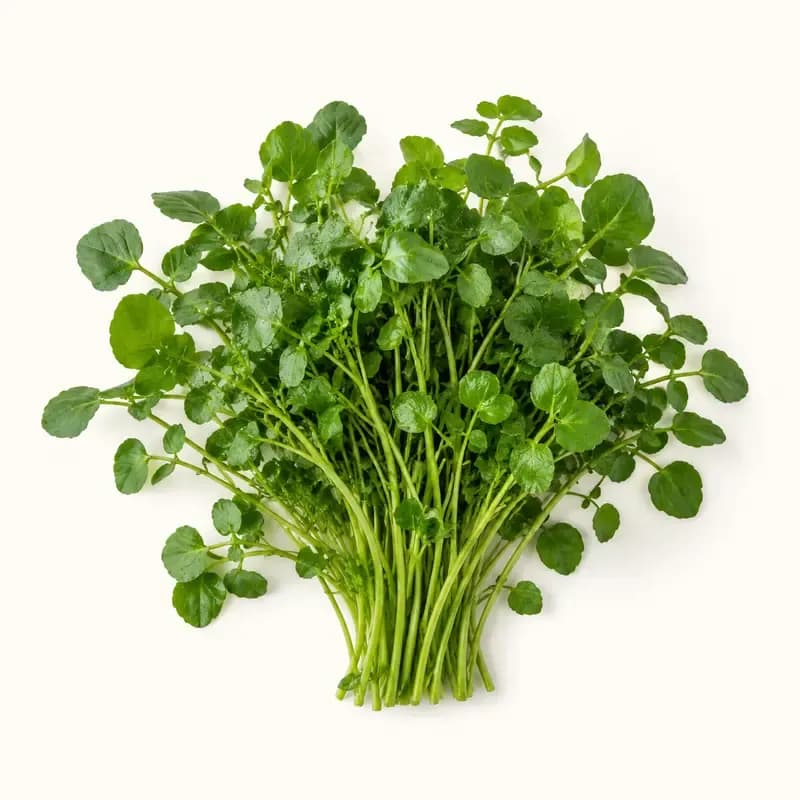
Watercress
Nasturtium officinale W.T.Aiton
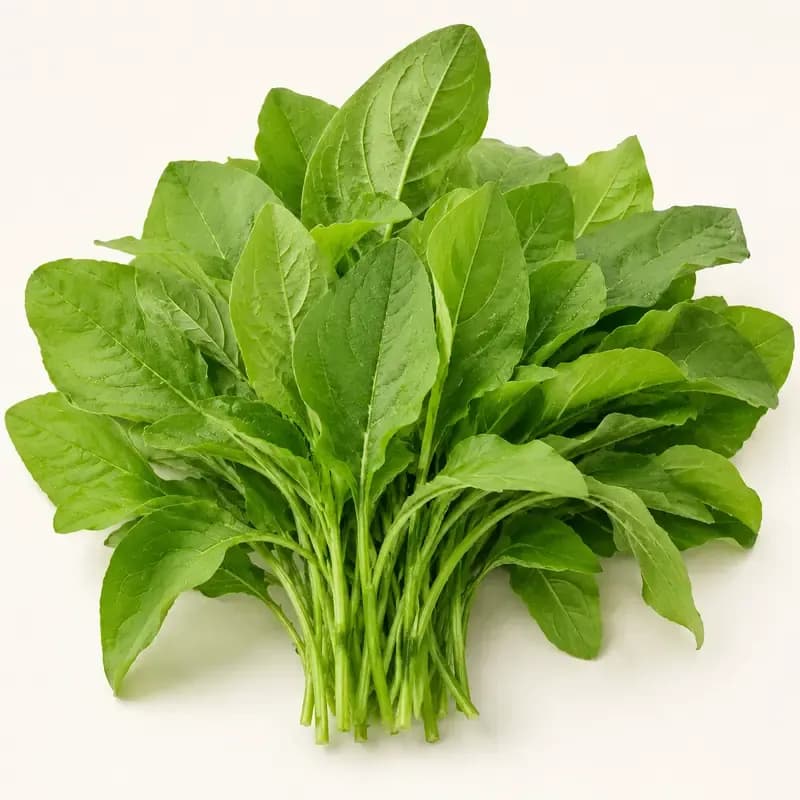
Watercress, scientifically known as Nasturtium officinale, is a fast-growing aquatic or semi-aquatic leafy vegetable in the mustard family, Brassicaceae. It is also called yellowcress, water rocket, and true watercress. The perennial plant develops creeping or floating hollow stems bearing clusters of smooth, rounded, deep-green leaflets and small white flowers. Its leaves, tender stems, young shoots, flower buds, and flowers are edible. Fresh watercress has a bright, peppery, slightly bitter flavor created partly by glucosinolates and their pungent breakdown products. Young shoots are generally milder, while mature or flowering plants can taste stronger. Watercress is eaten raw in salads and sandwiches, blended into sauces and soups, or briefly sautéed, steamed, simmered, and wilted. Raw watercress contains approximately 95% water and provides vitamin K, vitamin C, provitamin A carotenoids, manganese, calcium, riboflavin, copper, thiamin, vitamin B6, potassium, magnesium, phosphorus, and protein for very few calories. Native to Eurasia and neighboring parts of northern Africa, it has been cultivated and naturalized across many temperate regions. Commercial watercress is commonly produced in carefully managed flowing-water beds or hydroponic systems because wild plants from contaminated waterways can carry dangerous microorganisms or liver-fluke parasites.
Watercress फोटो गैलरी
Watercress को शानदार विवरण में देखें
Watercress - मुख्य दृश्य
Watercress पोषण तथ्य
💊विटामिन
प्रति 100 ग्राम
⚡खनिज
प्रति 100 ग्राम
प्रति सर्विंग
एक सर्विंग का पोषण विवरण
Watercress के स्वास्थ्य लाभ
Watercress उत्पत्ति और वितरण
Eurasia and adjoining parts of northern Africa, extending from Europe and the Mediterranean region into western and central Asia
Watercress is regarded as one of the oldest leafy vegetables eaten by humans. Wild populations occur across Eurasia and parts of northern Africa, where people historically gathered the plant from springs, streams, and wet ground. Ancient Greek and Roman traditions used watercress as both food and a medicinal herb, although historical remedies should not be treated as modern clinical evidence. The plant continued to be cultivated in European gardens and waterways through the medieval period. Commercial watercress production became especially prominent in England during the nineteenth century, with cultivation documented in Kent in 1808 and later concentrated around the chalk streams of southern England. Rail transport carried fresh bunches rapidly to urban markets, and a Hampshire railway became known as the Watercress Line. Cultivation later expanded globally through irrigated beds, recirculating hydroponics, greenhouses, and indoor farms designed to provide clean water, predictable nutrition, and year-round harvests.
Watercress पीक सीज़न
Watercress favors cool conditions and can be harvested during much of the year where clean flowing water or controlled hydroponic production is available. Growth is often strongest during spring and autumn.
Watercress किस्में
हर किस्म का स्वाद, बनावट और उपयोग अलग होता है
Common Watercress
Aqua Watercress
Large-Leaved Watercress
Onerow Watercress
Hybrid Watercress
Boldrewood Dwarf Watercress
Watercress स्टोरेज और चयन गाइड
फलों को अधिक समय तक ताज़ा रखें
सही फल कैसे चुनें
Choose watercress with crisp, vibrant green leaves and firm, succulent stems.
Look for fresh bunches without extensive yellowing, browning, bruising, or flowering.
Select young shoots for a milder flavor and mature bunches when stronger pepperiness is preferred.
Avoid watercress with slime, mold, sour odors, extensive wilting, or blackened stem ends.
Purchase commercially cultivated watercress from a traceable supplier rather than gathering it from an unknown stream or irrigation channel.
Inspect packaged watercress for an intact seal, a valid use-by date, and minimal excessive condensation.
सही स्टोरेज तरीके
Refrigerate watercress promptly at 4°C or below because its tender leaves deteriorate quickly.
Store the stems wrapped loosely in a clean, slightly damp towel inside a ventilated container or perforated bag.
Alternatively, place freshly cut stem ends in a small container of clean water, cover the leaves loosely, and refrigerate, changing the water daily.
If the watercress has been washed, dry it carefully before storage to prevent excessive surface moisture and decay.
Keep watercress separate from raw meat, poultry, seafood, eggs, and their juices.
Remove slimy or decayed pieces promptly to prevent spoilage from spreading.
शेल्फ लाइफ गाइड
Preparation Tips
Purchase commercially cultivated watercress from a reputable supplier and do not eat wild watercress collected from unknown waterways.
Remove roots, coarse stem ends, yellow leaves, slime, and damaged portions.
Rinse the leaves and stems thoroughly under cool running water while separating the bunch to remove grit and insects.
Dry watercress in a clean salad spinner or with clean towels when using it in salads or sandwiches.
Retain tender hollow stems because they are edible and provide a crisp texture.
Add watercress near the end of cooking because the leaves wilt rapidly and prolonged heating softens its flavor.
Blanch briefly before freezing or before adding it to recipes requiring very short final cooking.
Do not use soap, detergent, bleach, or household disinfectants to wash watercress.
फ्रीज़ करने के निर्देश
कई महीनों तक ताज़गी बनाए रखें
Freezing is unsuitable for watercress intended for salads because thawed leaves lose their crisp texture.
Wash commercially cultivated watercress thoroughly and trim damaged portions before freezing.
Blanch the leaves and tender stems for approximately 1 to 2 minutes, then cool immediately in ice water.
Drain thoroughly, press out excess moisture, and freeze in airtight portions.
Alternatively, puree clean watercress with a small amount of water or oil and freeze it in cubes.
Use frozen watercress in soups, sauces, purees, casseroles, and other cooked dishes.
प्रो टिप
ताज़गी ट्रैक करने के लिए जमे हुए आइटम पर तारीख लिखें। सही तरीके से फ्रीज़ करने पर अधिकांश फल 2-3 महीनों तक गुणवत्ता बनाए रखते हैं। फ्रीज़र बर्न से बचने के लिए एयरटाइट कंटेनर या फ्रीज़र बैग का उपयोग करें।
पाक यात्रा
स्वादिष्ट विकल्प खोजें
सामान्य उपयोग
परफेक्ट पेयरिंग
लोकप्रिय रेसिपी
Cooking Methods
ताज़ा पेय
सुरक्षा जानकारी
Allergy to watercress is uncommon but possible. Reactions may involve oral itching, hives, swelling, digestive symptoms, breathing difficulty, or, rarely, anaphylaxis. People allergic to mustard or other Brassicaceae vegetables may require professional evaluation because cross-reactivity is possible. Breathing difficulty, throat swelling, faintness, or widespread hives requires urgent medical attention.
Pesticide use and measured residues vary by country, farm, season, and production system. Rinse commercially cultivated watercress thoroughly under running water while separating the leaves and stems. Washing can reduce soil, microorganisms, and some surface residues but cannot remove every residue or make contaminated wild watercress reliably safe. Organic watercress should also be handled carefully because organic production does not eliminate microbial or parasitic contamination.
- • People with a diagnosed watercress or mustard-family vegetable allergy should avoid it unless cleared by an allergy specialist.
- • People taking warfarin or another vitamin K antagonist should maintain a consistent intake and consult their clinician before making major dietary changes.
- • People with weakened immune systems, pregnant people, older adults, and young children should avoid raw wild watercress and watercress from an uncertain source.
- • People with kidney disease who have been instructed to restrict potassium should ask their renal clinician or dietitian about appropriate portions.
- • People taking medicines with a known potential interaction involving CYP2E1 should discuss unusually large or concentrated watercress intake with a pharmacist or clinician.
- • Anyone should avoid watercress that is slimy, moldy, foul-smelling, extensively decayed, recalled, or stored at unsafe temperatures.
- •Large servings may cause gas, bloating, or digestive discomfort because watercress contains fiber and fermentable carbohydrates.
- •Its pungent compounds may irritate the mouth, throat, or stomach of sensitive individuals when consumed raw in large quantities.
- •Sudden changes in intake can affect anticoagulation in people taking warfarin because watercress is exceptionally rich in vitamin K.
- •Raw wild watercress contaminated with Fasciola larvae can transmit fascioliasis, a potentially serious liver-fluke infection.
- •Improperly grown, washed, or stored watercress can transmit foodborne microorganisms.
- •Concentrated extracts or unusually large medicinal quantities may have effects and interactions that cannot be assumed from ordinary culinary use.
- • Purchase commercially cultivated watercress from a traceable source rather than gathering it from streams, ditches, ponds, or livestock-grazing areas.
- • Wash hands, knives, cutting boards, sinks, salad spinners, and bowls before preparation.
- • Keep watercress separate from raw meat, poultry, seafood, eggs, and their juices.
- • Rinse unwashed commercial watercress under cool running water without using soap, detergent, bleach, or household disinfectants.
- • Do not rely on washing alone to make wild watercress from a potentially contaminated waterway safe.
- • Cook watercress thoroughly when its microbial or parasitic safety is uncertain.
- • Refrigerate cooked watercress dishes within two hours, or within one hour in very hot conditions.
- • Discard watercress with slime, mold, foul odors, or extensive decay.
रोचक तथ्य Watercress के बारे में
ऐसी बातें जो आपको पसंद आएंगी!
Watercress is considered one of the oldest leafy vegetables consumed by humans.
Its hollow stems help the plant creep across wet surfaces and float in shallow water.
Watercress belongs to the same family as cabbage, mustard, broccoli, radish, and wasabi.
The genus Nasturtium should not be confused with the ornamental garden nasturtium in the unrelated genus Tropaeolum.
Commercial watercress cultivation became established in England during the early nineteenth century.
A heritage railway in Hampshire, England, became known as the Watercress Line because it transported the crop to market.
Watercress produces four-petaled white flowers typical of the mustard family.
Stem nodes can form roots, allowing watercress to spread vegetatively.
Watercress can become invasive outside its native range by forming dense growth in streams and wetlands.
Its characteristic pepperiness develops when damaged plant cells allow glucosinolates and myrosinase to interact.
अक्सर पूछे जाने वाले प्रश्न
What is watercress, and is it related to garden nasturtium?
ScienceTrue watercress is the aquatic or semi-aquatic perennial Nasturtium officinale in the mustard family, Brassicaceae. It has hollow creeping stems, rounded green leaflets, small white flowers, and a peppery flavor. It is not the same plant as the ornamental garden nasturtium, Tropaeolum majus, although that unrelated plant also has edible peppery leaves and flowers. Watercress is also distinct from garden cress, Lepidium sativum, and land cress, Barbarea verna. These vegetables share some culinary similarities, but they differ botanically, visually, and in their preferred growing environments.
Why does watercress taste peppery?
ScienceWatercress contains glucosinolates, especially gluconasturtiin, stored separately from an enzyme called myrosinase. Cutting, crushing, or chewing damages plant cells and allows the enzyme to transform gluconasturtiin into phenethyl isothiocyanate and related compounds. These volatile sulfur-containing products create the characteristic peppery, mustard-like sensation. Flavor intensity varies with plant age, cultivar, temperature, nutrient supply, water conditions, harvest timing, storage, and preparation. Young shoots are usually milder, while older or flowering plants may be stronger. Cooking reduces enzyme activity and disperses some pungent compounds, producing a softer flavor.
Is wild watercress safe to eat?
HealthWild watercress from an unknown stream, ditch, spring, or irrigation channel should not be eaten raw. Freshwater plants can carry Fasciola liver-fluke larvae when water is contaminated by infected sheep, cattle, goats, or other animals. They may also be exposed to sewage, agricultural runoff, harmful microorganisms, or chemical contamination. Visual appearance and clear water cannot establish safety, and ordinary rinsing may not eliminate every hazard. Commercially cultivated watercress from a traceable supplier is the safer choice. People in regions where fascioliasis occurs should follow local public-health guidance and avoid uncooked wild aquatic plants.
How should commercially grown watercress be washed and prepared?
PreparationCheck the package instructions first, particularly if the watercress is labeled washed and ready to eat. For an unwashed bunch, remove roots, damaged leaves, slime, and coarse stem ends. Separate the sprigs and rinse them thoroughly under cool running water, gently moving the leaves and stems to dislodge grit and insects. Do not use soap, detergent, bleach, or household disinfectant. Dry the watercress in a clean salad spinner or with clean towels when serving it raw. Use clean hands, knives, boards, bowls, and storage containers to prevent cross-contamination.
Is watercress healthier raw or cooked?
HealthRaw and cooked watercress offer different advantages. Raw leaves generally retain more heat-sensitive vitamin C and active myrosinase, the enzyme that transforms glucosinolates after chopping or chewing. Cooking reduces microbial and parasite risks, especially when the source is uncertain, and softens the peppery flavor. It may also make larger portions easier to eat. Prolonged boiling can reduce vitamin C and move water-soluble nutrients into the cooking liquid, whereas steaming, quick sautéing, or adding watercress near the end of soup preparation limits these losses. Source safety should take priority over nutrient retention.
Can people taking warfarin eat watercress?
HealthRaw watercress provides approximately 250 mcg of vitamin K per 100 g, more than twice the FDA Daily Value. Vitamin K can influence the action of warfarin and other vitamin K antagonist medicines. People taking these drugs generally should not eliminate nutritious leafy vegetables automatically. Clinicians commonly recommend maintaining a reasonably consistent vitamin K intake so medication can be managed appropriately. Sudden major increases or decreases may alter anticoagulation. Anyone using an anticoagulant should follow individualized instructions from the prescribing clinician or registered dietitian and should not independently change medication.
How long does fresh watercress last in the refrigerator?
GeneralWatercress is highly perishable and is usually at its best for approximately two to three days after purchase. Refrigerate it promptly at 4°C or below. Wrap the stems loosely in a clean, slightly damp towel inside a ventilated container, or stand freshly cut ends in a small amount of clean water and change that water daily. Washed watercress should be dried before storage because excessive moisture encourages decay. Discard leaves and stems that become slimy, moldy, foul-smelling, or extensively discolored. Freezing is suitable only when the watercress will later be cooked.
Is watercress really one of the most nutrient-dense vegetables?
GeneralWatercress provides considerable amounts of several nutrients relative to its very low calorie content. Per 100 g, raw watercress supplies vitamin K, vitamin C, provitamin A carotenoids, manganese, calcium, riboflavin, copper, vitamin B6, thiamin, potassium, magnesium, and phosphorus while containing only approximately 11 calories. However, a typical cup weighs about 34 g, so actual nutrient intake depends on portion size. Nutrient-density rankings are useful comparisons, but they do not mean watercress provides every required nutrient or should replace a varied diet containing multiple vegetables and other food groups.