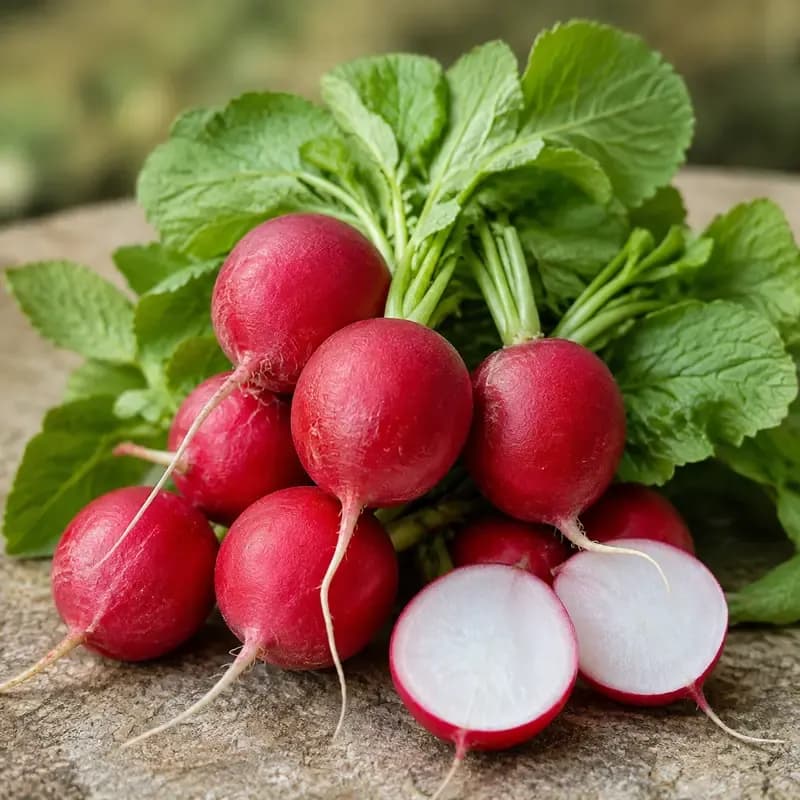
Radish
Raphanus raphanistrum subsp. sativus
The radish, scientifically accepted as Raphanus raphanistrum subsp. sativus and widely known by the synonym Raphanus sativus, is a fast-growing root vegetable in the mustard family, Brassicaceae. Its principal edible structure is a swollen taproot together with adjoining hypocotyl tissue, making root the best botanical category. Radishes range from marble-sized red globes to long white daikon, dense Korean radishes, black-skinned winter types, and watermelon radishes with green-white exteriors and vivid pink centers. Their texture is crisp and juicy, while flavor varies from mild and slightly sweet to sharply peppery. Cutting or chewing damages plant cells and allows the enzyme myrosinase to transform glucosinolates into pungent isothiocyanates. Raw radishes enliven salads, slaws, sandwiches, and garnishes; cooking softens their bite and can reveal gentle sweetness. The leaves, tender stems, sprouts, and young seed pods are also edible when properly handled. Raw roots provide abundant water, vitamin C, folate, potassium, copper, fiber, and small amounts of several other micronutrients. Radish has been cultivated for thousands of years, but its precise domestication center remains uncertain. Long selection in Europe and Asia produced the extraordinary range of shapes, colors, growing seasons, and culinary traditions seen today.
Radish फोटो गैलरी
Radish को शानदार विवरण में देखें
Radish - मुख्य दृश्य
Radish पोषण तथ्य
💊विटामिन
प्रति 100 ग्राम
⚡खनिज
प्रति 100 ग्राम
प्रति सर्विंग
एक सर्विंग का पोषण विवरण
Radish के स्वास्थ्य लाभ
Radish उत्पत्ति और वितरण
Exact domestication center uncertain; cultivated radish likely emerged from Old World wild relatives and diversified across the Mediterranean region, western Asia, South Asia, and East Asia
Radish has been cultivated for thousands of years, making its exact place and pathway of domestication difficult to reconstruct. Historical records show that diverse radishes were known in ancient Mediterranean and Asian agriculture. Long-rooted, round, mild, hot, white, red, purple, and black forms developed through selection in multiple regions. East Asian farmers developed large white daikon and dense Korean radishes, while European cultivation produced numerous spring and winter types. Radishes later traveled widely through trade and colonization and became established in cuisines throughout the Americas. Current international crop statistics do not consistently report table radish as a separate global commodity, so a reliable current ranking of producing countries is not supplied here.
Radish पीक सीज़न
Radishes are generally cool-season crops. Small spring varieties mature quickly, while daikon, black, and other winter radishes require longer growth and are commonly harvested in autumn or winter.
Radish किस्में
हर किस्म का स्वाद, बनावट और उपयोग अलग होता है
Cherry Belle
French Breakfast
Daikon
Watermelon Radish
Black Spanish
Sakurajima
Korean Radish
Radish स्टोरेज और चयन गाइड
फलों को अधिक समय तक ताज़ा रखें
सही फल कैसे चुनें
Choose small red radishes that feel firm, smooth, and heavy for their size, without cracks, slime, mold, or spongy soft areas.
Select daikon and other long radishes that are dense, straight or naturally shaped for the cultivar, and free from deep cuts or extensive shriveling.
When tops are attached, look for fresh green leaves without severe yellowing, decay, or wilting.
Avoid oversized spring radishes that feel light or hollow because they may be pithy, fibrous, or strongly pungent.
सही स्टोरेज तरीके
Remove leafy tops before storing roots because the greens draw moisture from them and accelerate softening.
Store unwashed radish roots in a perforated or loosely closed bag in the refrigerator crisper drawer.
Refrigerate radish greens separately in a breathable or moisture-retaining container and use them within several days.
Keep cut radishes in an airtight refrigerated container and use them promptly for the best texture and flavor.
Inspect stored radishes regularly and discard any that become slimy, moldy, leaking, or strongly off-smelling.
शेल्फ लाइफ गाइड
Preparation Tips
Rinse radishes under cool running water and scrub away soil with a clean vegetable brush; do not use soap or household detergent.
Trim the thin root tail and stem end. Peeling is usually unnecessary for red, white, and watermelon radishes but may soften the strong flavor of black radish.
Slice radishes thinly for salads and sandwiches, or cut them into evenly sized pieces for roasting, braising, or steaming.
Soak sound but slightly limp radishes briefly in ice water to restore some crispness, then drain and refrigerate.
Salt sliced radish briefly and drain it when a milder flavor and more flexible texture are desired for salads or pickles.
Wash radish greens thoroughly, remove damaged leaves and tough stems, and cook them like other mustard-family greens.
फ्रीज़ करने के निर्देश
कई महीनों तक ताज़गी बनाए रखें
Freezing raw radishes is not recommended when crisp texture is desired because thawed roots become soft and watery.
For cooked uses, wash, trim, and cut roots into uniform pieces before briefly blanching or partially cooking them.
Cool the pieces rapidly in ice water, drain thoroughly, and freeze them in a single layer before packing airtight.
Use frozen radishes directly in soups, stews, braises, or roasted dishes where a softened texture is acceptable.
Label freezer packages with the date and minimize trapped air to reduce freezer burn.
प्रो टिप
ताज़गी ट्रैक करने के लिए जमे हुए आइटम पर तारीख लिखें। सही तरीके से फ्रीज़ करने पर अधिकांश फल 2-3 महीनों तक गुणवत्ता बनाए रखते हैं। फ्रीज़र बर्न से बचने के लिए एयरटाइट कंटेनर या फ्रीज़र बैग का उपयोग करें।
पाक यात्रा
स्वादिष्ट विकल्प खोजें
सामान्य उपयोग
परफेक्ट पेयरिंग
लोकप्रिय रेसिपी
Cooking Methods
सुरक्षा जानकारी
Radish allergy is uncommon but possible. Reported reactions include oral itching, hives, swelling, gastrointestinal symptoms, wheezing, and, rarely, anaphylaxis. Because radish belongs to the mustard family, cross-reactivity may be relevant for some people with allergies to related foods, although this is not universal. Anyone experiencing breathing difficulty, faintness, or rapidly progressing swelling should seek emergency care, while suspected allergy should be evaluated by a qualified specialist.
Agricultural practices and measured residues vary by farm, country, and season. Wash radish roots, greens, and pods thoroughly under running water and remove adhering soil before cutting or eating. Peeling can reduce some surface residues but does not replace agricultural safety controls and is unnecessary for most sound radishes. Do not use soap, bleach, or household detergent on produce. Consumers seeking current residue information should consult their national food-safety authority.
- • People with a diagnosed radish allergy should avoid the forms identified by their allergy specialist.
- • Individuals with significant reactions to mustard-family foods should seek personalized advice before testing radish tolerance.
- • People following a clinician-prescribed potassium restriction should account for portions within their individualized plan.
- • People with thyroid disease and known iodine deficiency should discuss unusually large daily intakes of raw cruciferous vegetables with their clinician rather than eliminating normal portions automatically.
- • Anyone should avoid radishes that are moldy, slimy, rotten, leaking, or strongly off-smelling.
- •Large portions of raw radish may cause gas, bloating, abdominal discomfort, or changes in bowel habits in sensitive people.
- •Highly pungent radishes may irritate the mouth or aggravate reflux-like symptoms in susceptible individuals.
- •Sweetened pickled radishes can contain considerably more added sugar, while heavily salted pickles may contribute substantial sodium.
- •Allergic reactions can range from localized oral itching to systemic symptoms requiring urgent medical attention.
- •Very large, sustained raw cruciferous-vegetable intake may be relevant to iodine metabolism in people with inadequate iodine status.
- • Wash and scrub radish roots before cutting so soil is not transferred to the interior.
- • Keep unwashed roots and greens separate from ready-to-eat foods, utensils, and clean preparation surfaces.
- • Discard radishes or greens that are moldy, slimy, rotten, leaking, or strongly off-smelling.
- • Cut hard raw radishes into thin or age-appropriate pieces for young children because whole radishes and thick round slices can present a choking hazard.
- • Handle radish sprouts as a higher-risk raw food; people who are pregnant, older, very young, or immunocompromised should avoid raw or lightly cooked sprouts unless advised otherwise by a clinician.
- • Refrigerate cooked radishes within two hours, or within one hour in very hot conditions, and use refrigerated leftovers within 3 to 4 days.
रोचक तथ्य Radish के बारे में
ऐसी बातें जो आपको पसंद आएंगी!
Radish belongs to the Brassicaceae family alongside cabbage, mustard, broccoli, turnip, and horseradish.
The sharp flavor develops when cutting or chewing allows glucosinolates to interact with the enzyme myrosinase.
Radish pungency comes from isothiocyanates rather than the capsaicin found in chili peppers.
Small spring radishes can mature in only a few weeks, making them popular crops for beginner gardeners.
Daikon can grow far longer and heavier than common red radishes.
The young seed pods of radish are edible, and some cultivars are grown primarily for their pods.
Sakurajima radish is famous for producing exceptionally large round roots in southern Japan.
Oaxaca, Mexico, celebrates the annual Night of the Radishes, featuring elaborate sculptures carved from oversized roots.
अक्सर पूछे जाने वाले प्रश्न
Is radish botanically a root vegetable?
ScienceRadish is appropriately classified as a root vegetable. Its familiar round, cylindrical, or elongated edible structure develops from the taproot together with adjoining hypocotyl tissue, the transition between the seedling stem and root. This storage organ enlarges as the plant accumulates water and carbohydrates. If left to mature, the plant produces leaves, flowers, and segmented seed pods above ground. Those leaves and young pods are also edible, but the swollen underground organ is the principal commercial product. Radish is therefore categorized as a root rather than a tuber, bulb, stem, or botanical fruit.
Why do radishes taste spicy or peppery?
ScienceRadish pungency comes mainly from the mustard-family glucosinolate system. In intact tissue, glucosinolates and the enzyme myrosinase are stored separately. Cutting, grating, or chewing damages cells and lets them interact, producing isothiocyanates and related compounds with sharp aromas and flavors. The intensity depends on cultivar, maturity, temperature, water availability, storage, and how finely the root is cut. Salt, cooking, soaking, dairy, and fat can moderate the perceived heat. The pungency is not caused by capsaicin, the compound responsible for chili-pepper heat, or by black-pepper piperine.
Are raw radishes healthier than cooked radishes?
HealthNeither preparation is universally healthier. Raw radishes retain their crisp texture, active myrosinase, and more heat-sensitive vitamin C, while providing the characteristic peppery flavor. Cooking softens the root, reduces pungency, and can make it easier to tolerate for people who experience discomfort from raw cruciferous vegetables. Boiling can move vitamin C and other water-soluble compounds into cooking liquid, whereas steaming, roasting, or quick sauteing reduces that loss. A varied approach works well: eat raw radishes in salads and use cooked radishes in soups, braises, curries, or roasted vegetable dishes.
Can radish leaves and seed pods be eaten?
GeneralRadish leaves, tender stems, sprouts, and immature seed pods are edible when properly identified, cleaned, and handled. Young leaves can be added to salads, while mature greens are often sauteed, steamed, blended into pesto, or cooked in soups and saag. Tender pods have a crisp, peppery character and may be eaten raw, stir-fried, or pickled. These plant parts have nutritional profiles different from the raw root values listed here. Discard yellowed, slimy, moldy, or pest-damaged greens, and handle raw sprouts especially carefully because sprouting conditions can support bacterial growth.
Can people with diabetes eat radishes?
HealthRadishes can generally fit easily into a diabetes eating plan. Raw radish contains about 3.4 g of carbohydrate, 1.86 g of natural sugars, and 1.6 g of fiber per 100 g, so a typical serving provides relatively little carbohydrate. The actual glucose response still depends on portion size and the other foods in the meal. Pickled radishes may contain added sugar, and restaurant preparations can include sweet sauces. Whole, sliced, roasted, or unsweetened fermented radishes are usually straightforward to account for, but individual medication and glucose targets should guide personalized advice.
Do radishes affect thyroid function?
HealthRadishes are cruciferous vegetables and contain glucosinolates that can form compounds capable of influencing iodine use under certain experimental or high-intake conditions. For most people with adequate iodine intake, normal food portions of radish are not considered a thyroid problem. Risk is more relevant when very large amounts of raw cruciferous vegetables are consumed regularly alongside iodine deficiency. Cooking modifies some of these compounds. People with diagnosed thyroid disease do not usually need to eliminate radishes automatically, but they should follow their clinician's advice and avoid replacing prescribed treatment with dietary strategies.
What is the difference between daikon and small red radish?
GeneralDaikon and small red radishes are cultivated forms within the same radish species complex, but they were selected for different root shapes, textures, seasons, and culinary uses. Daikon is usually long, white, juicy, and relatively mild, although the tip can be peppery. Small red radishes are typically round or oval, mature quickly, and often taste sharper. Daikon works especially well in soups, braises, grated condiments, kimchi, and pickles, while red radishes are common in salads and garnishes. Their exact nutrient composition can differ, so the USDA profile here represents generic raw radishes rather than every cultivar.
How should fresh radishes be stored?
GeneralRemove leafy tops before refrigeration because the greens continue drawing water from the roots and accelerate softening. Store unwashed roots in a perforated or loosely closed bag in the refrigerator crisper. Small radishes generally retain good quality for about one to two weeks, while dense daikon and winter radishes may last longer. Refrigerate the greens separately and use them within several days. Slightly limp but otherwise sound roots may regain crispness after a brief ice-water soak. Discard radishes that are slimy, moldy, leaking, hollow with decay, or strongly off-smelling.
Should radishes be peeled before eating?
PreparationMost radishes do not need peeling. The skins of red, white, daikon, and watermelon radishes are edible after thorough washing and contribute color, texture, and reduced food waste. Scrub away soil, trim the stem end and thin root tail, and remove damaged areas. Black radish has a rough, strongly flavored skin that may be peeled when a milder taste or smoother texture is desired. Thin slicing, salting, soaking, or cooking can also reduce pungency. Always discard roots that are slimy, moldy, rotten, or deeply damaged rather than relying on peeling to make spoiled produce safe.