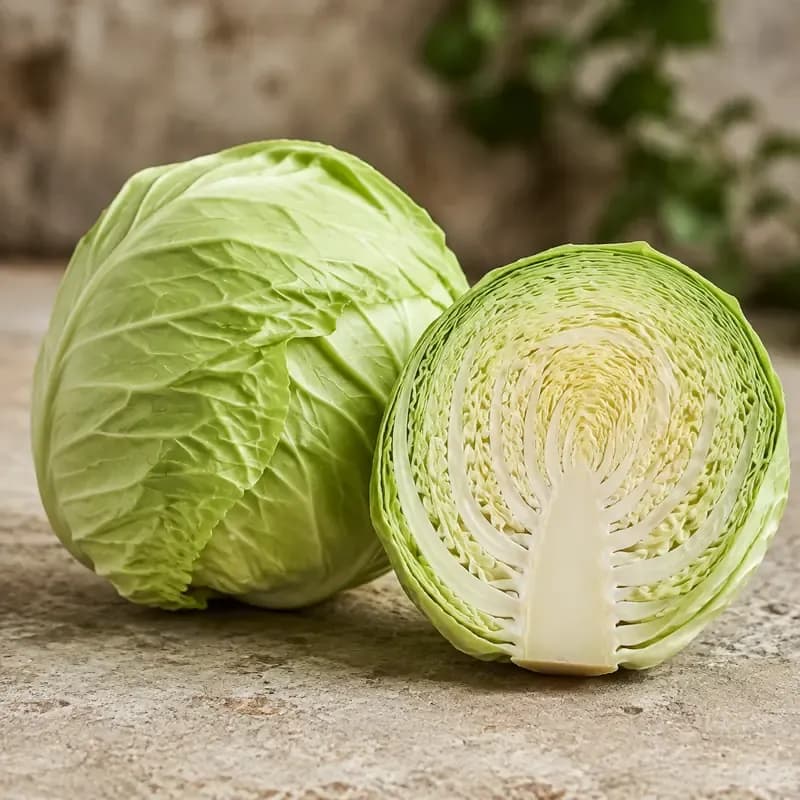
Cabbage
Brassica oleracea var. capitata
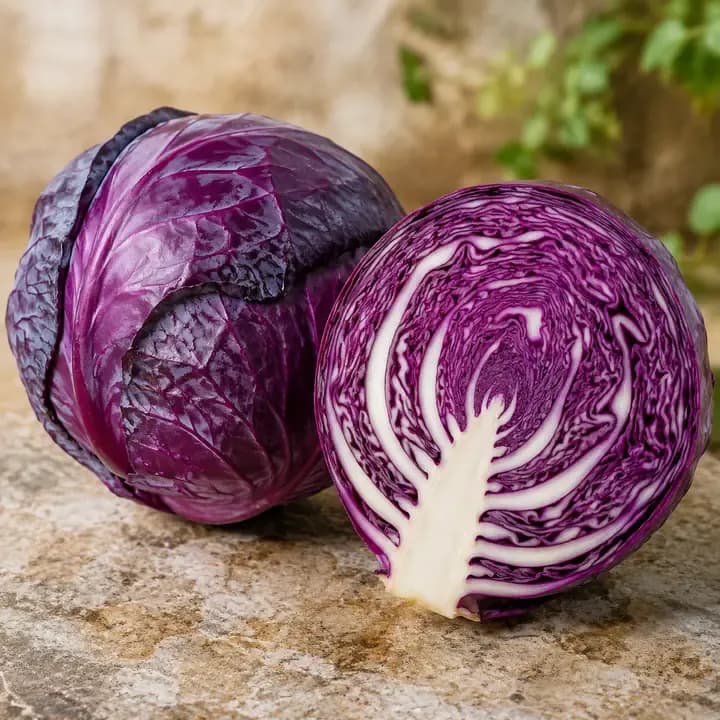
Cabbage, scientifically known as Brassica oleracea var. capitata, is a cool-season leafy vegetable that forms a dense head of overlapping leaves around a shortened stem. It belongs to the Brassicaceae family and shares its species with broccoli, cauliflower, kale, kohlrabi, and Brussels sprouts, each shaped by centuries of selective breeding for a different edible structure. Common green cabbage has crisp, pale-to-medium green leaves and a clean, mildly peppery flavor that becomes sweeter and softer with cooking. Red cabbage contributes purple-red color from anthocyanins, while Savoy cabbage has tender, deeply crinkled leaves. Raw green cabbage is low in calories and provides vitamin C, vitamin K, folate, fiber, vitamin B6, manganese, and smaller amounts of several other nutrients. Cutting or chewing brings glucosinolates into contact with the plant enzyme myrosinase, producing biologically active breakdown compounds such as isothiocyanates and indoles. Cabbage can be shredded for slaws, roasted in wedges, sautéed, braised, added to soups, stuffed, pickled, or fermented into foods such as sauerkraut and kimchi. This nutrition profile refers specifically to raw green cabbage; red, Savoy, Napa, cooked, and fermented products have different nutrient values.
Cabbage फोटो गैलरी
Cabbage को शानदार विवरण में देखें
Cabbage - मुख्य दृश्य
Cabbage पोषण तथ्य
💊विटामिन
प्रति 100 ग्राम
⚡खनिज
प्रति 100 ग्राम
प्रति सर्विंग
एक सर्विंग का पोषण विवरण
Cabbage के स्वास्थ्य लाभ
Cabbage उत्पत्ति और वितरण
Europe and the Mediterranean region, derived from wild Brassica oleracea populations associated with coastal environments
Cultivated cabbage developed from wild Brassica oleracea populations native to parts of Europe and the Mediterranean coastal region. Ancient farmers selected leafy brassicas long before tightly headed cabbage emerged as a distinct crop. Classical Greek and Roman writers described cultivated brassicas, although the compact heads familiar today became more clearly established through European selection during the medieval period. Cabbage spread widely because it tolerated cool weather, produced substantial food from limited land, and could be stored or preserved through salting, pickling, and fermentation. European migration and global trade later carried heading cabbages to the Americas, Asia, Africa, and Oceania. Modern breeding has produced green, red, white, Savoy, pointed, early-season, heat-tolerant, and long-storage cultivars.
Cabbage पीक सीज़न
Cabbage is a cool-season crop. Spring varieties are harvested earlier and tend to be tender, while autumn and winter storage cabbages form denser heads and keep longer. Regional production, cold storage, and trade make cabbage available throughout the year.
Cabbage किस्में
हर किस्म का स्वाद, बनावट और उपयोग अलग होता है
Green Cabbage
Red Cabbage
Savoy Cabbage
Pointed or Sweetheart Cabbage
January King
Danish Ballhead
Cabbage स्टोरेज और चयन गाइड
फलों को अधिक समय तक ताज़ा रखें
सही फल कैसे चुनें
Choose a head that feels firm, compact, and heavy for its size, with crisp leaves appropriate to the variety.
Avoid heads with widespread yellowing, slime, mold, deep cracks, soft watery areas, or a rotten odor.
Minor damage to an outer leaf can be removed, but avoid cabbage with decay extending into the head or core.
For cut or shredded cabbage, choose refrigerated packages with intact seals and no excessive liquid or browning.
Select Savoy or pointed cabbage for tender leaves and dense green, red, or storage cabbage when longer keeping quality is important.
सही स्टोरेज तरीके
Store whole, unwashed cabbage in the refrigerator crisper drawer inside a loose or perforated food-safe bag.
Keep the head intact until needed because cutting increases moisture loss, oxidation, and opportunities for contamination.
Wrap cut cabbage or place it in a clean airtight container and refrigerate it at 4°C or below.
Keep cabbage away from strong ethylene-producing fruit when practical because ethylene can accelerate yellowing and quality loss.
Remove wilted outer leaves before use and discard the head if the core or inner leaves become slimy, moldy, or rotten.
शेल्फ लाइफ गाइड
Preparation Tips
Remove the outermost leaves, rinse the cabbage under clean running water, and dry it with a clean towel before cutting. Do not use soap, detergent, bleach, or household cleaners.
Quarter the head through the core for stability. Remove the dense core if the recipe requires tender leaves, or slice the sound core thinly because it is edible.
Use a sharp knife, mandoline with a hand guard, or food processor to shred cabbage evenly for slaws, stir-fries, and fermentation.
For a more tender raw slaw, lightly salt and massage shredded cabbage, allow it to rest briefly, and drain excess liquid before dressing.
Cook cabbage only until it reaches the desired tenderness; prolonged high heat can intensify sulfur aromas and soften the leaves excessively.
When cooking red cabbage, acidic ingredients such as vinegar or apple help retain a red-purple color, while alkaline ingredients can shift the pigments toward blue-green.
For home fermentation, use a tested recipe, accurate salt measurements, clean equipment, appropriate temperature control, and suitable containers rather than improvising preservation conditions.
For freezing, water-blanch shredded cabbage for 1.5 minutes, cool immediately in ice water, drain thoroughly, and pack in freezer-safe containers.
फ्रीज़ करने के निर्देश
कई महीनों तक ताज़गी बनाए रखें
Remove damaged outer leaves, rinse the cabbage, cut out tough portions if desired, and shred or slice it into useful portions.
Water-blanch shredded cabbage for 1.5 minutes before freezing to slow quality-damaging enzyme activity.
Cool blanched cabbage immediately in ice water for approximately the same amount of time, then drain and dry it thoroughly.
Pack in freezer-safe containers or bags, remove excess air, label with the date, and freeze promptly.
Use frozen cabbage mainly in soups, braises, casseroles, and stir-fries because thawing softens its crisp texture.
प्रो टिप
ताज़गी ट्रैक करने के लिए जमे हुए आइटम पर तारीख लिखें। सही तरीके से फ्रीज़ करने पर अधिकांश फल 2-3 महीनों तक गुणवत्ता बनाए रखते हैं। फ्रीज़र बर्न से बचने के लिए एयरटाइट कंटेनर या फ्रीज़र बैग का उपयोग करें।
पाक यात्रा
स्वादिष्ट विकल्प खोजें
सामान्य उपयोग
परफेक्ट पेयरिंग
लोकप्रिय रेसिपी
Cooking Methods
सुरक्षा जानकारी
Cabbage allergy is uncommon but possible. Reactions may include oral itching, hives, swelling, digestive symptoms, wheezing, or, rarely, anaphylaxis. Cross-reactivity with other Brassicaceae foods can occur in some sensitized individuals, but it should not be assumed without assessment. Anyone with breathing difficulty, throat or facial swelling, faintness, or another severe reaction should seek emergency medical care and obtain evaluation from a qualified allergy specialist.
Pesticide residues vary by country, season, and production practice. Regulatory monitoring generally finds the great majority of sampled foods within established tolerances. Remove the outermost leaves and rinse cabbage thoroughly under clean running water before cutting. Do not use soap, detergent, bleach, or household cleaners. Washing and trimming can reduce dirt and some surface residues but cannot remove every residue or internal contamination. Organic cabbage can also use approved pesticides and still requires safe handling.
- • People with a diagnosed cabbage allergy should avoid cabbage and follow guidance from their allergy specialist.
- • People taking warfarin should not abruptly increase or decrease cabbage intake and should discuss major dietary changes with their anticoagulation clinician.
- • People with significant sensitivity to fermentable carbohydrates may need smaller portions or cooked cabbage based on individualized dietary advice.
- • People following a sodium-restricted diet should check labels and portions of sauerkraut, kimchi, and pickled cabbage because these products can be high in sodium.
- • Anyone should avoid cabbage that is moldy, slimy, rotten, recalled, or stored unsafely after cutting or preparation.
- •Large portions can cause gas, bloating, or abdominal discomfort, especially when fiber intake increases suddenly.
- •Major changes in cabbage intake can affect warfarin response because cabbage contains vitamin K.
- •Fermented and pickled cabbage can contribute substantial sodium depending on the recipe and serving size.
- •Raw or prepared cabbage can carry foodborne pathogens if contaminated or handled improperly; rinsing reduces surface contamination but does not sterilize produce.
- • Wash hands with soap and water before and after preparation, remove the outermost leaves, and rinse cabbage under clean running water before cutting.
- • Do not wash cabbage with soap, detergent, bleach, or household cleaners, because produce is porous and these substances are not intended for consumption.
- • Use clean knives, cutting boards, and containers, and keep cabbage intended for raw dishes separate from raw meat, poultry, seafood, and their juices.
- • Refrigerate cut or shredded cabbage at 4°C or below and do not leave it at room temperature for more than 2 hours, or more than 1 hour above 32°C.
- • Refrigerate cooked cabbage and cabbage-containing leftovers within 2 hours and use them within 3 to 4 days.
- • For fermentation or shelf-stable pickling, follow a tested preservation recipe with accurate salt or acid measurements, clean equipment, suitable containers, and specified processing conditions.
- • Discard recalled cabbage and fermented cabbage showing unsafe spoilage, objectionable rot, or unexpected mold rather than tasting it to test safety.
रोचक तथ्य Cabbage के बारे में
ऐसी बातें जो आपको पसंद आएंगी!
A cabbage head is a dense arrangement of overlapping leaves around a shortened stem, not a single leaf or bulb.
Cabbage, broccoli, cauliflower, kale, kohlrabi, and Brussels sprouts are cultivated forms of the same species, Brassica oleracea.
Red cabbage anthocyanins change color with acidity, appearing redder in acidic conditions and bluer or greener in alkaline conditions.
The English word cabbage is connected to an Old French word associated with a head, reflecting the vegetable's rounded form.
Cool growing conditions can make some cabbage cultivars taste sweeter as the plant adjusts the sugars and other solutes in its tissues.
Cabbage is normally harvested during its first growing season, although the plant is biennial and can flower and set seed after exposure to suitable cold conditions.
Fermented cabbage traditions developed in multiple regions, including sauerkraut in Europe, kimchi in Korea, and curtido in Central America.
Dense storage cabbages were historically valuable because they could supply vegetables during seasons when fresh produce was limited.
अक्सर पूछे जाने वाले प्रश्न
What part of the cabbage plant is the cabbage head?
ScienceA cabbage head is primarily a tightly packed cluster of leaves arranged around a very short central stem. It is therefore classified botanically as a leaf vegetable rather than a root, bulb, flower, or fruit. The pale central core is shortened stem tissue and is also edible when it is sound, although it is denser and more fibrous than the leaves. Heading cabbage is Brassica oleracea var. capitata, one cultivated form of the same species that humans selected into kale, broccoli, cauliflower, kohlrabi, and Brussels sprouts.
Is cabbage healthier raw or cooked?
PreparationRaw and cooked cabbage offer different advantages, and neither is universally healthier. Raw cabbage retains crunch and generally preserves more heat-sensitive vitamin C and active plant myrosinase. Cooking softens the fiber, reduces volume, and may make cabbage easier for some people to eat and digest. Boiling can move vitamin C and other water-soluble compounds into the cooking liquid, while steaming, microwaving, sautéing, and brief stir-frying limit direct water contact. Long cooking can intensify sulfur aromas. Eating cabbage in several forms is more useful than assigning one method absolute superiority.
Why does cabbage cause gas, and how can it be reduced?
HealthCabbage contains fiber and fermentable carbohydrates that intestinal microorganisms can use, producing gases such as hydrogen, carbon dioxide, and, in some people, methane. Its sulfur-containing compounds can also influence odor. This reaction is not the same as an allergy, and tolerance varies considerably. Start with a smaller serving, increase fiber gradually, chew thoroughly, and try cooked rather than large raw portions. Rinsing canned or fermented accompaniments does not remove cabbage fiber. Persistent pain, major bowel changes, or severe symptoms warrant assessment by a qualified healthcare professional.
Can eating cabbage interfere with thyroid function?
HealthCabbage contains glucosinolates whose breakdown products can influence iodine handling under certain experimental conditions. For most people with adequate iodine intake, ordinary portions of raw or cooked cabbage are not considered a reason for concern. Risk is more plausible with iodine deficiency and unusually large, repetitive intakes of raw cruciferous vegetables. Cooking alters myrosinase activity and some breakdown products. People with diagnosed thyroid disease should not eliminate nutritious cruciferous vegetables automatically, but they should follow their clinician's advice and avoid using concentrated cabbage or green powders as self-treatment.
Can people taking warfarin eat cabbage?
HealthPeople taking warfarin can often eat cabbage, but they should keep their vitamin K intake reasonably consistent. Raw green cabbage provides approximately 63% of the FDA Daily Value for vitamin K per 100 g, and sudden large changes in cabbage or other vitamin K-rich foods can alter warfarin's anticoagulant effect and INR results. Complete avoidance is not routinely necessary and can unnecessarily reduce vegetable variety. Discuss major dietary changes, frequent large cabbage servings, green powders, or juice concentrates with the clinician or anticoagulation service managing the medication.
What is the nutritional difference between green and red cabbage?
ScienceBoth are heading forms of Brassica oleracea and supply fiber, vitamin C, vitamin K, folate, and glucosinolates, but their exact amounts differ. Red cabbage contains red-purple anthocyanin pigments and generally has a different vitamin C, vitamin K, carotenoid, and mineral profile from green cabbage. Variety, maturity, growing conditions, storage, and preparation also affect composition. The nutrition values in this object describe raw green cabbage and should not be reused unchanged for red cabbage. Choosing both colors provides culinary variety and a broader range of pigments without requiring one to be labelled universally better.
How should a whole or cut cabbage be stored?
GeneralKeep a whole, unwashed cabbage in the refrigerator crisper drawer, preferably in a loose or perforated food-safe bag that limits moisture loss without trapping excessive condensation. Dense green and red heads usually keep longer than tender Savoy or pointed types. Once cut, wrap the exposed portion or place it in a clean airtight container and refrigerate at 4°C or below. Use cut cabbage within roughly three to seven days. Discard cabbage with slime, mold, liquid decay, a rotten core, or an unpleasant spoilage odor rather than merely trimming deeply affected tissue.
Does fermented cabbage always contain probiotics?
ScienceNo. Proper lactic-acid fermentation can produce populations of live microorganisms, but the final product contains live cultures only if they remain viable. Heat processing or pasteurization can greatly reduce or eliminate them, and storage conditions and product age also matter. Labels such as unpasteurized or contains live cultures can provide useful information, but they do not make the product a treatment for disease. Sauerkraut, kimchi, and similar foods may contain substantial sodium, and their nutrition differs from raw cabbage. Home fermentation should follow a tested recipe with accurate salt and temperature control.
Does cabbage need to be washed before cutting?
PreparationYes. Remove the outermost leaves, rinse the head under clean running water, and dry it with a clean towel before cutting. Washing first helps prevent a knife from carrying dirt or microorganisms from the outside into freshly cut surfaces. Do not use soap, detergent, bleach, or household cleaning products on cabbage. Cut away minor damaged areas and discard a head with widespread rot or mold. Use clean hands, knives, boards, and containers, and keep cabbage that will be eaten raw separate from raw meat, poultry, seafood, and their juices.