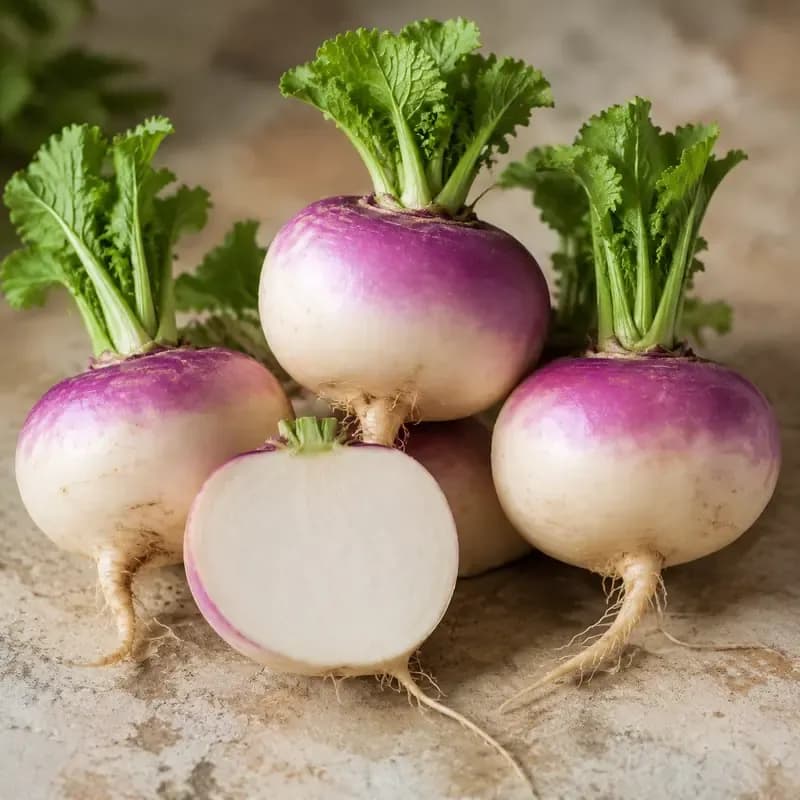
Turnip
Brassica rapa subsp. rapa
The turnip, scientifically known as Brassica rapa subsp. rapa, is a cool-season root vegetable belonging to the mustard family, Brassicaceae. Its familiar rounded storage organ develops primarily from enlarged hypocotyl and taproot tissues, making root the best botanical category. Turnips vary from small, smooth, white roots with purple shoulders to golden, red-skinned, elongated, and Japanese salad types. Young roots are crisp, juicy, mildly sweet, and gently peppery, while larger or older turnips can develop a firmer texture and stronger mustard-like flavor. Cooking softens their pungency, concentrates their sweetness, and produces a tender texture suitable for roasting, mashing, braising, soups, curries, and stews. The leafy tops, called turnip greens, are also edible and possess a more assertive, pleasantly bitter flavor. Raw turnip roots contain abundant water and provide vitamin C, fiber, potassium, copper, manganese, folate, and several B vitamins with relatively few calories. Turnips have been cultivated since ancient times for human food, livestock fodder, and oil-rich relatives within the Brassica rapa species. They remain especially valuable in cool climates because they mature quickly, tolerate light frost, store well, and can supply both edible roots and nutritious greens.
Turnip Galería de fotos
Explora Turnip con todo detalle
Turnip - Vista principal
Turnip Información nutricional
💊Vitaminas
Por 100 g
⚡Minerales
Por 100 g
Por porción
Desglose nutricional por porción
Beneficios para la salud de Turnip
Turnip Origen y distribución
Exact domestication center uncertain; cultivated turnips likely developed from wild Brassica rapa populations in Europe and western or central Asia
Turnips have been cultivated since ancient times, although their long association with related Brassica rapa crops makes the precise domestication pathway difficult to determine. Archaeological and historical evidence indicates that turnip-like plants were used in Europe and western Asia thousands of years ago. Greek and Roman agricultural writers described turnips as food for people and livestock. The crop later became an important cool-climate staple across northern Europe because it matured quickly, tolerated frost, and could be stored through winter. European settlers carried turnips to the Americas, while distinct forms were selected in Asia. Modern agricultural statistics often combine turnips with carrots or other root crops, so a dependable current country-by-country production ranking is not provided here.
Turnip Temporada alta
Turnips are cool-season crops generally planted for spring or autumn harvest. In mild climates they may also be grown throughout winter, while stored mature roots remain available beyond the field-harvest season.
Turnip Variedades
Cada variedad ofrece sabores, texturas y usos culinarios únicos
Purple Top White Globe
Tokyo Cross
Hakurei
Golden Ball
Milan Purple Top
Seven Top
Scarlet Queen
Turnip Guía de selección y conservación
Mantén tu fruta fresca y deliciosa por más tiempo
Cómo elegir la fruta perfecta
Choose turnips that feel firm, smooth, and heavy for their size, without soft areas, deep cuts, slime, mold, or extensive shriveling.
Select small to medium roots for a tender texture and mild flavor; oversized mature roots may be woody, pithy, or strongly flavored.
When greens are attached, choose bunches with crisp, richly colored leaves rather than yellowed, slimy, or severely wilted tops.
Select varieties according to the recipe: small Japanese turnips for raw preparations and mature storage types for roasting, mashing, soups, and stews.
Métodos de conservación
Remove leafy tops before storing because the greens draw moisture from the roots and accelerate softening.
Store unwashed roots in a perforated or loosely closed bag in the refrigerator crisper drawer.
Refrigerate turnip greens separately in a breathable or moisture-retaining container and use them within several days.
Keep cut turnips in an airtight refrigerated container and use them promptly for the best flavor and texture.
Inspect stored roots regularly and discard any that become moldy, slimy, leaking, rotten, or strongly off-smelling.
Guía de vida útil
Preparation Tips
Rinse turnips under cool running water and scrub away soil with a clean vegetable brush; do not use soap or household detergent.
Trim the thin root end and the stem attachment. Small young turnips usually need no peeling, while mature roots may have tougher skin that is best removed.
Cut away bruised or damaged tissue and discard roots showing mold, slime, extensive decay, or a strong off-odor.
Cut turnips into similarly sized pieces so they roast, boil, steam, or braise evenly.
Blanch turnip pieces briefly before freezing, then cool them immediately in ice water to slow enzymatic deterioration.
Wash turnip greens thoroughly in several changes of water, remove tough stems and damaged leaves, and cook them like mustard or collard greens.
Instrucciones de congelación
Conserva la frescura por meses
Wash, peel if necessary, and cut turnips into uniform cubes or slices before freezing.
Blanch pieces in boiling water for approximately 2 minutes, then cool them promptly in ice water.
Drain and dry the blanched turnips thoroughly before freezing them in a single layer.
Transfer frozen pieces to airtight freezer containers or bags, remove excess air, and label them with the date.
Mashed or fully cooked turnips may also be frozen, although thawed texture can be softer than freshly cooked turnip.
Consejo
Etiqueta los alimentos congelados con la fecha para controlar la frescura. La mayoría de las frutas mantienen su calidad durante 2-3 meses si se congelan correctamente. Para mejores resultados, usa recipientes herméticos o bolsas para congelador para evitar quemaduras por congelación.
Viaje culinario
Descubre posibilidades deliciosas
Usos comunes
Maridajes perfectos
Recetas populares
Cooking Methods
Información de seguridad
Turnip allergy is uncommon but possible. Reactions may include oral itching, hives, swelling, digestive symptoms, wheezing, or, rarely, anaphylaxis. Cross-reactivity may occur in some people allergic to mustard-family vegetables or sensitized to certain pollens, although this is not universal. Anyone experiencing breathing difficulty, faintness, or rapidly progressing swelling should seek emergency medical care, while suspected turnip allergy should be evaluated by a qualified allergy specialist.
Agricultural practices and measured residues vary by farm, country, and season. Wash turnip roots and greens thoroughly under running water and remove adhering soil before cutting or cooking. Peeling may reduce some surface residues but is unnecessary for most young, sound turnips and does not replace agricultural safety controls. Do not wash produce with soap, bleach, or household detergent. Consumers seeking current residue information should consult their national food-safety authority.
- • People with a diagnosed turnip allergy should avoid turnip and follow advice from their allergy specialist.
- • Individuals with severe reactions to mustard-family vegetables should obtain personalized guidance before testing turnip tolerance.
- • People taking warfarin or another vitamin K-sensitive anticoagulant should keep intake of vitamin K-rich turnip greens consistent and follow clinical advice.
- • People following a prescribed potassium restriction should account for turnip roots and greens within their individualized plan.
- • Anyone should avoid turnips or greens that are moldy, slimy, rotten, leaking, or strongly off-smelling.
- •Large portions of raw turnip may cause gas, bloating, or abdominal discomfort in people sensitive to cruciferous vegetables.
- •Very large and sustained raw cruciferous-vegetable intake may be relevant to iodine metabolism in people with inadequate iodine status.
- •Turnip greens contain substantially more vitamin K than turnip roots and can interfere with anticoagulation management when intake changes abruptly.
- •Salted pickles and heavily seasoned turnip dishes may contribute substantial sodium.
- •Allergic reactions can range from localized oral symptoms to a potentially serious systemic response.
- • Wash and scrub turnip roots before cutting so soil is not transferred to the interior.
- • Wash greens thoroughly in several changes of water because soil and grit can collect around stems and leaf surfaces.
- • Keep unwashed roots and greens separate from ready-to-eat foods, clean utensils, and preparation surfaces.
- • Discard turnips or greens that are moldy, slimy, rotten, leaking, or strongly off-smelling.
- • Cut firm raw turnips into thin or age-appropriate pieces for young children to reduce choking risk.
- • Refrigerate cooked turnips within two hours, or within one hour in very hot conditions, and use refrigerated leftovers within 3 to 4 days.
Datos curiosos sobre Turnip
¡Trivias sorprendentes que te encantarán!
Turnip belongs to the Brassicaceae family alongside cabbage, mustard, broccoli, radish, and kale.
The edible turnip root develops from both hypocotyl and taproot tissue rather than being a stem tuber like potato.
Turnips have been cultivated since ancient times as food for both people and livestock.
Young Japanese salad turnips are mild enough to eat raw without peeling.
Turnip greens are edible and have a different nutritional profile from the root.
Before pumpkins became the usual choice, turnips were traditionally carved into lanterns in parts of Ireland and Scotland.
The Scottish dish known as neeps and tatties traditionally combines mashed swede or turnip with potatoes.
Light frost can improve the sweetness of turnip roots by influencing stored carbohydrates.
Preguntas frecuentes
Is a turnip botanically a root vegetable?
ScienceYes. Turnip is classified as a root vegetable because its principal edible storage organ develops from the taproot together with the adjoining hypocotyl, the region between the seedling root and stem. This swollen structure stores water and carbohydrates for the plant. Turnip is therefore different from a potato, which is a modified underground stem tuber with buds or eyes. The leaves and tender stems growing above ground are also edible, but the rounded white, purple, red, or golden storage root is the portion usually meant when recipes call for turnip.
Are turnips and rutabagas the same vegetable?
ScienceNo. Turnip is generally Brassica rapa subsp. rapa, whereas rutabaga, also called swede, is Brassica napus var. napobrassica or a closely equivalent botanical classification. Rutabagas are usually larger, denser, yellower inside, and sweeter after cooking. Turnips are commonly smaller, white-fleshed, quicker to mature, and more peppery. Their culinary roles overlap, and either may be roasted, mashed, or added to stews, but cooking time can differ. Naming also varies by country, so a vegetable called turnip in one region may occasionally refer to a rutabaga elsewhere.
Can turnips be eaten raw?
PreparationTurnips can be eaten raw, especially when they are young, small, firm, and freshly harvested. Japanese salad turnips such as Hakurei are particularly crisp, juicy, and mild. Raw turnips may be sliced, grated, shaved, or cut into sticks for salads, slaws, sandwiches, and dips. Larger mature roots can taste stronger and may have tough skin that benefits from peeling. Wash and scrub the root thoroughly before cutting. People who experience bloating from raw cruciferous vegetables may find steamed, roasted, or braised turnips easier to tolerate.
Are turnips healthy?
HealthPlain turnip roots can contribute to a balanced diet. Raw turnip provides approximately 28 calories per 100 g, along with vitamin C, fiber, potassium, copper, manganese, folate, and several B vitamins. Turnip greens are nutritionally different and are especially rich in vitamins K, A, and C. Preparation strongly affects the finished dish: steaming, roasting, or boiling adds little energy, while large amounts of butter, cream, cheese, sugar, or salt can change its nutritional profile. Turnips should be considered one component of a varied diet rather than a treatment for disease.
Do turnips affect thyroid function?
HealthTurnips belong to the cruciferous vegetable family and contain glucosinolates that can form compounds capable of affecting iodine use under certain experimental conditions. For most people with adequate iodine intake, ordinary food portions of turnips are not considered a thyroid concern. Potential relevance is greater when extremely large amounts of raw cruciferous vegetables are eaten regularly in the presence of iodine deficiency. Cooking modifies some of these compounds. People with diagnosed thyroid disease generally do not need to eliminate turnips automatically, but they should follow individualized advice from their clinician or dietitian.
Should turnips be peeled before cooking?
PreparationPeeling depends on the turnip's age, variety, and intended recipe. Small, young turnips usually have thin, tender skin that can be eaten after thorough washing and scrubbing. Mature storage turnips often develop thicker or more fibrous skin, which can produce a smoother mash, soup, or gratin when removed. Trim the root end and stem attachment, then use a vegetable peeler or paring knife if needed. Peeling does not make spoiled produce safe, so discard turnips that are moldy, slimy, leaking, deeply rotten, or strongly off-smelling.
How can the bitter or peppery flavor of turnips be reduced?
PreparationChoose small, young turnips because they are generally milder and sweeter than oversized or overmature roots. Peeling an older turnip removes some strongly flavored outer tissue. Cooking also mellows pungency: roasting encourages browning and sweetness, while boiling or blanching can move some sharp-tasting compounds into the water. Combining turnip with potato, carrot, apple, dairy, butter, or a small amount of sweetener creates balance. Avoid overcooking turnips, however, because prolonged heating can produce a strong cabbage-like aroma and an excessively soft texture.
Can people with diabetes eat turnips?
HealthTurnips can generally fit comfortably into a diabetes eating plan. Raw turnip contains about 6.43 g of carbohydrate and 1.8 g of fiber per 100 g, making it less carbohydrate-dense than potato, rice, or pasta. Portion size and the complete meal still determine the glucose response. Plain roasted, steamed, boiled, or mashed turnip is straightforward to account for, while glazed turnips, sweet pickles, creamy gratins, and turnip-potato mash may contain substantially more sugar, fat, or carbohydrate. Individual glucose targets, medications, and dietary needs should guide personalized portion advice.
How should fresh turnips and turnip greens be stored?
GeneralRemove the greens before refrigeration because attached leaves continue drawing moisture from the roots and cause them to soften more quickly. Store unwashed roots in a perforated or loosely closed bag in the refrigerator crisper, where they generally keep for about one to two weeks. Dense mature turnips may last longer under controlled cold, humid storage. Refrigerate the washed or unwashed greens separately and use them within approximately three to five days. Discard roots or leaves that become moldy, slimy, leaking, rotten, or strongly off-smelling.