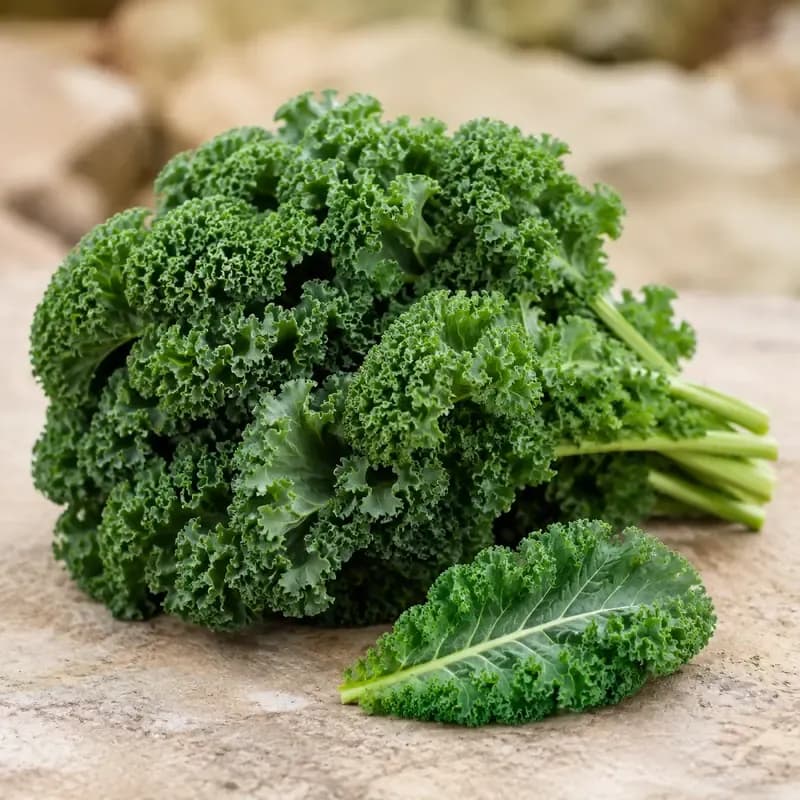
Kale
Brassica oleracea var. sabellica
Kale, commonly classified as Brassica oleracea var. sabellica and included within the non-heading Acephala group of Brassica oleracea, is a leafy vegetable in the mustard family, Brassicaceae. Unlike cabbage, kale does not form a compact head. Instead, its leaves grow openly around an upright central stem and may be tightly curled, flat, blistered, narrow, broad, blue-green, deep green, red, or purple. Raw kale has a firm texture and an earthy, grassy, mildly bitter flavor with the peppery character typical of cruciferous vegetables. Massaging finely sliced leaves with oil, salt, or an acidic dressing softens their structure for salads, while steaming, sauteing, braising, roasting, and stir-frying produce tender leaves with a sweeter, more savory flavor. The leaves, tender ribs, young stems, and flowering shoots are edible when properly prepared. Raw kale provides vitamin K, vitamin C, vitamin A carotenoids, riboflavin, folate, fiber, calcium, manganese, iron, magnesium, and potassium. It also contains glucosinolates, lutein, zeaxanthin, beta-carotene, kaempferol, and quercetin. Kale developed from ancient non-heading forms of wild cabbage cultivated around the Mediterranean and Europe. Its cold tolerance, productivity, and ability to remain in the field during winter made it an important traditional vegetable long before its modern popularity in salads, smoothies, soups, and baked chips.
Kale Galería de fotos
Explora Kale con todo detalle
Kale - Vista principal
Kale Información nutricional
💊Vitaminas
Por 100 g
⚡Minerales
Por 100 g
Por porción
Desglose nutricional por porción
Beneficios para la salud de Kale
Kale Origen y distribución
Developed from wild Brassica oleracea native to coastal western and southern Europe and the Mediterranean region
Kale descended from ancient non-heading forms of Brassica oleracea cultivated around the Mediterranean and Europe. Unlike headed cabbage, these plants retained open arrangements of leaves around an upright stem. Greek and Roman communities cultivated leafy cabbages, and related forms later became important throughout medieval Europe. Kale was especially valuable in cool northern regions because many cultivars tolerated frost and supplied fresh leaves during winter. Farmers developed curly Scotch types, Italian lacinato kale, Portuguese broad-leaved forms, tall Jersey kale, and colorful ornamental or culinary cultivars. European settlers introduced kale to the Americas, Australia, and other regions. Its modern international popularity expanded through salads, smoothies, baked chips, soups, and plant-focused cooking. Agricultural statistics commonly group kale with collards or other leafy Brassica vegetables, so a dependable current country-by-country production ranking specifically for kale is not supplied here.
Kale Temporada alta
Kale is a cool-season crop that can be planted for spring, autumn, or winter harvest. In mild climates it may grow through winter, while protected cultivation and regional supply chains extend availability throughout the year.
Kale Variedades
Cada variedad ofrece sabores, texturas y usos culinarios únicos
Dwarf Blue Curled Scotch
Lacinato
Winterbor F1
Redbor F1
Scarlet
Portuguese Kale
Jersey Kale
Kale Guía de selección y conservación
Mantén tu fruta fresca y deliciosa por más tiempo
Cómo elegir la fruta perfecta
Choose kale with crisp, deeply colored leaves that look fresh and hydrated.
Select bunches with firm stems and leaves appropriate to the cultivar's green, blue-green, red, or purple coloration.
Avoid kale with widespread yellowing, slime, mold, blackened spots, severe wilting, or strong off-odors.
Choose smaller, younger leaves for raw salads and larger mature leaves for soups, braises, and sauteing.
Check the folds and undersides of curly leaves for excessive insect damage or trapped debris.
Métodos de conservación
Store unwashed kale in a perforated or loosely closed bag in the refrigerator crisper.
Keep the leaves dry during storage because trapped moisture can encourage slime and decay.
Wrap stems in a slightly damp paper towel if the bunch is beginning to lose moisture, without soaking the leaves.
Refrigerate washed and thoroughly dried kale in an airtight container lined with an absorbent towel.
Inspect stored kale regularly and discard leaves that become moldy, slimy, rotten, or strongly off-smelling.
Guía de vida útil
Preparation Tips
Rinse kale thoroughly under cool running water, paying attention to folds where soil, grit, or insects may collect.
Strip mature leaves from thick stems by pulling the leaf away or cutting along both sides of the central rib.
Slice tender stems thinly and cook them before adding the leaves because they require more time to soften.
Massage raw kale with a small amount of oil, salt, or acidic dressing for several minutes to soften its fibers.
Cut leaves into evenly sized pieces so they steam, saute, roast, or braise consistently.
Dry kale thoroughly before making chips so trapped water does not cause steaming and uneven crisping.
Instrucciones de congelación
Conserva la frescura por meses
Remove damaged leaves, wash the kale thoroughly, and separate tender leaves from thick stems.
Blanch leaves briefly in boiling water or steam to slow enzymatic deterioration.
Cool the blanched kale promptly in ice water, then drain and squeeze or dry it thoroughly.
Freeze portions flat or in a single layer before transferring them to airtight freezer bags or containers.
Use frozen kale directly in soups, stews, curries, pasta, smoothies, or sauteed dishes.
Consejo
Etiqueta los alimentos congelados con la fecha para controlar la frescura. La mayoría de las frutas mantienen su calidad durante 2-3 meses si se congelan correctamente. Para mejores resultados, usa recipientes herméticos o bolsas para congelador para evitar quemaduras por congelación.
Viaje culinario
Descubre posibilidades deliciosas
Usos comunes
Maridajes perfectos
Recetas populares
Cooking Methods
Bebidas refrescantes
Información de seguridad
Kale allergy is uncommon but possible. Reactions may include oral itching, hives, swelling, digestive symptoms, wheezing, or, rarely, anaphylaxis. Some people allergic to mustard-family vegetables may react to kale, although cross-reactivity is not universal. Anyone experiencing breathing difficulty, faintness, or rapidly progressing swelling should seek emergency medical care, while suspected kale allergy should be evaluated by a qualified allergy specialist.
Agricultural practices and measured residues vary by farm, country, and season. Rinse kale thoroughly under running water, paying attention to curled edges, folds, stems, and leaf undersides where soil and insects can collect. Washing removes debris, microorganisms, and some surface residues but does not replace agricultural safety controls. Do not wash produce with soap, bleach, or household detergent. Consumers seeking current residue information should consult their national food-safety authority.
- • People with a diagnosed kale or Brassica allergy should avoid kale and follow advice from their allergy specialist.
- • People taking warfarin or another vitamin K-sensitive anticoagulant should maintain consistent intake and follow clinical guidance.
- • Individuals with thyroid disease and iodine deficiency should discuss unusually large daily quantities of raw kale or concentrated kale drinks with their clinician.
- • People following a prescribed potassium restriction should account for kale portions within their individualized plan.
- • Anyone should avoid kale that is moldy, slimy, rotten, leaking, or strongly off-smelling.
- •Large portions of raw or cooked kale may cause gas, bloating, or abdominal discomfort in sensitive individuals.
- •A sudden major change in vitamin K intake may interfere with warfarin management.
- •Very large sustained intakes of raw kale may affect iodine metabolism in people with inadequate iodine status.
- •Large servings of kale can contribute substantial fiber and may cause temporary digestive changes when intake increases abruptly.
- •Allergic reactions can range from localized oral symptoms to a potentially serious systemic response.
- • Wash kale thoroughly under cool running water before eating, blending, or cooking.
- • Use clean knives, boards, salad spinners, blender containers, and utensils to reduce cross-contamination.
- • Keep raw kale separate from raw meat, poultry, seafood, and contaminated preparation surfaces.
- • Refrigerate prepared salads and smoothies promptly and avoid leaving them at room temperature for extended periods.
- • Discard kale that is extensively moldy, slimy, rotten, leaking, or strongly off-smelling.
- • Refrigerate cooked kale within two hours, or within one hour in very hot conditions, and use refrigerated leftovers within 3 to 4 days.
Datos curiosos sobre Kale
¡Trivias sorprendentes que te encantarán!
Kale belongs to the same species as cabbage, broccoli, cauliflower, Brussels sprouts, and kohlrabi.
Unlike headed cabbage, kale produces open leaves around an upright central stem.
Cool weather or light frost can make many kale varieties taste sweeter.
Lacinato kale is also called Tuscan kale, dinosaur kale, cavolo nero, and black kale.
Jersey kale can grow into a tall, woody-stemmed plant historically used for both food and animal fodder.
Red and purple kale cultivars contain anthocyanin pigments in addition to green chlorophyll.
Whole blended kale retains its fiber, while juicing and discarding pulp removes much of it.
Kale flower shoots can be harvested and cooked similarly to broccoli raab.
Preguntas frecuentes
Is kale botanically a leaf vegetable?
ScienceYes. Kale is best classified as a leaf vegetable because its leaves are the principal edible and commercially harvested structures. Unlike cabbage, kale does not form a dense head; its leaves remain open around an upright central stem. Tender stems, young shoots, and unopened flower buds can also be eaten, but the leaves define the crop. Kale belongs to Brassica oleracea, the same species as cabbage, broccoli, cauliflower, Brussels sprouts, kohlrabi, and collard greens. Selective breeding emphasized open leaf production, texture, color, cold tolerance, and repeated harvesting in kale.
Can kale be eaten raw?
PreparationKale can be eaten raw after thorough washing and preparation. Young leaves are naturally more tender, while mature leaves usually benefit from having their thick ribs removed. Finely slice the leaves and massage them with oil, salt, lemon juice, or another acidic dressing to soften their fibers and reduce their chewy texture. Raw kale retains more heat-sensitive vitamin C and active myrosinase than extensively cooked kale. However, large raw portions may cause gas or bloating in sensitive people, who may tolerate steamed, sauteed, or braised kale more comfortably.
Is kale healthier raw or cooked?
HealthNeither form is universally healthier. Raw kale retains more heat-sensitive vitamin C, folate, and active myrosinase. Cooking softens the leaves, reduces their volume, and can make kale easier to chew and tolerate. Boiling may transfer water-soluble nutrients into discarded liquid, while steaming, microwaving, sauteing, or consuming soup broth reduces that loss. Cooking with a small amount of fat can improve absorption of carotenoids such as beta-carotene, lutein, and zeaxanthin. Eating kale in both raw and carefully cooked preparations provides useful nutritional and culinary variety.
Is kale high in calcium, and can the body absorb it?
HealthRaw kale provides approximately 254 mg of calcium per 100 g in the USDA profile used here, equal to about 20% of the Daily Value. Calcium supports bones, nerve transmission, muscle contraction, and cellular signaling. Kale is generally lower in oxalate than spinach, so its calcium is considered relatively available for absorption. Actual absorption still depends on the entire meal, vitamin D status, age, digestive health, and other dietary factors. Kale can contribute meaningfully to calcium intake but should be combined with other calcium-rich foods rather than treated as the sole source.
Can people taking warfarin eat kale?
HealthKale is exceptionally rich in vitamin K, providing more than three times the Daily Value per 100 g. Vitamin K participates in blood-clotting pathways and can influence the effect of warfarin and similar vitamin K-sensitive anticoagulants. People taking these medicines generally do not need to eliminate kale, but they should keep their intake reasonably consistent instead of suddenly eating much larger or smaller quantities. Medication monitoring and individual targets differ, so patients should follow guidance from their prescribing clinician or anticoagulation service rather than changing medication or diet independently.
Does kale affect thyroid function?
HealthKale contains glucosinolates that can form compounds capable of influencing iodine use under certain experimental or high-intake conditions. For most people with adequate iodine intake, normal food portions are not considered a thyroid concern. Potential relevance is greater when extremely large quantities of raw cruciferous vegetables or concentrated raw kale drinks are consumed regularly alongside iodine deficiency. Cooking modifies some glucosinolate-related compounds. People with diagnosed thyroid disease usually do not need to avoid kale automatically, but they should maintain adequate iodine intake and follow personalized clinical guidance.
Does blending kale into a smoothie remove its fiber?
ScienceBlending whole kale does not remove its fiber. A blender mechanically breaks the leaves into smaller particles, but soluble and insoluble fiber remain in the beverage as long as the pulp is retained. Juicing is different because many juicers separate and discard fibrous pulp, substantially reducing fiber. Smoothie nutrition also depends on the other ingredients and portion size. Fruit juice, sweetened yogurt, syrups, or large amounts of dried fruit can add considerable sugar and calories. Wash kale thoroughly and consume freshly prepared smoothies promptly or refrigerate them safely.
How can the bitterness and toughness of raw kale be reduced?
PreparationChoose young leaves or naturally tender varieties such as lacinato kale. Remove thick central ribs, slice the leaves finely, and massage them for several minutes with a small amount of salt, olive oil, lemon juice, vinegar, or dressing. This physical action disrupts some plant structure and makes the leaves softer and less chewy. Allowing dressed kale to rest briefly also improves tenderness. Sweet or creamy ingredients such as apple, dried fruit, avocado, nuts, yogurt, or tahini can balance bitterness. Cooking by sauteing, steaming, or braising softens mature kale further.
How should fresh kale be stored?
GeneralStore unwashed kale in a perforated or loosely closed bag in the refrigerator crisper. Keep the leaves relatively dry because excess moisture encourages slime and decay. If kale has already been washed, dry it thoroughly and refrigerate it in a container lined with an absorbent towel. For the best texture and nutrient quality, use it within approximately three to five days, although very fresh leaves may last about a week. Discard kale that develops widespread slime, mold, rotten tissue, or a strongly unpleasant odor rather than merely removing visible damage.