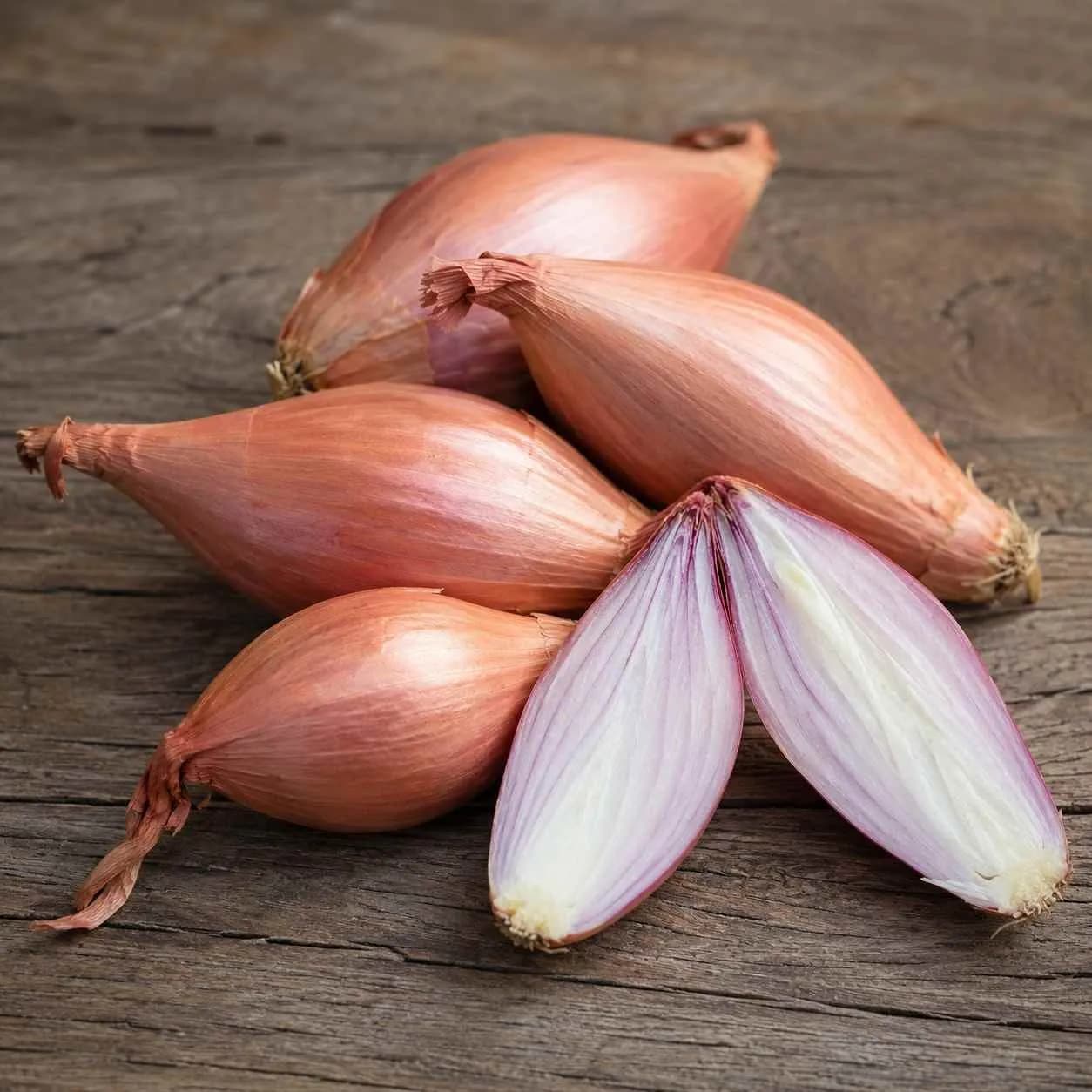
Shallot
Allium cepa L. Aggregatum Group
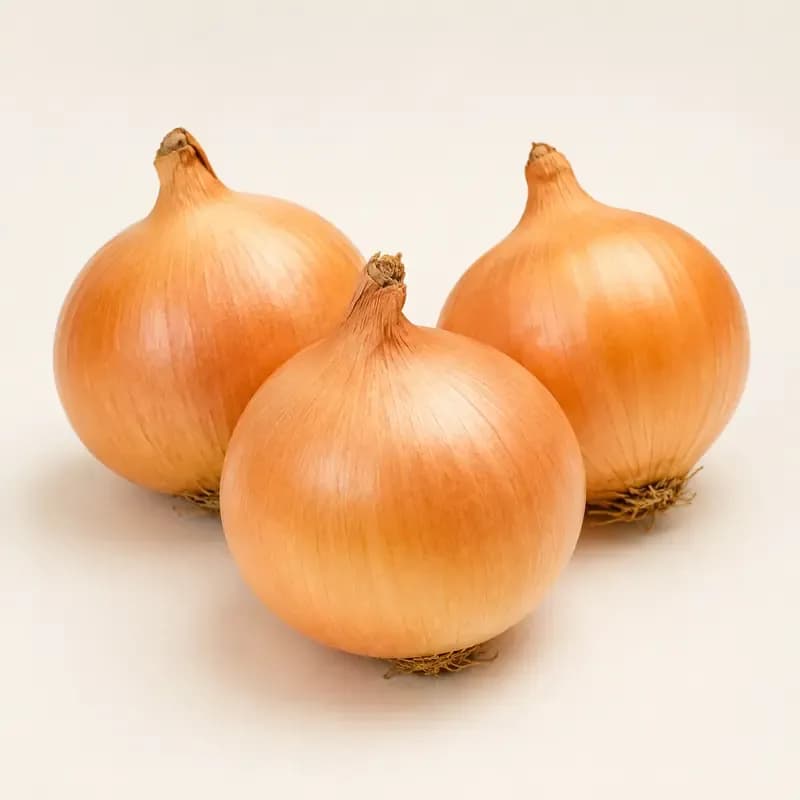
Shallot is a small, aromatic bulb vegetable belonging to the onion species Allium cepa L., most commonly classified within the Aggregatum Group. Historically, shallots were also referred to as Allium ascalonicum, but modern botanical treatment generally places them within the cultivated onion complex. Shallot bulbs typically grow in clusters of several cloves or divisions beneath papery copper, brown, reddish, or purple skins. Their flesh may be white, pale pink, or purple-tinged depending on the cultivar. Compared with many mature onions, shallots usually have a more delicate, subtly sweet flavor with complex garlic-like and onion-like notes, making them especially prized in French, Southeast Asian, Indian, Middle Eastern, and Mediterranean cooking. They can be minced raw into vinaigrettes, sliced into salads, fried until crisp, caramelized, roasted whole, sautéed with vegetables, or slowly cooked into sauces and stews. Nutritionally, raw shallots provide carbohydrate, fiber, vitamin B6, vitamin C, potassium, manganese, iron, phosphorus, magnesium, copper, and smaller amounts of several B vitamins. Like other Allium vegetables, they also contain flavonoids such as quercetin and sulfur-containing compounds produced when their cells are chopped or crushed. Their combination of concentrated flavor, compact size, long storage potential, and culinary versatility makes shallots one of the most valued aromatic vegetables in professional and home kitchens.
Shallot फोटो गैलरी
Shallot को शानदार विवरण में देखें
Shallot - मुख्य दृश्य
Shallot पोषण तथ्य
💊विटामिन
प्रति 100 ग्राम
⚡खनिज
प्रति 100 ग्राम
प्रति सर्विंग
एक सर्विंग का पोषण विवरण
Shallot के स्वास्थ्य लाभ
Shallot उत्पत्ति और वितरण
The exact origin of cultivated shallots is uncertain, but their ancestry is associated with Central and Southwestern Asia within the broader domestication history of Allium cepa.
Shallots have been cultivated for centuries across Western and Central Asia, the Middle East, Europe, and later Southeast Asia. Their older botanical name, Allium ascalonicum, was linked historically with Ascalon, an ancient city in the eastern Mediterranean, although this does not establish that location as the plant's true evolutionary origin. Shallots became particularly important in French cuisine because of their refined flavor and in Southeast Asian cuisines where they are extensively fried, ground into spice pastes, and cooked in curries and sauces. Modern botanical classification generally treats cultivated shallots as forms of Allium cepa within the Aggregatum Group.
Shallot पीक सीज़न
Available year-round through regional production and storage, with fresh harvests commonly concentrated from summer into autumn in temperate climates.
Shallot किस्में
हर किस्म का स्वाद, बनावट और उपयोग अलग होता है
French Gray Shallot
Jersey Shallot
Dutch Yellow Shallot
Ambition Shallot
Asian Red Shallot
Shallot स्टोरेज और चयन गाइड
फलों को अधिक समय तक ताज़ा रखें
सही फल कैसे चुनें
Select shallots that feel firm, dry, and heavy for their size with tight, intact papery skins.
Avoid bulbs with soft spots, wet areas, visible mold, extensive sprouting, or a sour or fermented smell.
Choose uniformly firm bulbs for roasting and larger shallots when a recipe requires substantial slicing or mincing.
Small shallots are often convenient for roasting whole or pickling.
सही स्टोरेज तरीके
Store whole, unpeeled shallots in a cool, dry, dark, well-ventilated place.
Avoid sealed plastic bags because trapped humidity can encourage mold and premature sprouting.
Use mesh bags, baskets, or ventilated containers that allow air to circulate around the bulbs.
Refrigerate peeled, sliced, or chopped shallots in a clean airtight container.
Keep stored shallots away from excessive heat, direct sunlight, and high humidity.
शेल्फ लाइफ गाइड
Preparation Tips
Remove the dry papery skin and trim away the root tip and dried stem end before cooking.
If the skin is difficult to remove, briefly soaking whole shallots in warm water can help loosen the outer layers.
Rinse peeled shallots under cool running water if soil or loose skin remains, then dry them before slicing.
Use a sharp knife for fine mincing because cleaner cuts reduce unnecessary crushing and produce more uniform pieces.
For roasting, leave small shallots whole or halve larger bulbs so they cook evenly.
For sauces and vinaigrettes, mince shallots finely to distribute their flavor without leaving large pungent pieces.
फ्रीज़ करने के निर्देश
कई महीनों तक ताज़गी बनाए रखें
Peel and slice, chop, or mince shallots before freezing.
Spread prepared shallots in a single layer on a tray before transferring them to a freezer-safe container to reduce clumping.
Freeze in measured portions if they will be used for sauces, soups, curries, or stir-fries.
Use frozen shallots primarily in cooked dishes because their texture becomes softer after thawing.
Label containers with the freezing date and keep them tightly sealed to limit odor transfer and freezer burn.
प्रो टिप
ताज़गी ट्रैक करने के लिए जमे हुए आइटम पर तारीख लिखें। सही तरीके से फ्रीज़ करने पर अधिकांश फल 2-3 महीनों तक गुणवत्ता बनाए रखते हैं। फ्रीज़र बर्न से बचने के लिए एयरटाइट कंटेनर या फ्रीज़र बैग का उपयोग करें।
पाक यात्रा
स्वादिष्ट विकल्प खोजें
सामान्य उपयोग
परफेक्ट पेयरिंग
लोकप्रिय रेसिपी
Cooking Methods
सुरक्षा जानकारी
True allergy to shallot is uncommon but possible, particularly in people allergic to other Allium vegetables such as onion, garlic, or leek. Reactions can include oral irritation, skin symptoms, gastrointestinal symptoms, respiratory symptoms, or, rarely, severe systemic reactions. Fructan intolerance is more common than true allergy.
Shallots may contain agricultural pesticide residues depending on farming practices and region. Their dry outer skins are normally removed before consumption, reducing surface contamination. Rinse peeled bulbs under running water when necessary and purchase from reputable, regulated suppliers. Washing cannot remove all systemic residues, so responsible agricultural practices and regulatory monitoring remain important components of food safety.
- • People with a diagnosed shallot, onion, garlic, or broader Allium allergy should avoid shallots unless advised otherwise by a qualified healthcare professional.
- • People following a medically supervised low-FODMAP diet may need to restrict shallots because of their fructan content.
- • Individuals who experience significant reflux, bloating, abdominal pain, or digestive discomfort after eating Allium vegetables may need smaller portions or cooked preparations.
- •Fructans may cause gas, bloating, abdominal pain, or altered bowel habits in sensitive individuals.
- •Raw shallots may aggravate gastroesophageal reflux or heartburn in some people.
- •Cutting shallots may cause temporary eye irritation and tearing.
- •Repeated occupational handling can rarely contribute to contact dermatitis in susceptible individuals.
- • Discard shallots with extensive mold, sliminess, severe softening, or a fermented or rotten smell.
- • Use a stable cutting board and sharp knife when peeling and slicing the small bulbs.
- • Refrigerate peeled or cut shallots promptly at 4°C/40°F or below.
- • Prevent cross-contamination by keeping prepared shallots away from utensils or surfaces contaminated with raw meat, poultry, seafood, or eggs.
- • Wash hands and food-contact surfaces before preparing raw shallots for salads, dressings, or garnishes.
रोचक तथ्य Shallot के बारे में
ऐसी बातें जो आपको पसंद आएंगी!
Shallots commonly grow in clusters of several connected bulbs, somewhat like garlic cloves.
The historical name Allium ascalonicum refers to Ascalon, an ancient Mediterranean city, although this does not prove that shallots originated there.
Modern botanical classification generally places shallots within Allium cepa rather than treating them as a completely separate species.
Shallots are fundamental ingredients in classical French sauces and vinaigrettes.
Crispy fried shallots are a common garnish across Indonesia, Thailand, Vietnam, Malaysia, and other Southeast Asian cuisines.
Shallot flavor combines characteristics associated with both onions and garlic because all three belong to the Allium group.
Slow roasting can transform strongly aromatic raw shallots into exceptionally sweet, soft bulbs.
अक्सर पूछे जाने वाले प्रश्न
What is a shallot and how is it different from an onion?
GeneralA shallot is a cultivated form of Allium cepa that commonly grows as clusters of smaller bulbs rather than producing one large bulb like many conventional onions. Its flavor is usually more delicate, sweet, aromatic, and slightly garlic-like, particularly when raw. Shallots also tend to have finer layers, which makes them easy to mince for sauces and vinaigrettes. Nutritionally, shallots and onions share many characteristics, including fiber, vitamin C, potassium, flavonoids, and sulfur compounds. Shallots are not simply miniature onions, but they are botanically very closely related and can often substitute for onions in recipes.
Can shallots be eaten raw?
PreparationYes. Raw shallots are widely used in vinaigrettes, salads, relishes, tartares, seafood dishes, sandwiches, and sauces because their flavor is generally finer and less aggressively pungent than many mature onions. For the mildest result, mince or slice the shallot very thinly. If a batch tastes especially sharp, soaking the sliced pieces briefly in cold water or marinating them in vinegar or citrus juice can soften the perceived pungency. Raw preparation also avoids heat-related loss of some vitamin C, although both raw and cooked shallots can contribute useful nutrients and phytochemicals to a varied diet.
Why do shallots taste sweeter when cooked?
ScienceCooking changes several chemical and physical properties of shallots. Heat reduces the intensity of volatile sulfur compounds responsible for the sharp raw aroma, while moisture evaporates and the tissues soften. As cooking continues, naturally occurring sugars become more concentrated, and browning reactions produce additional sweet, nutty, roasted, and savory flavor compounds. This is why slowly sautéed or roasted shallots taste significantly sweeter and more mellow than raw ones. The effect does not necessarily mean that large quantities of new sugar have been created; instead, changes in aroma, moisture, texture, and browning alter how the existing carbohydrates are perceived.
Are shallots healthier than regular onions?
HealthNeither vegetable can be called universally healthier because both belong to the same species complex and provide valuable nutrients and phytochemicals. Shallots are somewhat more energy- and carbohydrate-dense than common bulb onions per 100 g and provide notable amounts of vitamin B6, manganese, fiber, copper, potassium, and iron. Both shallots and onions contain flavonoids and sulfur-containing Allium compounds. Differences also depend on cultivar, growing conditions, storage, and portion size. From a practical nutrition perspective, regularly eating a variety of onions, shallots, garlic, leeks, and other vegetables is more useful than selecting one Allium vegetable as nutritionally superior.
Why do cutting shallots sometimes make your eyes water?
ScienceShallot cells contain sulfur-containing precursor molecules and enzymes that are kept physically separated while the tissue is intact. Cutting, crushing, or chopping breaks the cells and allows these components to interact, producing volatile sulfur compounds related to those generated by onions. Some of these vapors can reach the eyes and stimulate sensory nerves, triggering tears as a protective response. A sharp knife can reduce excessive cell crushing, while good ventilation can disperse the volatile molecules more quickly. Chilling shallots before cutting may also reduce the intensity for some cooks, although the effect varies.
Can shallots support gut health?
HealthShallots provide about 3.2 g of dietary fiber per 100 g, equivalent to roughly 11% of the Daily Value, and they contain fructans characteristic of Allium vegetables. Some fructans act as fermentable substrates for intestinal bacteria and can contribute to production of short-chain fatty acids. This is one reason Allium vegetables are often discussed as prebiotic foods. However, fructans are also FODMAP carbohydrates, meaning they can cause substantial gas, bloating, abdominal discomfort, or altered bowel habits in people with irritable bowel syndrome or other sensitivities. Digestive effects therefore vary considerably between individuals and depend strongly on portion size.
How should shallots be peeled and prepared?
PreparationBegin by trimming the dry stem end and the fibrous root tip, although leaving a small part of the root intact can help hold the layers together when making fine slices. Remove the dry papery skin with your fingers or the tip of a small knife. If several skins cling tightly, briefly placing the bulbs in warm water can loosen them. Once peeled, shallots can be minced, sliced into rings, quartered, or left whole depending on the recipe. Use a sharp knife for even pieces, and refrigerate any unused peeled or cut shallots promptly in a clean, covered container.
Are shallots good for people trying to manage blood pressure?
HealthShallots can fit well into a blood-pressure-conscious dietary pattern because they are naturally low in sodium and provide approximately 334 mg of potassium per 100 g, or about 7% of the Daily Value. Potassium participates in fluid and electrolyte balance and helps counter physiological effects associated with excessive sodium intake. Shallots also add substantial flavor to meals, potentially reducing reliance on very salty sauces or seasonings. However, eating shallots alone should not be expected to treat hypertension. Blood pressure is influenced by total diet, sodium intake, body weight, physical activity, genetics, medication, sleep, and other health factors.