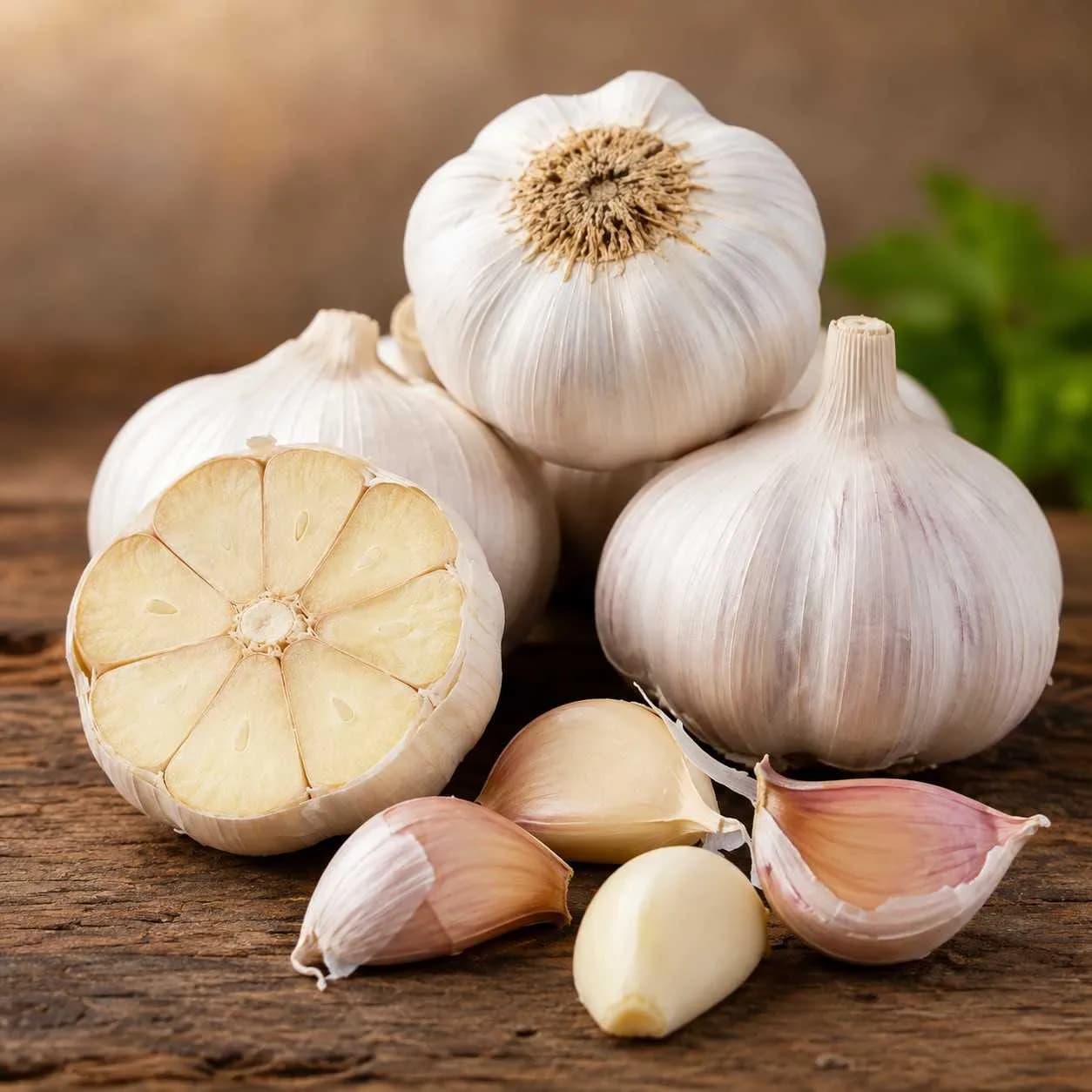
Garlic
Allium sativum L.
Garlic is the strongly aromatic bulb of Allium sativum L., a perennial member of the Amaryllidaceae family and one of the world's most important culinary Allium vegetables. A mature garlic bulb, often called a head, is composed of multiple individual cloves wrapped in papery white, cream, pink, or purple-tinged skins. Raw garlic has an intense, hot, sulfurous flavor, while roasting or slow cooking transforms the cloves into soft, sweet, nutty, and deeply savory morsels. Garlic's characteristic aroma develops primarily after its tissues are cut, crushed, or chewed. Cell damage allows the enzyme alliinase to convert the sulfur compound alliin into allicin, a short-lived compound responsible for much of freshly crushed garlic's pungency and biological activity. Garlic is nutritionally concentrated compared with many vegetables, providing notable amounts of vitamin B6, manganese, vitamin C, selenium, copper, phosphorus, calcium, zinc, and protein per 100 grams, although typical serving sizes are much smaller. It is used throughout Mediterranean, Middle Eastern, Indian, Chinese, Korean, Southeast Asian, African, European, and Latin American cuisines. Garlic may be minced into sauces, roasted whole, sautéed with vegetables, blended into marinades, fried until crisp, or eaten in fermented and pickled preparations. Both softneck and hardneck forms are cultivated, with hardneck types also producing edible flower stalks called scapes.
Garlic फोटो गैलरी
Garlic को शानदार विवरण में देखें
Garlic - मुख्य दृश्य
Garlic पोषण तथ्य
💊विटामिन
प्रति 100 ग्राम
⚡खनिज
प्रति 100 ग्राम
प्रति सर्विंग
एक सर्विंग का पोषण विवरण
Garlic के स्वास्थ्य लाभ
Garlic उत्पत्ति और वितरण
Central Asia, with domestication strongly associated with regions extending from Central Asia toward northeastern Iran and western Asia.
Garlic has been cultivated for several thousand years and is among humanity's oldest documented food plants. Its domestication is generally associated with Central Asia, from which cultivation spread into the Middle East, Mediterranean region, South Asia, East Asia, Europe, and eventually the Americas. Garlic was valued by ancient Egyptian, Greek, Roman, Chinese, and Indian cultures as both food and a traditional medicinal plant. Selection over centuries produced distinct hardneck and softneck groups adapted to different climates. Modern garlic remains a fundamental aromatic ingredient across cuisines worldwide.
Garlic पीक सीज़न
Garlic is available year-round because cured bulbs store exceptionally well. In temperate regions, it is commonly planted in autumn or early spring and harvested during summer.
Garlic किस्में
हर किस्म का स्वाद, बनावट और उपयोग अलग होता है
Rocambole
Porcelain
Purple Stripe
Artichoke
Silverskin
Garlic स्टोरेज और चयन गाइड
फलों को अधिक समय तक ताज़ा रखें
सही फल कैसे चुनें
Choose garlic bulbs that feel firm, dry, compact, and heavy for their size.
Look for tightly enclosed cloves covered by intact papery skins.
Avoid bulbs with soft spots, mold, excessive sprouting, dampness, or a fermented or musty odor.
For storage, select well-cured bulbs with dry necks and no visible mechanical damage.
सही स्टोरेज तरीके
Store whole garlic bulbs in a cool, dry, dark, well-ventilated place.
Use mesh bags, baskets, or containers that allow air circulation rather than sealed plastic bags.
Keep bulbs away from excessive moisture and direct sunlight, both of which can accelerate sprouting and spoilage.
Refrigerate peeled or cut garlic in a clean airtight container and use promptly.
Do not store fresh garlic submerged in oil at room temperature because oxygen-free conditions can create a botulism risk.
शेल्फ लाइफ गाइड
Preparation Tips
Separate the required number of cloves from the bulb and remove the dry papery skins before cooking.
Gently crushing a clove with the flat side of a knife can loosen the skin and make peeling easier.
For maximum fresh garlic pungency, mince or crush the cloves finely; larger slices produce a milder flavor.
After crushing or chopping garlic, allowing it to rest briefly before heating permits alliinase-mediated formation of allicin before heat deactivates the enzyme.
When sautéing minced garlic, use moderate heat and cook briefly because small pieces burn quickly and become bitter.
For roasting, leave the bulb mostly intact, trim the top to expose the cloves, and cook until the cloves become soft and sweet.
फ्रीज़ करने के निर्देश
कई महीनों तक ताज़गी बनाए रखें
Freeze peeled whole cloves, chopped garlic, or garlic paste in small portions suitable for cooking.
Spread whole peeled cloves on a tray before transferring them to a freezer-safe container to prevent clumping.
Freeze minced garlic in measured portions or ice-cube trays for convenient addition to cooked dishes.
Expect thawed garlic to lose some crisp texture, making it best suited to sauces, soups, stews, curries, and sautés.
Keep frozen garlic tightly sealed because its strong aroma can transfer to other foods.
प्रो टिप
ताज़गी ट्रैक करने के लिए जमे हुए आइटम पर तारीख लिखें। सही तरीके से फ्रीज़ करने पर अधिकांश फल 2-3 महीनों तक गुणवत्ता बनाए रखते हैं। फ्रीज़र बर्न से बचने के लिए एयरटाइट कंटेनर या फ्रीज़र बैग का उपयोग करें।
पाक यात्रा
स्वादिष्ट विकल्प खोजें
सामान्य उपयोग
परफेक्ट पेयरिंग
लोकप्रिय रेसिपी
Cooking Methods
सुरक्षा जानकारी
True garlic allergy is uncommon but possible and may involve oral itching, skin reactions, gastrointestinal symptoms, respiratory symptoms, or more serious allergic responses. Garlic can also cause non-allergic irritation and fructan-related intolerance, particularly in people sensitive to FODMAP carbohydrates.
Garlic may contain agricultural residues depending on farming practices, although the dry outer wrappers are removed before the cloves are eaten. Purchase firm, clean bulbs from reputable suppliers and remove dirty or damaged outer layers. Washing peeled cloves can reduce surface contamination but cannot remove every systemic pesticide residue. Regulatory oversight, responsible application practices, and adherence to residue limits are important components of food safety.
- • People with a diagnosed garlic or broader Allium allergy should avoid garlic unless advised otherwise by a qualified healthcare professional.
- • People following a medically supervised low-FODMAP diet often need to restrict garlic because it is rich in fructans.
- • Individuals with severe reflux, gastritis, or gastrointestinal sensitivity may tolerate cooked garlic better than large amounts of raw garlic.
- • People taking anticoagulant or antiplatelet medication, or preparing for surgery, should discuss concentrated garlic supplements with a healthcare professional because high supplemental doses may affect bleeding risk.
- •Raw garlic can cause heartburn, nausea, abdominal discomfort, gas, or diarrhea, especially in large amounts.
- •Garlic fructans may cause pronounced bloating and intestinal symptoms in people with FODMAP sensitivity.
- •Handling crushed raw garlic for prolonged periods can irritate the skin and may cause contact dermatitis or burns in susceptible individuals.
- •Garlic commonly produces temporary strong breath and body odor because sulfur compounds are absorbed and later excreted.
- •Concentrated garlic supplements may interact with certain medications and should not be assumed to have the same safety profile as normal culinary portions.
- • Never store homemade fresh garlic submerged in oil at room temperature because the low-oxygen environment can permit dangerous botulinum toxin formation.
- • Refrigerate peeled, minced, or otherwise cut garlic promptly at 4°C/40°F or below.
- • Discard garlic that is moldy, slimy, severely softened, or has an abnormal fermented or rotten odor.
- • Use clean knives and cutting boards and prevent cross-contamination from raw meat, poultry, seafood, or eggs.
- • Avoid leaving crushed raw garlic directly against the skin for prolonged periods because it can cause significant irritation or chemical burns.
रोचक तथ्य Garlic के बारे में
ऐसी बातें जो आपको पसंद आएंगी!
A garlic bulb is composed of multiple cloves, each of which is capable of producing a new plant when planted.
Garlic's strongest aroma is created after its cells are damaged; an intact clove smells far milder than freshly crushed garlic.
The compound allicin does not exist in large quantities inside an intact clove but forms rapidly when alliin and alliinase interact after cutting or crushing.
Hardneck garlic produces a curling flower stalk called a scape, which is edible and has a milder garlic flavor.
Softneck garlic generally stores longer than hardneck garlic and is the type most commonly braided.
Purple Stripe garlic is considered one of the older domesticated garlic lineages.
Slow roasting can transform pungent raw garlic into a soft, spreadable ingredient with a noticeably sweet flavor.
अक्सर पूछे जाने वाले प्रश्न
Is garlic a vegetable, herb, or spice?
GeneralBotanically and horticulturally, garlic is generally treated as a bulb vegetable. Its scientific name is Allium sativum L., and it belongs to the same broader plant family as onions, shallots, leeks, and chives. The mature underground structure consists of multiple cloves enclosed within a bulb. In cooking, however, garlic behaves more like an aromatic seasoning because only small quantities are usually needed to flavor a dish. This is why it is sometimes informally called an herb or spice. For food classification purposes, describing garlic as a bulb vegetable and culinary aromatic is the most accurate approach.
Why should garlic be crushed before cooking?
ScienceCrushing, chopping, or mincing garlic breaks open its cells and allows the enzyme alliinase to contact alliin, a sulfur-containing precursor stored elsewhere in the tissue. Alliinase rapidly converts alliin into allicin, the unstable compound responsible for much of freshly crushed garlic's distinctive aroma. Allicin then breaks down into additional sulfur compounds. Heat can deactivate alliinase, so garlic placed immediately into very hot oil may form less allicin than garlic that is crushed and allowed to rest briefly first. Culinary flavor still develops during cooking, but the chemistry differs depending on how the garlic is prepared.
Is raw garlic healthier than cooked garlic?
HealthRaw and cooked garlic provide different culinary and chemical profiles, so one cannot simply be labeled healthier in every situation. Raw crushed garlic permits formation of allicin and retains more heat-sensitive vitamin C, but it is also much more pungent and can irritate the digestive tract in sensitive people. Cooking reduces sharpness, makes garlic sweeter and easier to incorporate into larger portions, and still leaves many minerals and sulfur-derived compounds present. Allowing crushed garlic to rest briefly before cooking may permit more enzymatic sulfur chemistry to occur. A varied diet can reasonably include both raw and cooked garlic according to tolerance and preference.
Why does roasted garlic taste sweet instead of sharp?
ScienceRaw garlic's strong flavor comes largely from volatile sulfur compounds generated when cells are damaged. During roasting, prolonged heat changes or reduces many of these pungent molecules while softening the tissues and driving off water. Naturally occurring carbohydrates become more concentrated, and browning reactions create additional nutty, caramel-like, and savory aromas. As a result, roasted cloves develop a creamy texture and mild sweetness that is dramatically different from freshly minced garlic. The change reflects a combination of altered sulfur chemistry, moisture loss, carbohydrate concentration, and heat-generated flavor compounds rather than simply the creation of large amounts of new sugar.
Can garlic support heart health?
HealthGarlic can fit well into a heart-healthy diet because it is naturally low in sodium and fat and contains potassium, sulfur compounds, antioxidants, and several micronutrients. Clinical studies of garlic powders, aged garlic extracts, and other preparations have reported modest improvements in certain cardiovascular risk markers in some participants, including blood pressure or blood lipids, but results vary according to preparation, dose, baseline health, and study quality. Culinary garlic should therefore not replace prescribed blood-pressure or cholesterol medication. Its strongest practical benefit is as part of a plant-rich eating pattern and as a flavorful alternative to excessive salt.
Can garlic improve gut health?
HealthGarlic contains fructans and other fermentable carbohydrates that can act as substrates for intestinal microorganisms. In people who tolerate them well, these compounds may function as prebiotics and help support production of short-chain fatty acids by gut bacteria. Garlic also provides dietary fiber, although typical serving sizes are small. The same fructans can cause substantial digestive problems in people with irritable bowel syndrome or FODMAP sensitivity, including gas, bloating, cramping, and diarrhea. Therefore, garlic can support a diverse diet for many people but may need to be reduced or replaced with suitable alternatives for those with clinically significant fructan intolerance.
How can I peel garlic easily?
PreparationSeparate the cloves you need from the bulb and place one clove on a stable cutting board. Press gently with the flat side of a chef's knife until the papery skin loosens, then peel it away with your fingers. For recipes requiring whole, uncrushed cloves, trimming the root end first can make the skin easier to remove. When peeling many cloves, briefly soaking them in warm water can soften stubborn skins. Avoid aggressively smashing cloves if the recipe requires neat slices because crushing immediately activates garlic's sulfur chemistry and produces a stronger flavor than leaving the cells relatively intact.
Is garlic safe to store in oil?
PreparationGarlic can be combined with oil, but storage requires particular care. Fresh garlic is a low-acid food, and when it is submerged in oil the oxygen-poor environment can support growth and toxin production by Clostridium botulinum if conditions are favorable. Homemade fresh garlic-in-oil mixtures should therefore not be stored at room temperature. They should be refrigerated promptly and used within a short, food-safety-appropriate period or frozen for longer storage. Commercial garlic-in-oil products may be acidified or otherwise processed for safety, so their labeled storage instructions should be followed. When in doubt, prepare small quantities and keep them cold.