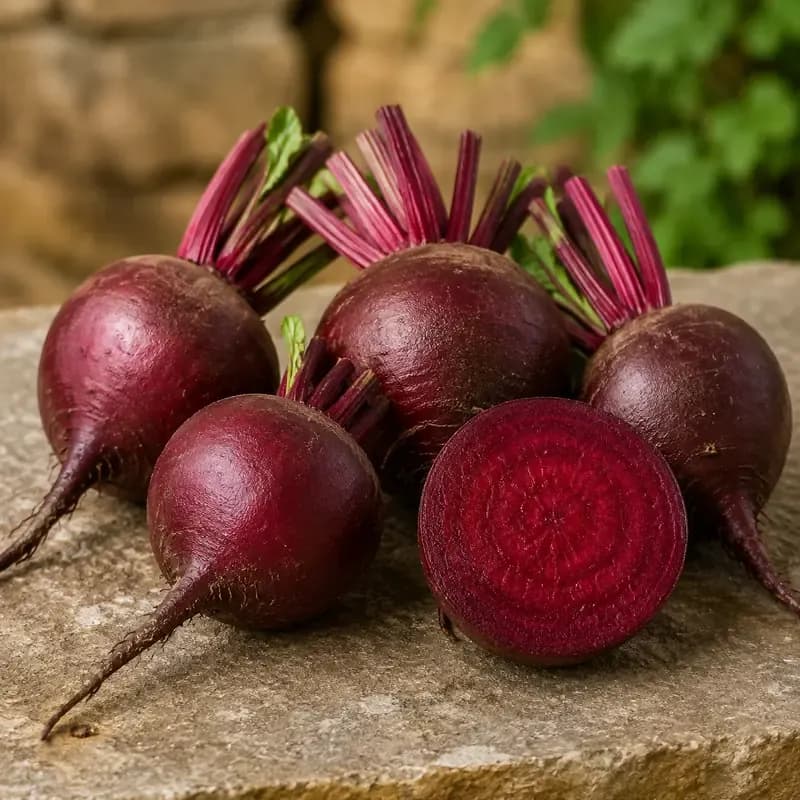
Beetroot
Beta vulgaris (Conditiva Group)
Beetroot, scientifically classified as Beta vulgaris within the Conditiva Group, is a cool-season root vegetable in the amaranth family, Amaranthaceae. Its rounded, cylindrical, or flattened edible body is formed from a swollen taproot together with the adjoining hypocotyl, making root the best botanical category for culinary classification. Although deep crimson beetroot is most familiar, cultivars also produce golden, white, pink, and striking red-and-white-ringed roots. Their flavor combines natural sweetness with an earthy aroma associated partly with geosmin. Beetroot may be eaten raw, roasted, steamed, boiled, pressure-cooked, pickled, fermented, juiced, or blended into soups, dips, breads, desserts, and savory dishes. The leaves and tender stalks are edible as well and can be cooked similarly to chard. Red and golden roots obtain their colors from betalains rather than anthocyanins, while naturally occurring nitrate, betaine, phenolic compounds, fiber, folate, manganese, potassium, copper, and magnesium contribute to their nutritional profile. Modern beetroot descends from wild sea beet native across coastal western Europe, the Mediterranean region, and western Asia. Early cultivation emphasized the leaves; selection for large, tender, swollen roots produced the table beet now grown around the world.
Beetroot फोटो गैलरी
Beetroot को शानदार विवरण में देखें
Beetroot - मुख्य दृश्य
Beetroot पोषण तथ्य
💊विटामिन
प्रति 100 ग्राम
⚡खनिज
प्रति 100 ग्राम
प्रति सर्विंग
एक सर्विंग का पोषण विवरण
Beetroot के स्वास्थ्य लाभ
Beetroot उत्पत्ति और वितरण
Coastal western Europe, the Mediterranean basin, North Africa, and western Asia through the range of its wild sea-beet ancestor
Modern beetroot descends from wild sea beet, Beta vulgaris subsp. maritima, a coastal plant distributed from western Europe through the Mediterranean and western Asia. Early cultivation focused largely on edible leaves, producing ancestors of modern leaf beet and chard. Swollen-rooted forms appeared later and were progressively selected for tenderness, sweetness, size, shape, and color in Europe. By the medieval and early modern periods, recognizable garden beets were established in European agriculture. The same species subsequently produced specialized sugar-beet and fodder-beet groups through separate breeding. Beetroot is now cultivated worldwide, but internationally comparable statistics often combine table beet with other vegetables or focus on sugar beet; therefore, a reliable global table-beet producer ranking is not provided here.
Beetroot पीक सीज़न
Beetroot is a cool-season crop grown for spring, early-summer, and autumn harvests. Regional production, cold storage, and protected cultivation make it available throughout much of the year.
Beetroot किस्में
हर किस्म का स्वाद, बनावट और उपयोग अलग होता है
Detroit Dark Red
Chioggia
Burpee's Golden
Cylindra
Crapaudine
Boltardy
Beetroot स्टोरेज और चयन गाइड
फलों को अधिक समय तक ताज़ा रखें
सही फल कैसे चुनें
Choose beetroot that feels firm, dense, and heavy for its size, with smooth skin and no sliminess, mold, deep soft spots, or leaking decay.
Small and medium roots are often tender and cook evenly, while very large roots may be more fibrous depending on cultivar and maturity.
When greens are attached, look for crisp, brightly colored leaves without extensive yellowing, decay, or wilting.
Select golden or striped cultivars when reduced red staining is desirable, and deep red varieties for intense color in soups, juices, and pickles.
सही स्टोरेज तरीके
Remove the greens before refrigerating the roots, leaving about 1 inch of stem to reduce moisture loss and pigment bleeding.
Store unwashed roots in a perforated or loosely closed bag in the refrigerator crisper drawer.
Refrigerate beet greens separately in a breathable or moisture-retaining container and use them within several days.
Wash beetroot immediately before preparation rather than before storage because excess surface moisture can promote decay.
Check stored roots regularly and discard any that become slimy, moldy, leaking, or strongly off-smelling.
शेल्फ लाइफ गाइड
Preparation Tips
Rinse beetroot under cool running water and scrub away soil with a clean vegetable brush; do not use soap or household detergent.
For boiling or steaming whole beets, leave some stem and the thin taproot attached and keep the skin on to reduce pigment loss; peel after cooking when the skin slips off easily.
Wear food-safe gloves or protect porous cutting boards if staining is a concern, and rinse tools promptly after preparation.
Cut roots into similarly sized pieces so they cook evenly; smaller pieces cook faster but lose more water-soluble pigment into cooking liquid.
Use lemon juice or vinegar in finished dishes to brighten flavor and help stabilize the red-purple appearance of betalain pigments.
Wash beet greens thoroughly, remove damaged leaves and tough stems, and cook them separately or use them like chard.
फ्रीज़ करने के निर्देश
कई महीनों तक ताज़गी बनाए रखें
Choose young, tender beetroot, wash it, sort by size, and trim the tops while leaving about 1/2 inch of stem and the taproot attached.
Cook whole beets in boiling water until tender, approximately 25 to 30 minutes for small roots and 45 to 50 minutes for medium roots.
Cool cooked beets promptly in cold water, slip off the skins, and remove the remaining stems and taproots.
Slice or cube the peeled beetroot, pack it in airtight freezer containers with appropriate headspace, label, and freeze.
Raw beetroot does not freeze well because freezing without cooking can produce poor texture and color.
प्रो टिप
ताज़गी ट्रैक करने के लिए जमे हुए आइटम पर तारीख लिखें। सही तरीके से फ्रीज़ करने पर अधिकांश फल 2-3 महीनों तक गुणवत्ता बनाए रखते हैं। फ्रीज़र बर्न से बचने के लिए एयरटाइट कंटेनर या फ्रीज़र बैग का उपयोग करें।
पाक यात्रा
स्वादिष्ट विकल्प खोजें
सामान्य उपयोग
परफेक्ट पेयरिंग
लोकप्रिय रेसिपी
Cooking Methods
ताज़ा पेय
सुरक्षा जानकारी
Beetroot allergy is uncommon but possible. Reactions may include oral itching, hives, swelling, gastrointestinal symptoms, wheezing, or, rarely, anaphylaxis. Occupational exposure to beet products and reactions to raw or cooked beet have both been reported. Anyone experiencing breathing difficulty, faintness, or rapidly progressing swelling should seek emergency care, while suspected food allergy should be evaluated by a qualified allergy specialist.
Agricultural practices and measured residues vary by farm, country, and season. Wash beetroot and greens thoroughly under running water and remove adhering soil before cutting or cooking. Peeling can reduce some surface residues but does not replace agricultural safety controls and removes edible tissue. Do not use soap, bleach, or household detergent on produce. Consumers seeking current residue information should consult their national food-safety authority.
- • People with a diagnosed beetroot allergy should avoid the forms identified by their allergy specialist.
- • People with kidney disease or another condition requiring potassium restriction should discuss appropriate portions with their clinician or renal dietitian.
- • Individuals following a medically prescribed low-oxalate diet should ask how beetroot and especially beet greens fit into their individualized plan.
- • People with low blood pressure or those taking blood-pressure medication should obtain medical guidance before using concentrated beetroot juice or nitrate supplements regularly.
- • Anyone should avoid beetroot that is moldy, slimy, leaking, rotten, or strongly off-smelling.
- •Beetroot pigments may temporarily turn urine or stool pink, red, or purple; this is often harmless but unexplained or persistent bleeding-like discoloration requires medical assessment.
- •Large portions or a sudden increase in beetroot fiber may cause gas, bloating, abdominal discomfort, or changes in bowel habits.
- •Concentrated beetroot juice may lower blood pressure in some people and can cause lightheadedness when combined with other blood-pressure-lowering factors.
- •Beetroot and beet greens contain oxalates, which may be relevant to susceptible people with certain kidney-stone risks.
- •Allergic reactions can range from localized itching to systemic symptoms requiring urgent medical attention.
- • Wash and scrub beetroot before cutting so soil is not transferred to the interior.
- • Keep soil-covered roots and unwashed greens separate from ready-to-eat foods, utensils, and clean preparation surfaces.
- • Discard beetroot that is moldy, slimy, leaking, rotten, or strongly off-smelling rather than attempting to salvage heavily affected tissue.
- • Refrigerate cooked beetroot within two hours, or within one hour in very hot conditions, and use refrigerated leftovers within 3 to 4 days.
- • Use only tested recipes for fermentation, pickling, or home canning; plain beets are a low-acid food and require pressure canning, while boiling-water canning is suitable only for properly acidified tested recipes.
- • Pregnant people, older adults, young children, and immunocompromised individuals should choose pasteurized beet juice rather than unpasteurized packaged juice unless advised otherwise by a clinician.
रोचक तथ्य Beetroot के बारे में
ऐसी बातें जो आपको पसंद आएंगी!
Beetroot, Swiss chard, sugar beet, and fodder beet are cultivated forms of the same species, Beta vulgaris.
The red-violet pigments in beetroot are betalains rather than the anthocyanins responsible for many red, blue, and purple berries.
Chioggia beetroot displays alternating pink or red and white rings when sliced across the root.
The earthy aroma of beetroot is associated partly with geosmin, a compound also linked to the smell of damp soil.
Beetroot leaves and stalks are edible and can be cooked similarly to chard.
Beeturia is the usually harmless appearance of pink or red urine after eating beetroot.
Sugar beet was developed from the same species through selection for roots with high sucrose concentration.
Leaving the skin, stem base, and taproot intact during boiling can reduce the amount of red pigment that escapes into the water.
अक्सर पूछे जाने वाले प्रश्न
Is beetroot botanically a root?
ScienceBeetroot is appropriately classified as a root vegetable, although the swollen edible structure is botanically more complex than a simple taproot. It includes the enlarged upper taproot together with tissue from the hypocotyl, the transitional region between the seedling stem and root. The storage organ accumulates sugars and other compounds that help the biennial plant survive before flowering in its second season. Beet leaves and stalks grow from the crown above this swollen structure and are also edible. Beetroot is therefore classified as root in culinary databases rather than as a tuber, bulb, or fruit.
Can beetroot be eaten raw, or does it need to be cooked?
PreparationBeetroot can be eaten raw or cooked. Raw roots are crisp and work well when thinly sliced, spiralized, or finely grated into salads and slaws. Cooking softens the dense tissue, concentrates perceived sweetness, and mellows some earthy flavor. Steaming and roasting reduce contact with cooking water, while boiling can transfer folate, vitamin C, nitrate, and betalain pigments into the liquid. Using that liquid in soup can retain some of those compounds. Wash raw beetroot carefully, use clean equipment, and begin with modest portions if large amounts of raw fiber cause digestive discomfort.
Should beetroot be peeled before cooking?
PreparationPeeling is optional and is often easiest after cooking. For whole boiling or steaming, scrub the root, leave approximately an inch of stem and the slender taproot attached, and cook it with the skin intact. This limits cuts through which water-soluble pigments can escape. Once tender and cooled enough to handle, the skin usually rubs or slips off easily. Peel raw beetroot before grating if a smoother texture is preferred, but sound skin is edible. Always remove soil, damaged tissue, and decay, and discard roots that are moldy, slimy, leaking, or strongly off-smelling.
Why can beetroot turn urine or stool red?
HealthBeetroot contains red-violet betalain pigments, especially betanin. In some people, a portion of these pigments passes through digestion and appears in urine, producing a harmless effect called beeturia. Pigments can also give stool a red or purple color. The effect varies with portion, digestive conditions, iron status, gut transit, and the amount of pigment in the cultivar. Beet-related color usually resolves after intake stops. However, red urine or stool should not automatically be attributed to food, particularly when accompanied by pain, weakness, clots, black stool, or persistent symptoms; seek medical assessment when uncertain.
Does beetroot lower blood pressure?
HealthBeetroot contains dietary nitrate that can be converted through the nitrate-nitrite-nitric-oxide pathway. Nitric oxide participates in blood-vessel signaling and can promote vasodilation. Controlled studies of nitrate-rich beetroot juice have reported modest, often temporary blood-pressure reductions in some participants, but results vary and a normal food serving does not provide a standardized dose. Beetroot is not a replacement for prescribed treatment. People with low blood pressure, kidney disease, or blood-pressure medication should discuss concentrated beet juice or supplements with a clinician and continue monitoring according to their treatment plan.
Can people with diabetes eat beetroot?
HealthBeetroot can usually fit into a diabetes eating plan when carbohydrate and portion size are considered. Raw beetroot contains about 9.56 g of carbohydrate, 6.76 g of natural sugars, and 2.8 g of fiber per 100 g. The glucose response varies with portion, cooking, processing, and the rest of the meal, so no single glycemic-index value represents every preparation. Whole or chopped beetroot retains fiber and is generally easier to portion than strained juice. Pairing it with protein, healthy fat, legumes, or other vegetables can create a more balanced meal tailored to individual glucose targets.
Are beetroot leaves and stems edible?
GeneralBeet leaves and tender stalks are edible and are closely related in use and flavor to chard, which belongs to the same species. Young greens can be added to salads when tender, while mature leaves are commonly steamed, boiled, sauteed, or added to soups and curries. Wash them thoroughly because soil can collect around the crown and stalks. Beet greens have a different nutrient and oxalate profile from the root, so the nutrition values in this record apply only to raw beetroot. People following a medically prescribed low-oxalate diet should ask how the greens fit their plan.
How should fresh beetroot be stored?
GeneralRemove attached greens before storage because the leaves continue to draw water from the root. Leave roughly an inch of stem, keep the roots unwashed, and place them in a perforated or loosely closed bag in the refrigerator crisper. Under typical home conditions, properly stored roots can retain quality for up to about three weeks. Refrigerate the greens separately and use them within several days. Wash the roots immediately before cooking. Discard beetroot that becomes slimy, moldy, leaking, unusually soft, or strongly off-smelling, regardless of how long it has been stored.
Are beetroot pigments the same as the anthocyanins in berries?
ScienceNo. The main red and yellow pigments in beetroot are betalains, not anthocyanins. Red-violet betalains are called betacyanins and include betanin, while yellow-orange forms are betaxanthins. Most plants produce either betalains or anthocyanins rather than both. These water-soluble pigments can act as antioxidants in chemical and laboratory systems, but their stability is affected by heat, light, oxygen, pH, storage, and cooking water. Golden, striped, and red cultivars contain different pigment mixtures, which explains their distinct colors and the amount of staining or color loss during preparation.